
Leah Contracting, powered by Maestro, is the next evolution of agentic contract lifecycle management. Where traditional CLM gave your team software to store, route, track, and remind, Leah Contracting runs the work itself. It drafts, reviews, redlines, approves, signs, and tracks obligations across the full lifecycle, with your team deciding where a person stays in the loop.
Specialist agents run each stage of the contracting lifecycle, apply your playbooks, assess risk, draft and redline agreements, and hand work between one another, while your team decides where approval and judgment stay with a person.
From managing contracts to running them
For more than two decades, CLM traditionally rested on one idea: people move contracts through the process while software stores, routes, and tracks the work. Agentic CLM made parts of the contract lifecycle faster, from drafting and review to extraction and redlining. What it did not change was who moved the work. A person still did.
Leah Contracting changes all that. Agents run each stage of the contract lifecycle and hand off to one another, applying your playbooks as they go. You set where judgment, escalation, and approval stay with a person, so contracts move forward without anyone pushing them through every stage.
An agentic harness for enterprise work
Leah Maestro is an agentic harness, the control layer around a group of AI agents: deterministic handoffs, approval gates, context, memory, permissions, observability, and an auditable record of what happened at each stage. In simple, a harness is what turns a capable model into an agent that ships work reliably. Maestro brings the same structure to contracting.
A harness defines what an agent knows, what it can do, what it is allowed to change, and what happens next. The models that power the reasoning are the same ones available to everyone. What makes the difference for contracting is the harness around them, carrying the contract, the playbook, the record of what earlier agents did, the skills, and the limits on who and what can act.
Leah Contracting is built for agents to do the work rather than to speed up a task a person still runs. The system was rebuilt with agents at the center, each one built for its stage with the context, skills, and limits that stage needs.
For context, two common approaches in the market are adding AI features on top of an existing product, and opening the product to general-purpose agents through connectors. Leah's approach is to rebuild the product itself around purpose-built contracting agents.
A model can draft and summarize. It cannot know your playbooks, your fallback positions, or which obligations carry the most risk. Leah pairs the harness with more than a decade of contracting domain intelligence, so your playbooks, negotiation positions, fallback language, and precedent are engineered into what agents see and how they act at each stage. That combination is what lets agents act on real agreements safely, so contracts move faster and risk gets caught before it becomes exposure.
How Leah Contracting runs the work
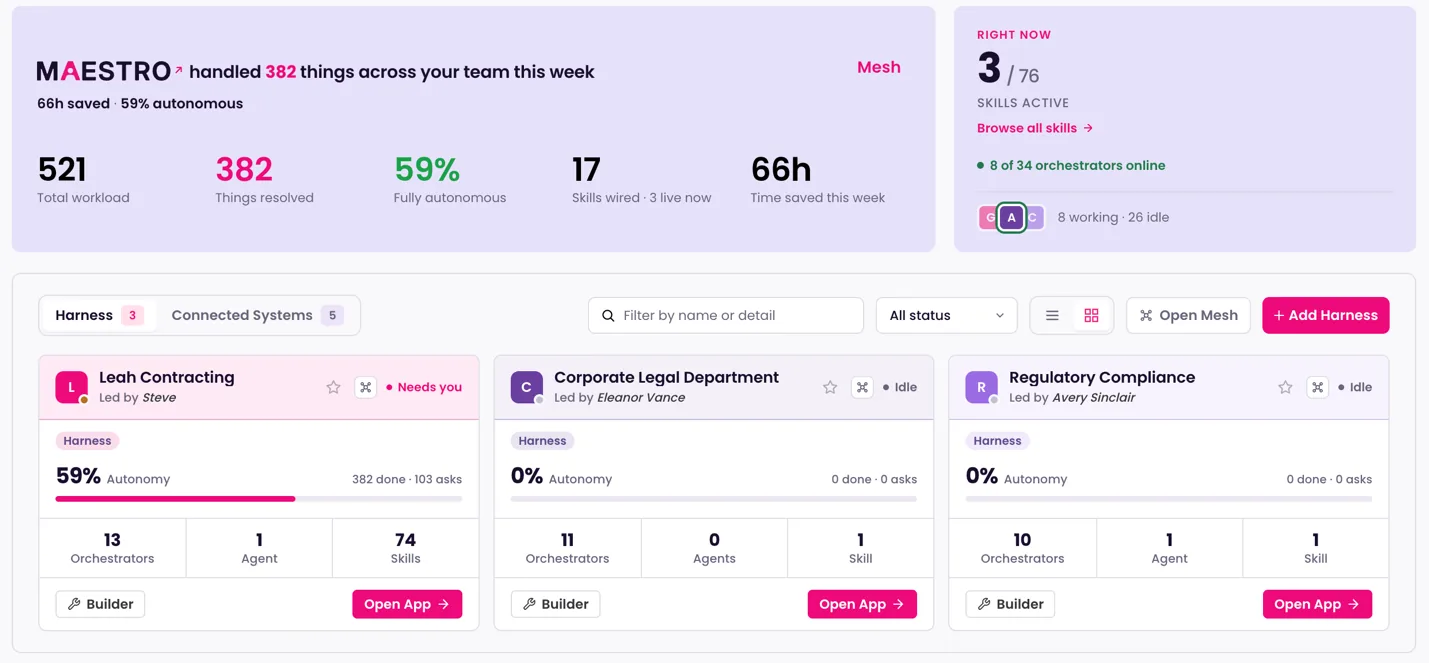
Leah Contracting, powered by Maestro, splits the contract lifecycle into workloads, and a specialist agent owns each one. Agents apply your playbooks, assess risk, draft and redline, execute permitted actions, and hand work to one another. You determine where judgment, escalation, and approval stay with a person, so contracts move forward without anyone pushing them through every stage.
Maestro sits at the top as the orchestrator, with a specialist agent at each stage of the lifecycle, all built on a repository that acts as the spine of the system. The repository holds your contracts, their amendments, and related documents, along with the key details of their clauses, obligations, and requests, so every agent works from the same source.
Leah Contracting covers the entire contract lifecycle, including:
- Intake: classify the contract type, extract fields and dates, flag what needs a person.
- Authoring: build the draft based on approved templates, playbooks, and the facts of the deal.
- Risk review: score clauses against your playbook and produce a risk report.
- Redlining and negotiation: draft redlines, act within your positions, manage the negotiation room.
- Approvals: route decisions to the right people at the right stage.
- Signature: execute once the approvals you require are complete.
- Obligations: track commitments across legal, finance, and operations, and manage evidence and renewals.
Your home view opens on what needs your immediate attention and what is pending with you, so the contracts waiting on a decision, an approval, or a review surface first, ahead of everything the system is handling on its own.
Intake that classifies the contract for you
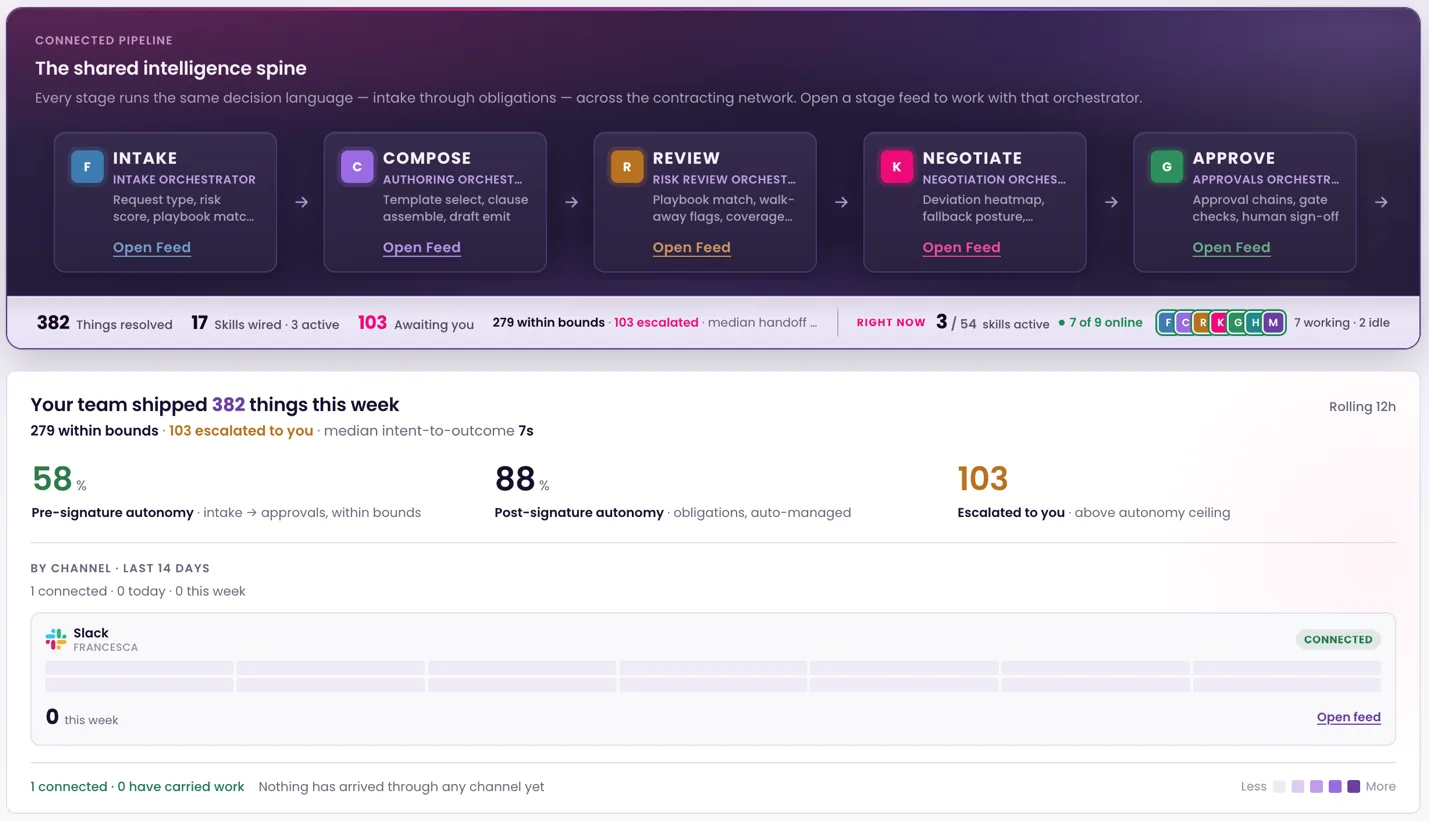
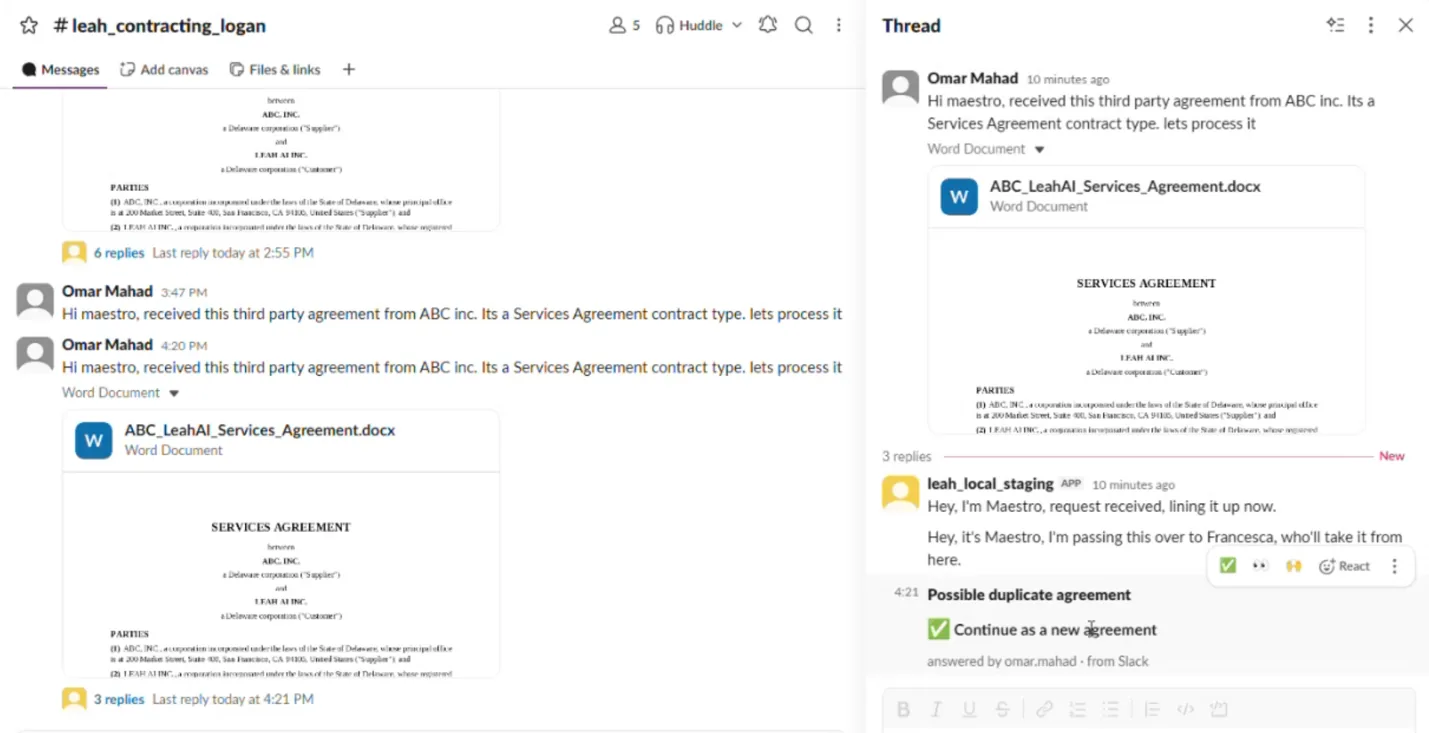
Intake starts with a document and a command. You drop a third-party contract into Leah Contracting and ask it to raise a request. You do not need to know whether it is an MSA, an NDA, or a framework agreement. Leah Contracting identifies the contract type, extracts the dates, clauses, and fields, applies your intake policy, and flags anything it cannot extract for you to confirm.
One of the first things intake does is check the repository for duplicates. If the same contract has already been submitted, it tells you and asks how to proceed, so you can continue on the existing record or start a new agreement.
Behind that request, intake does the reading for you. It computes the contract dates, extracts the clauses and the fields you have configured, applies the autonomy policy for that contract type, and marks any field it cannot find so a person can complete it before the contract moves on.
What intake captures drives how the contract is routed. The same fields decide which approvals to trigger and which stages to run, so one entry can send a request to a named approver and another can skip a step, for example skipping owner approval when the requester and the owner are the same person.
Every request opens on a snapshot page that shows the whole lifecycle in one view: the request details, the dates and clauses extracted, the fields completed, the versions and files, and the related contracts, collaborations, and obligations as they populate. When you are satisfied, initiating review moves the contract to the approval stage without reloading the page, and the approver is notified in their feed and by email.
When intake completes, Leah Contracting generates a request record and hands off to the next stage per your workflow. You can add a human gate here to verify what was extracted, or let simpler types like NDAs pass straight through.
Authoring drafts from your approved templates
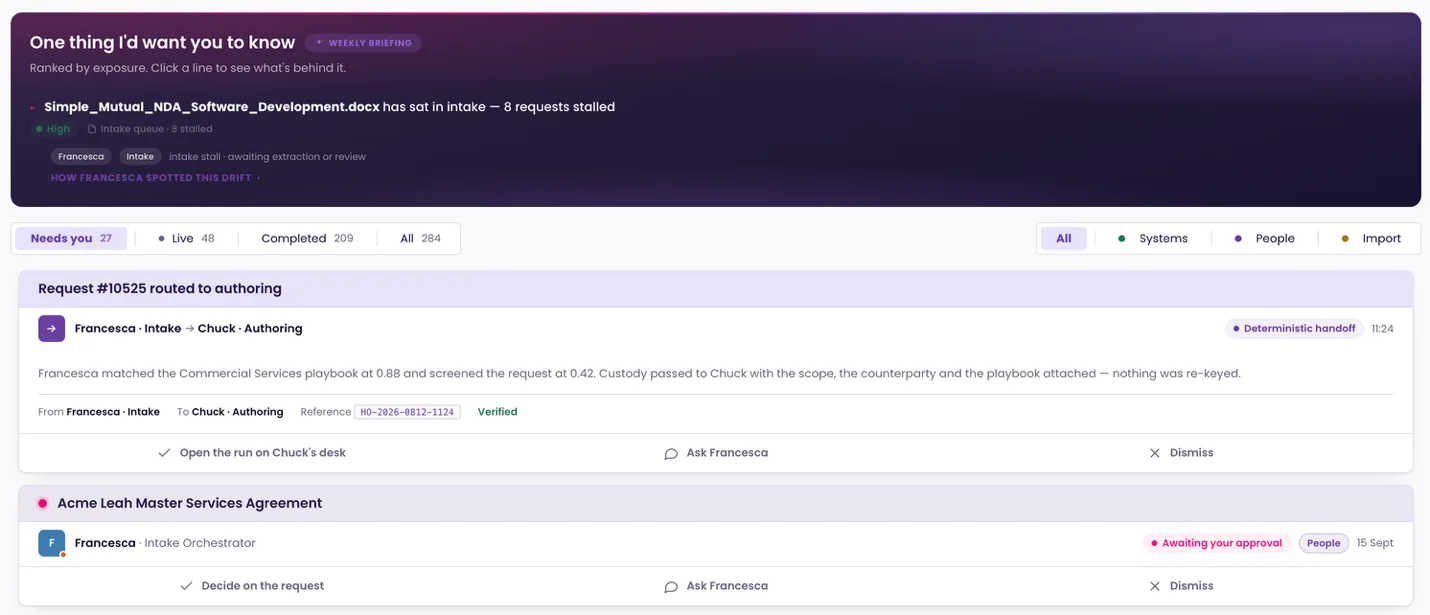
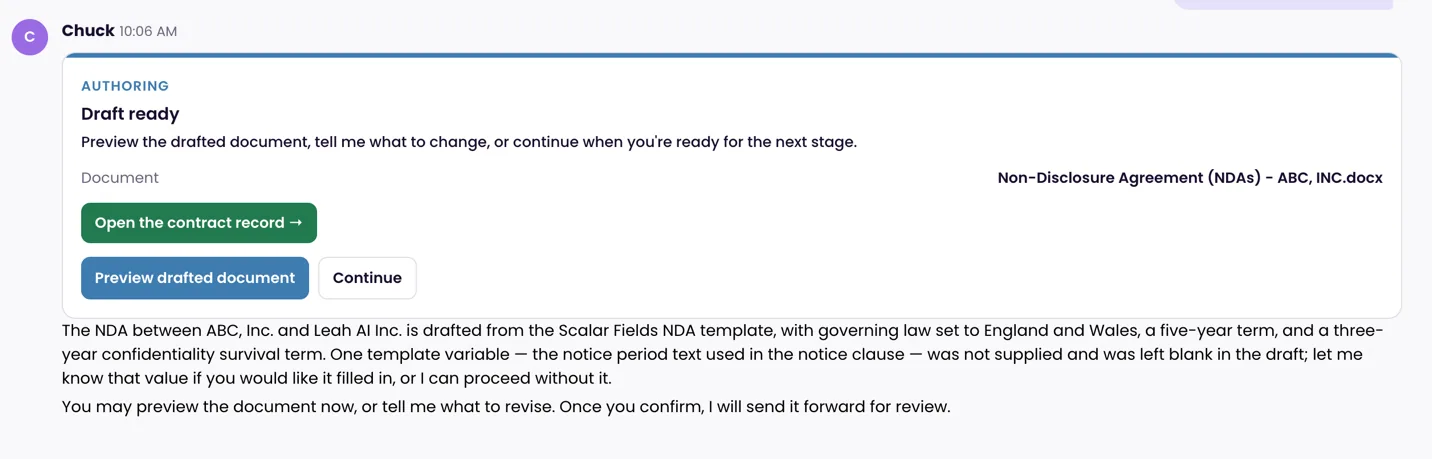
When you are creating a contract rather than reviewing one, authoring starts from a request. You describe the deal in plain language, such as an agreement you need for a specific bank, and Leah Contracting selects the approved template that fits and presents the questionnaire that goes with it.
Leah Contracting builds the draft based on your approved templates, the playbook that governs that contract type, and the facts of the deal you provide. It fills the template with the deal terms, applies your standard language, and assembles a first draft without you having to do anything. If a fact it needs is missing, the orchestrator pauses and asks for it before drafting, rather than guessing. You supply the detail, and authoring continues.
Templates are prepared once and reused. When you set up a template, you upload the source document and Leah Contracting identifies the placeholders that need automation and proposes the variables, so the questionnaire you answer later is generated from the template rather than tagged by hand. That removes the manual configuration a CLM requires today. When a draft is ready, it is handed off to risk review
Risk review scored against your playbook
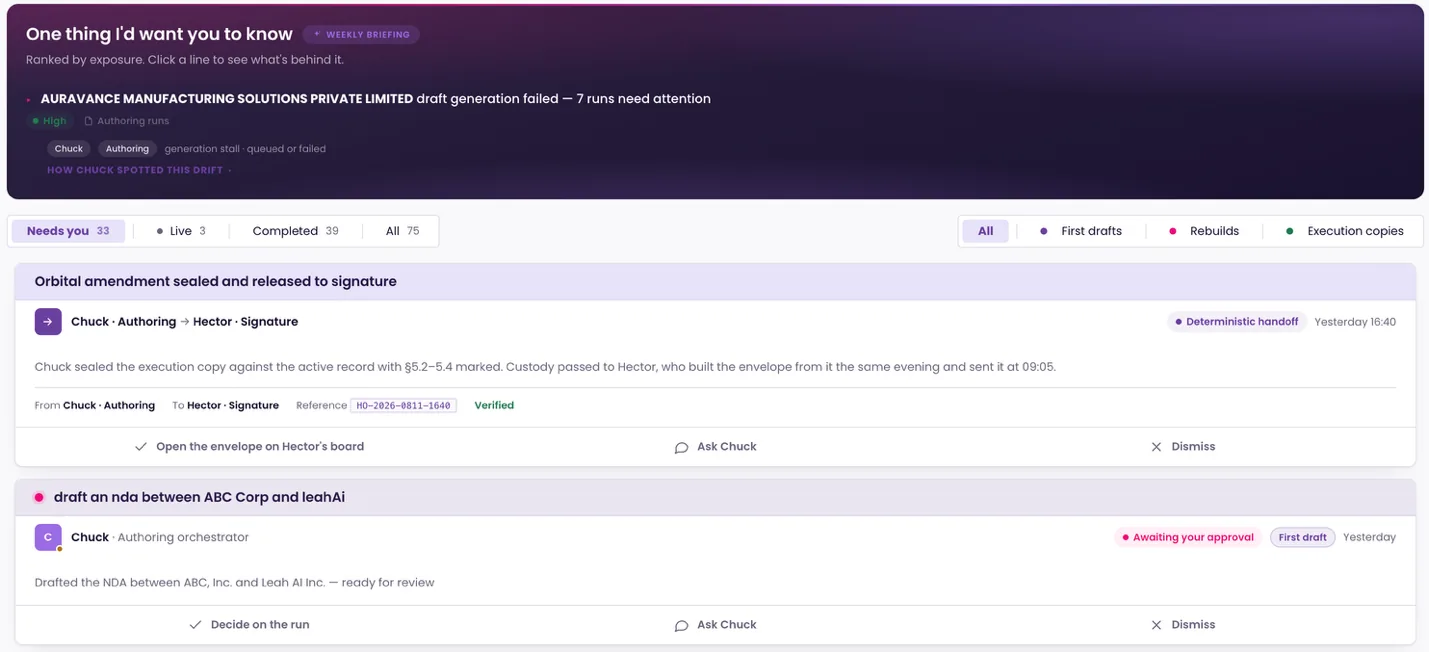
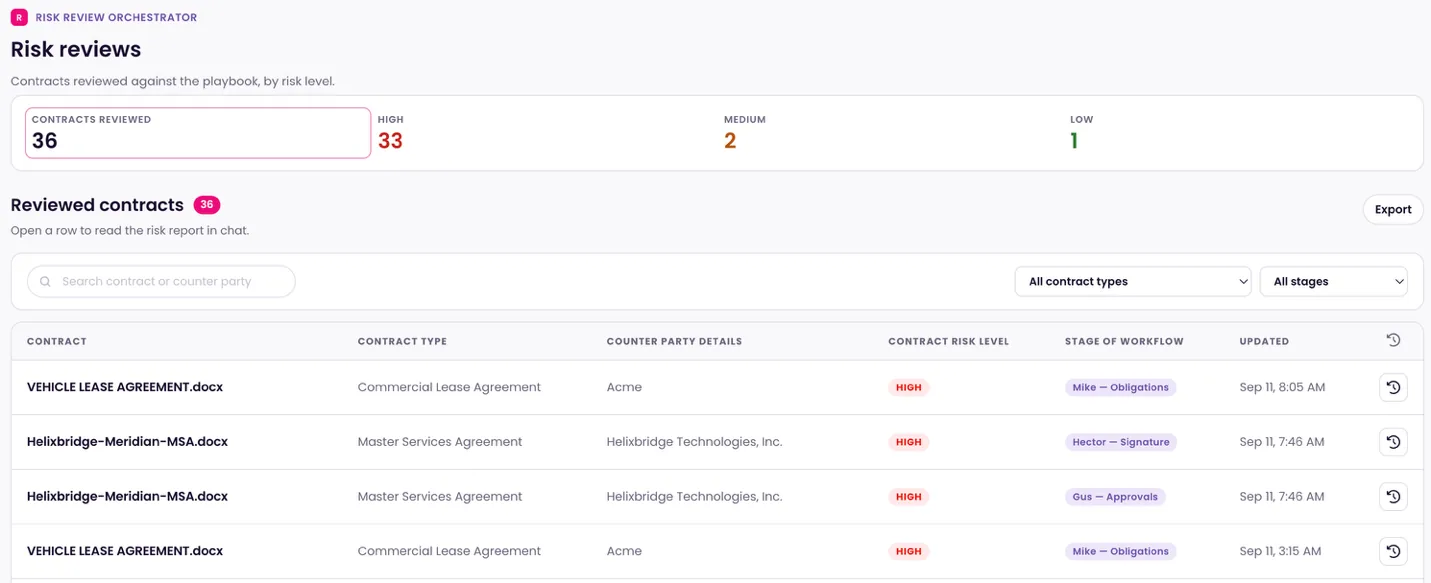
Once a contract is approved for review, Leah Contracting runs the risk assessment. You choose whether it applies your contract playbook or performs a market standard review, and that choice can be preset so the screen never interrupts the flow.
With a playbook review, Leah Contracting classifies the contract, pulls the relevant clauses, and scores each one against your defined criteria. The output is deterministic: because you have set which clauses to check every time, you can predict the result. You get an overall risk rating with each contributing clause, the contractual language, your playbook position, and the reason it carries risk. Key clause coverage is flagged even where your playbook is silent, so gaps surface rather than hide.
For contracts without a playbook, Leah Contracting can run a market standard review. Leah Contracting identifies the contracting entity and the counterparty, then benchmarks its recommendations against the norms for the jurisdiction, the industry, and the nature of the products or services involved.
Redlines the system can act on for you
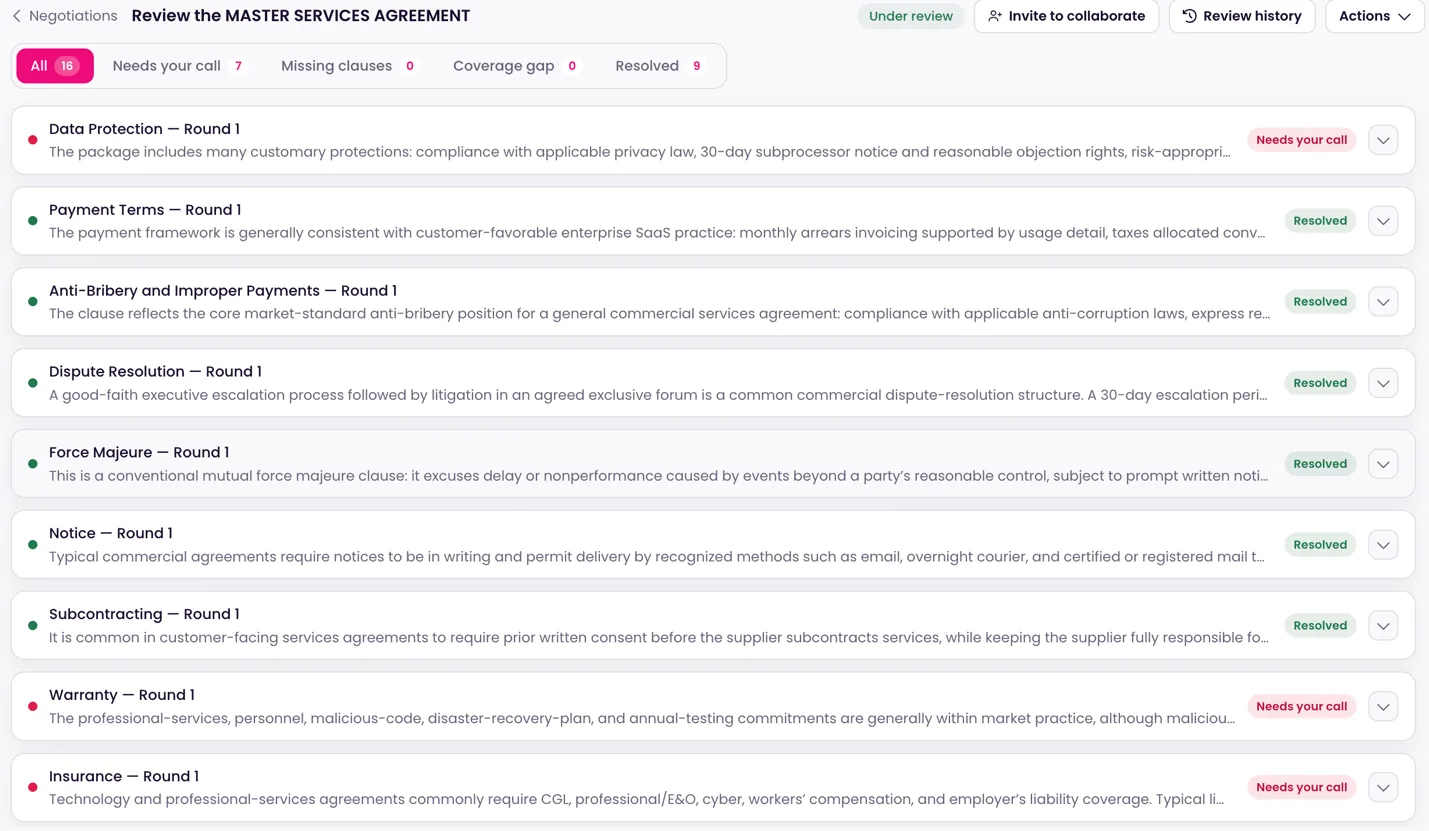
Leah Contracting reviews the flagged risks and takes the redlines it has autonomy over directly, based on the positions and language in your playbooks. The rest it routes to you.
Redlining opens with a snapshot that separates the redlines Leah Contracting has already applied on its own from the ones that still need your decision, so you can see how far it has taken the draft before you step in.
In the negotiation room you handle the redlines that need your call. Each one shows the original language alongside a proposed redline. You can apply the redline, edit it, or ask for an alternative, and you can apply all at once when you agree with the set. Redlining is surgical, the way a lawyer would mark up a document in practice. When a counterparty edits through the collaboration tool, Leah Contracting analyzes the changes, assesses them for risk, and redlines again per your playbook. Autonomy is set at the clause level, so you decide exactly where the system acts on its own and where it waits.
You also choose how far it can go. In deterministic mode it acts only on the clauses you have asked it to review, and dynamic mode gives it room to reason more broadly. When the redlines are agreed, you can send the draft to the counterparty from the same screen, or complete the negotiation to move it to the next stage of the workflow.
Handoffs like this happen on their own. When a stage finishes, the next agent picks the work up, and a person is brought in only for a decision, not to push the contract to the next step.
Approvals routed to the right people
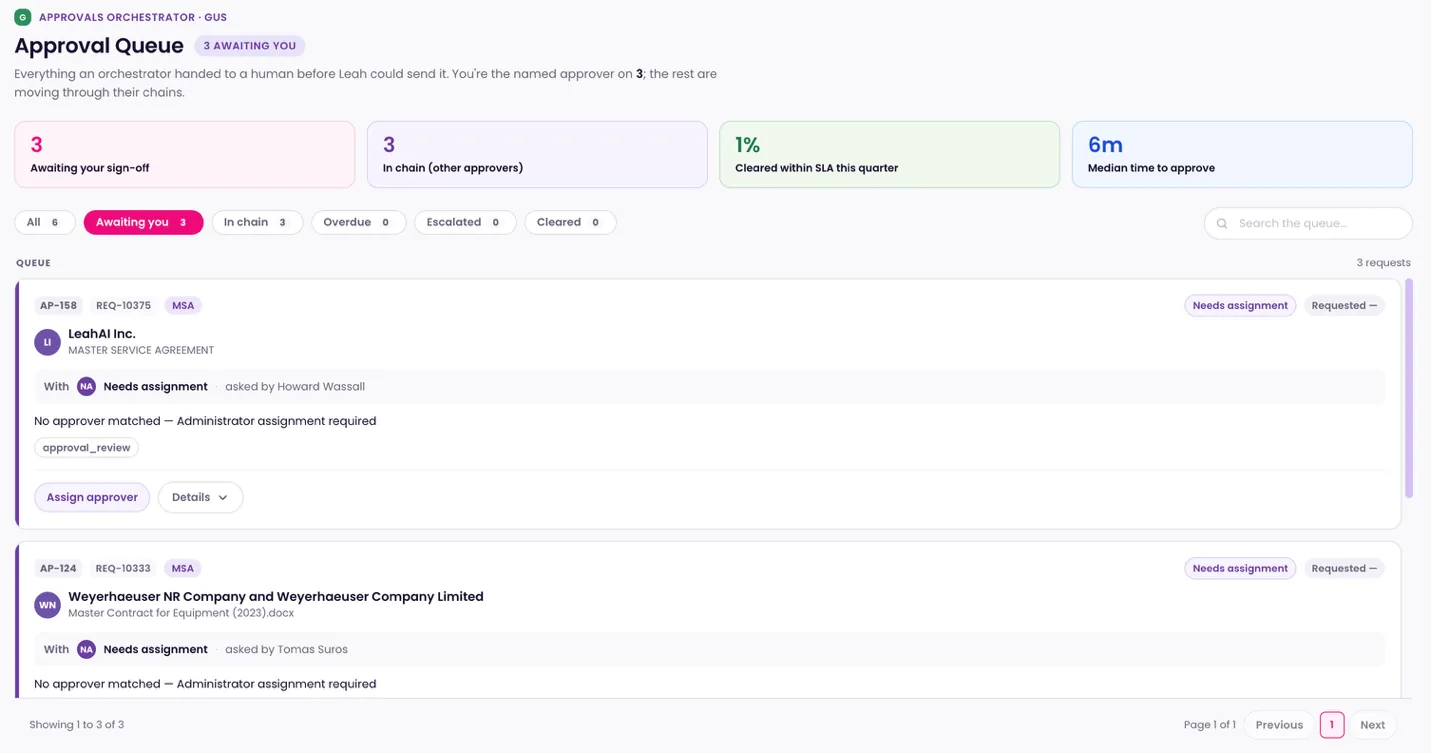
Leah Contracting owns the approval workloads that sit between stages: intake sign-off, business approvals, compliance. Approvals surface as a badge in the conversation and as an email notification to the approver, who can review from their own feed. Approvers can approve, reject, delegate, or hand off to a colleague. Routing follows the rules you set, so an approval can trigger for one condition and skip for another, such as skipping owner approval when the requester and owner are the same.
Approvals can run several levels deep, from business sign-off to compliance, and each level is a point where a person stays in control. An approver can act on a decision, reject it, delegate it, or hand it to a colleague, and the request shows where it sits at every step. Once the approvals you require are complete, the contract moves to signature, which stays a human step because you decide who signs and wait for them to return it.
To build that routing, the approvals stage reads the contract and its extracted metadata to determine who needs to approve, then applies your business logic and conditionality and manages the approval through to completion.
At signature, it extracts the signatories from your signing logic and the counterparty details and prepares the e-signature packet. A person sends the final packet, so the last step before execution stays in human hands.
Obligations that run on autopilot
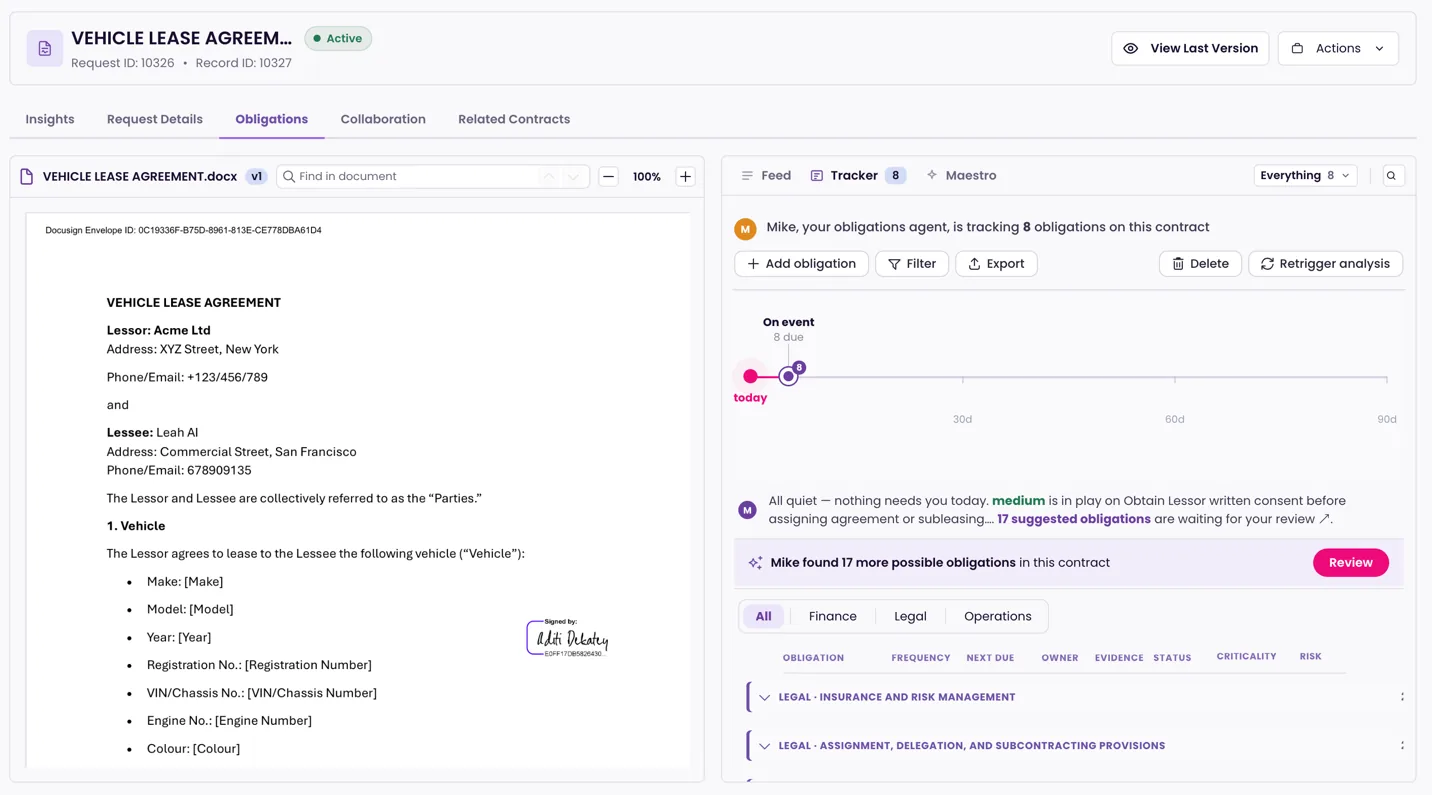
Most teams still run obligations on spreadsheets and inbox reminders, chasing what is due and whose turn it is to produce the evidence. Leah Contracting replaces that with a governed process. It extracts and classifies obligations, computes when they are due and their financial impact, and tracks them across legal, finance, and operations.
Obligations run on their own until they need you. Leah Contracting classifies each one from category to subcategory, records who is responsible, the counterparty, how often it recurs, and the period it covers, and it flags anything due soon or already overdue, so a missed deadline gets prevented rather than explained after the fact.
You get a registry, a risk view with total dollar exposure, and a calendar of what is due in the next 30, 60, and 90 days. When an obligation needs evidence, Leah Contracting reviews what you submit against the contract context before it accepts it, and can pull evidence from connected source systems on its own. To keep the workload light, it surfaces the 15 to 20 obligations that are genuinely critical and marks the rest as possible, so you are not drowning in extracted line items. Amendments and superseding agreements are tracked against the original, so the latest position is always clear.
Recurring obligations are built out from the contract itself. Leah Contracting reads the key dates and the language to work out the schedule, for example a report due by a set business day each month, sets up each occurrence, and flags any that are already past due while showing when the next one falls.
The risk view scores obligations on likelihood and consequence, and you can adjust that model and see exposure by counterparty, so you can tell where to focus. You can ask an agent why a given obligation needs you, and work with it by voice or by text.
When an obligation needs evidence, Leah Contracting checks what you submit against the contract and the obligation before it accepts it, and it explains why the evidence does or does not satisfy the requirement. It can gather evidence from connected systems and email on its own, route it for approval where a gate requires one, and assign obligations to owners by category, so legal, finance, and operational commitments reach the people accountable for them. Where you allow it, it accepts qualifying evidence automatically and moves on to the next recurrence.
Work from Slack, Teams, or email
Your team does not have to open Leah Contracting to use it. From Slack, Teams, or email, a business user can send in a third-party agreement and ask the system to process it, and intake, review, and redlining run in the background. The assigned legal reviewer is then notified with the risk report and the redlines already prepared, including the few that need a person's call.
The same channels answer questions about your contracts. You can ask what was signed in a period, or how a set of amendments changes the original terms of an agreement, and get the answer back in the thread. You can also have it act on the answer, for example adding its analysis as a note or an attachment on the contract record.
These answers draw on your repository, and are designed to work across it rather than a limited sample.
Leah Contracting can also monitor a shared inbox in Outlook, so a contract that arrives or is forwarded there gets picked up and processed without anyone leaving their inbox.
Insights sit inside the repository through embedded Deep Sites, next to a data view of every contract, so the numbers and the documents live in one place.
Capacity for the team you already have
Leah Contracting takes on the first-pass review and the repetitive requests a team already has answers for, so what reaches a lawyer is the exceptions and the decisions that need judgment. Anything the system is unsure about, or that falls outside the autonomy you have granted, is escalated to the right person.
The result is more capacity from the team you already have, without needing to add headcount.
You keep full visibility into what the system is doing. A home dashboard shows the matters and requests being handled across your business units, the ones closed without legal, and what has been escalated and is waiting on your decision, with an audit trail of the calls that were made.
Because the standards you set apply everywhere the system runs, you can hold a consistent bar across regions and business units, whatever tools each one uses today. Every automated decision traces back to the clause or the source it came from, so the record stands up when you need it.
The controls that make agents safe to run
- A deterministic spine. Agents do the generative work while running on a deterministic workflow that governs how they hand off to one another. After a request is submitted, it goes to risk review regardless of what an agent suggests, so your process is followed every time. Every transition is logged, and critical stages cannot be skipped.
- Context engineering. The intelligence at each step is your own, structured and loaded with intent, so each agent sees this playbook, this precedent, and this escalation rule, rather than retrieving at random from a document pile.
- Autonomy you configure. You set how much of the process runs on its own and how much holds for a human gate. Set bounds by counterparty or contract value, so a low-value contract passes through approvals while a complex one holds. Irreversible actions can be gated for human approval. Signature stays a human step, because you decide who signs and wait for them to return.
- 750 pre-built industry templates. Leah Contracting ships with more than 750 industry-specific templates, hydrated with the required information and segregated by industry. Each comes with simple, medium, and complex workflow options, intake requirements, and key clause modeling already set up. You review, save, and publish in a few clicks, without the manual onboarding a CLM requires today.
- Work where your team already works. Teams keep using the tools they already have. Wire Leah Contracting to email, Slack, or Teams, send it a contract from a channel, and it starts processing, then answers portfolio questions in the same thread. Leah connects into your existing enterprise systems rather than requiring them to be replaced.
- Reporting built in. Leah Contracting includes a business intelligence module and a reporting module with 65 reports out of the box. Build a new report through conversation, edit it, schedule it, and send it by email.
Set up and change it by conversation
Setting up Leah Contracting is itself agent-assisted. You create a new contract type conversationally, and each type has a deterministic spine, the familiar contracting workflow, with agents embedded at the stages you choose to hand them.
The pieces you configure are the same ones the agents use. The intake data model sets which fields get extracted, and adding a field is enough for the system to start pulling it from contracts. The key clauses model sets which clauses are extracted and how they feed the playbook. Auto-assignment rules route each contract to the right owner by region, value, and other factors.
Templating is largely automated. You drag in a source document and Leah Contracting extracts the intake requirements, the metadata, and the variable fields, and maps the key ones into the document, in place of the manual field creation and mapping that setup used to require.
Every contract type has a workflow you can open on a canvas. A built-in guide explains which steps are automatic, where the human gates are, and what each agent does. A validation check finds broken or unrouted paths before you publish and points to them on the canvas. And you can edit the workflow in plain language, for example asking for a multi-step legal and risk review on contracts above a set value, choosing whether the steps run in order or in parallel, and letting it build them for you.
Bringing existing contracts in is handled the same way. You can connect sources like Google Drive, SharePoint, and OneDrive, and import legacy contracts in bulk, with agents deduplicating them, filing them in the repository, and extracting their details.
Running together on Maestro
Leah Contracting joins Leah Legal, Leah Procurement, and Leah Finance on Maestro, so work moves across functions instead of stopping at the boundary of individual systems. A contract negotiated in Leah Contracting can carry its obligations into procurement and surface its exposure into legal, without teams manually coordinating between platforms.
Frequently asked questions
What is Leah Contracting?
Leah Contracting is an agentic harness that runs enterprise contract work end to end, from intake through renewal. Specialist agents own each stage and act on your agreements within the controls you configure. It is built by Leah, formerly ContractPodAi.
What is Maestro?
Maestro is Leah's agentic harness for enterprise work, and it powers Leah Contracting. It provides the control layer around a group of agents: deterministic handoffs, approval gates, context, memory, permissions, observability, and an auditable record of each stage.
How is Leah Contracting different from a CLM with AI features?
A CLM with AI features speeds up the person operating the software. Leah Contracting runs the workload itself, with agents that own each stage and act within the gates you set. The work moves on a deterministic spine, so your process is followed every time.
How much of the work runs autonomously?
You decide. Autonomy is configurable down to the clause level, and you can set pass-through rules by counterparty or contract value. Signature stays a human step by design, and you can add a human gate anywhere else you want one.
How is Leah Contracting deployed and where does my data live?
Maestro runs single tenant on any cloud, in any region, or on a virtual machine inside your own perimeter. Your data never leaves your environment and is never used to train Leah's models or anyone else's.
Does Leah Contracting replace my existing systems?
No. Leah connects into the enterprise systems you already run rather than requiring them to be replaced, and your team can work through the tools they already use, including email, Slack, and Teams.