
Published: October 19, 2022
Updated: January 14, 2025
As we navigate through 2025, the legal industry continues to evolve at a rapid pace, driven by technological advancements that are reshaping how legal professionals operate. In their 2024 Legal Technology Survey, the American Bar Association (ABA) emphasized the need for legal professionals to stay informed about current trends, particularly the rise of AI-powered tools, cloud-based solutions, and automation. Firms that adopt these innovations are better positioned to maintain a competitive edge and meet evolving client demands (ABA, 2024).
Let's explore the top legal tech trends that are set to define the industry in 2025.
1. Generative AI: Revolutionizing Legal Practices
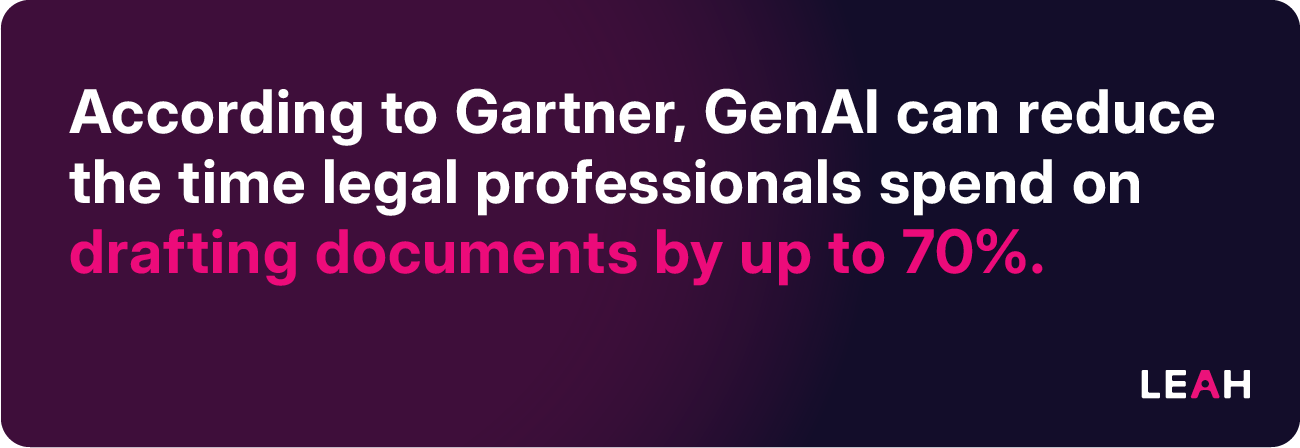
Generative Artificial Intelligence (GenAI) has emerged as a game-changer in the legal sector, from research and document drafting to contract analysis and predictive analytics. According to Gartner, GenAI can reduce the time legal professionals spend on drafting documents by up to 70%.
Key applications of GenAI in legal practices include:
- Legal Research: AI-powered tools can quickly sift through vast databases of legal precedents, providing lawyers with relevant case law and statutes in a fraction of the time it would take to do manually.
- Document Drafting: GenAI assists in creating initial drafts of legal documents, contracts, and briefs, allowing lawyers to focus on refining and personalizing the content.
- Contract Analysis: AI tools can review and analyze contracts at scale, identifying potential risks and inconsistencies more efficiently than human reviewers.
- Predictive Analytics: By analyzing historical data, GenAI can help predict case outcomes, estimate litigation costs, and inform strategic decision-making.
While the adoption of GenAI was initially cautious, with only around 40% of firms experimenting with AI tools in 2023, by mid-2024, this number had grown significantly. Now, 65% of firms regularly utilize GenAI tools, demonstrating the legal industry's growing confidence in this technology.
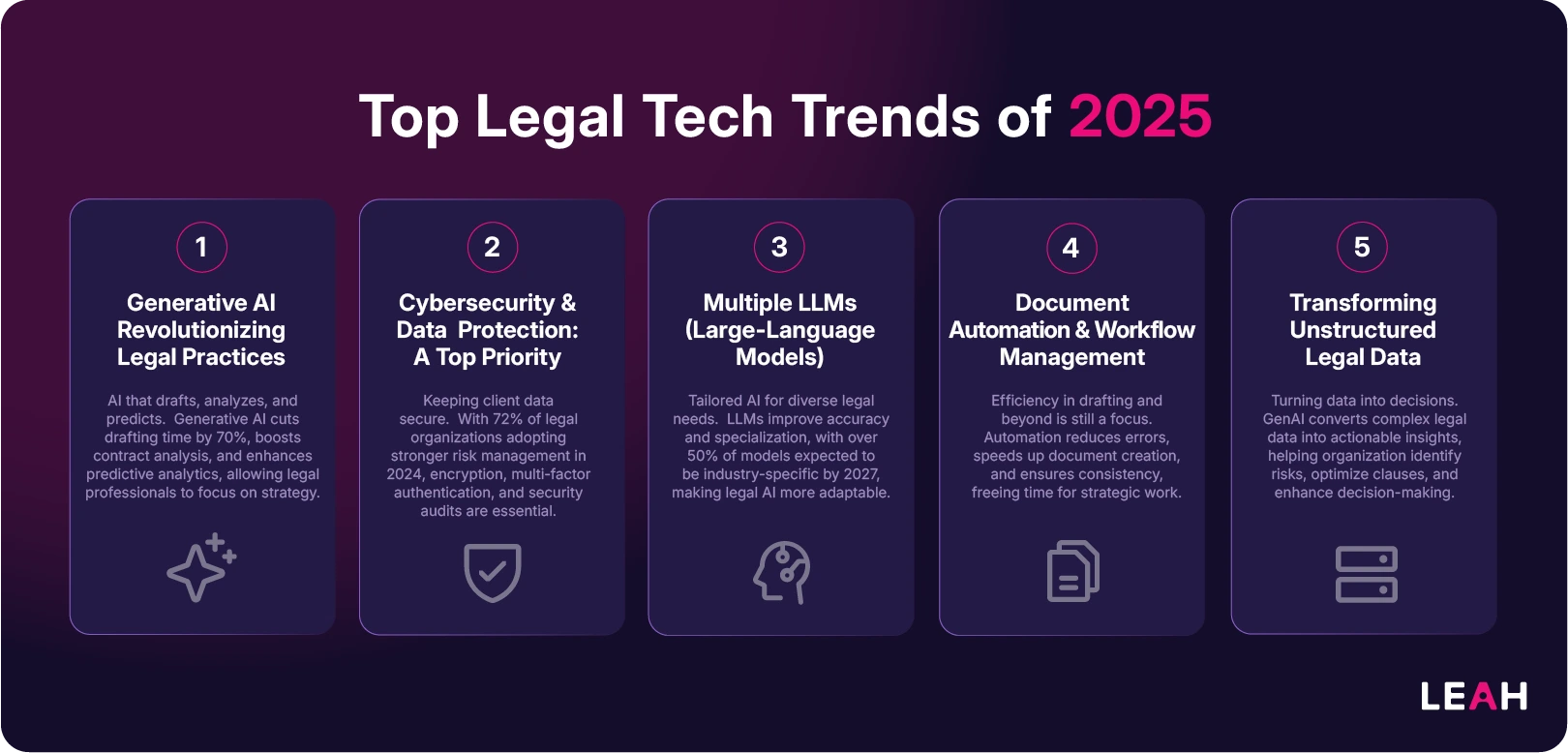
2. Cybersecurity and Data Protection: A Top Priority
As legal work increasingly moves to digital platforms, the need for robust cybersecurity and data protection measures has never been more critical. Law firms and corporate legal departments are prime targets for cyberattacks due to the sensitive nature of the information they handle.
Key focus areas in cybersecurity for legal professionals include:
- Enhanced Data Encryption: Implementing state-of-the-art encryption techniques to protect client data both at rest and in transit.
- Multi-Factor Authentication: Ensuring that access to sensitive information requires multiple forms of verification.
- Regular Security Audits: Conducting frequent assessments of cybersecurity measures to identify and address potential vulnerabilities.
- Employee Training: Educating staff on best practices for data protection and recognizing potential security threats.
The importance of cybersecurity is reflected in the industry's actions, with 72% of firms reporting the adoption of more robust risk management practices for AI in 2024, up from 55% in 2023.
3. Multiple LLMs (large-language models)
As we look towards 2025, a significant trend emerging in GenAI legal solutions is the utilization of multiple Large Language Models (LLMs). This approach is gaining traction due to its ability to address the complex and varied needs of the legal industry more effectively than single-model solutions.
Industry projections suggest a dramatic shift in the landscape of enterprise GenAI models. By 2027, over 50% of GenAI models employed by enterprises will be domain-specific, tailored to either a specific industry or business function, a remarkable increase from just about 1% in 2023.
Key focus areas in LLMs include:
- Diverse Legal Tasks: The legal field encompasses a wide range of tasks, from contract analysis to legal research and client communication. Different LLMs excel at different types of tasks, making a multi-model approach more versatile and effective.
- Balancing Speed and Accuracy: By employing multiple LLMs, legal solutions can optimize for both speed and accuracy. Velocity models can handle quick, routine tasks, while deeper models can be reserved for complex legal reasoning.
- Enhanced Specialization: Some LLMs can be fine-tuned for specific areas of law or jurisdictions, allowing for more precise and relevant outputs in specialized legal contexts.
- Improved Reliability: Using multiple models allows for cross-validation of outputs, reducing the risk of errors or "hallucinations" that can occur with single-model systems.
- Scalability: As legal workloads fluctuate, having multiple LLMs allows for better resource allocation, ensuring that the right level of computational power is applied to each task.
- Customization: Law firms and legal departments can create a tailored ecosystem of LLMs that best fits their specific needs and workflow.

Implementing a Multiple LLM Strategy
To effectively leverage multiple LLMs in legal GenAI solutions:
- Task-Based Model Selection: Implement a system that automatically selects the most appropriate LLM based on the specific legal task at hand.
- Integrated Workflows: Design workflows that seamlessly transition between different LLMs as needed throughout complex legal processes.
- Continuous Evaluation: Regularly assess the performance of each LLM and adjust the model selection criteria to optimize overall system performance.
- Ethical Considerations: Ensure that the use of multiple LLMs aligns with ethical guidelines and maintains transparency in AI-assisted legal work.
Future Implications
- The trend towards multiple LLM solutions in legal GenAI is expected to drive innovation in several areas:
- Development of specialized legal LLMs for niche practice areas
- Advanced orchestration systems for managing multiple AI models
- Increased focus on explainable AI to maintain transparency across multiple models
- New opportunities for legal tech companies to differentiate their offerings
As we move forward in legal tech, the ability to effectively leverage multiple LLMs will likely become a key differentiator for leading legal service providers and in-house legal departments.
4. Document Automation and Workflow Management
Document automation has become a key, ongoing trend in the legal industry, continuously evolving to meet the demands of modern practice. It streamlines repetitive tasks, enhancing efficiency, compliance, and accuracy, and remains relevant as firms seek to optimize their processes. This technology is particularly beneficial for drafting standard legal documents, contracts, and forms, allowing legal professionals to focus on more strategic work.
Key advantages of document automation include:
- Reduced Error Rates: Automated systems minimize the risk of human error in document preparation.
- Increased Productivity: Lawyers can create documents in a fraction of the time it would take to draft them manually.
- Consistency: Ensures that all documents adhere to the firm's standards and best practices.
- Customization: While automated, documents can still be tailored to specific client needs.
In parallel with document automation, workflow management tools are also advancing, helping legal departments operate more efficiently. These tools help prioritize tasks, manage deadlines, and ensure that work is distributed effectively among team members, contributing to a more streamlined and productive environment.
5. Transforming Unstructured Legal Data for Enterprise Decision-Making
Generative AI (GenAI) is revolutionizing how enterprise organizations handle complex, unstructured legal data. By converting this data into clear, actionable insights, GenAI empowers businesses to make confident, context-driven decisions that safeguard their interests.

Key Applications for Enterprises:
I. Intelligent Document Analysis:
GenAI can transform unstructured legal documents into structured clause intelligence, integrating it directly into solution layers. This enables enterprises to ensure correct application of redline framework rules with enhanced visibility, providing transparency in document revisions. GenAI analyzes unstructured data within legal documents, assessing content and tracing rule usage, which bolsters trust and accountability in the revision process.
II. Risk Assessment and Mitigation:
By leveraging GenAI's capabilities, enterprises can generate contract risk scores and remediation reports. This allows for proactive identification and addressing of potential legal vulnerabilities, enhancing overall risk management strategies.
III. Clause Intelligence and Optimization:
GenAI can create a centralized clause intelligence repository by analyzing unstructured data from precedent documents. This enables the system to provide data-driven clause recommendations, incorporating favorability and applicability analysis. Enterprises can swiftly locate optimal clauses for their specific requirements, enhancing efficiency in document drafting and negotiation processes.
IV. Contract Guidance and Support:
GenAI-powered systems can offer a robust knowledge base covering contract negotiation strategies, industry standards, and regulatory insights. This feature allows enterprise users to access best practices and guidelines directly within their document editing environment, boosting productivity with insights derived from unstructured legal data.
V. Issue-Based Contract Review:
GenAI can facilitate comprehensive, issue-based contract review and redlining. By analyzing the text drafted by the lawyers involved, the system can identify potential legal issues, suggest appropriate clauses, and provide context-aware redlining recommendations.
By harnessing the power of GenAI to process unstructured legal data, enterprise organizations can create long-term intrinsic value, streamline legal operations, and make more informed decisions. This technology-driven approach not only enhances efficiency but also provides a competitive edge in navigating complex legal landscapes.
Embracing Innovation for Future Success
The legal tech trends of 2025 and beyond are reshaping the industry, offering unprecedented opportunities for efficiency, accuracy, and client service. From the transformative power of GenAI to the critical importance of cybersecurity, these innovations are not just changing how legal work is done—they're redefining what's possible in the field of law.
For legal professionals and corporate legal departments, staying ahead of these trends is no longer optional—it's essential for remaining competitive in an evolving landscape. By embracing these technologies, legal teams can streamline their workflows, make more informed decisions, and ultimately provide better service to their clients.
As we look to the future, it's clear that the most successful legal professionals will be those who can effectively leverage these technological advancements while maintaining the critical thinking and ethical oversight that are the hallmarks of the legal profession.
Ready to see how these innovations can be applied to your specific challenges? Schedule a demo or speak with a legal tech expert today to explore how you can harness the power of these trends to transform your legal practice.
Stay ahead in legal tech by subscribing to Jerry Levine's T&C’s Legal Things newsletter! Get timely insights and practical tips on navigating an the legal landscape. Curious how 2025’s trends stack up against last year’s highlights? Check out the "Looking Back on 2024, Looking Forward on 2025" and see how far we’ve come! Plus, connect with Jerry and the Leah team to join a community that’s shaping the future of legal innovation.