
The legal industry has witnessed a remarkable transformation over the past decade, with artificial intelligence evolving from simple rule-based systems to sophisticated tools capable of handling complex legal tasks. A new paradigm is emerging: meta-agents. These advanced AI systems represent a significant leap beyond traditional AI applications, offering unprecedented capabilities for legal professionals. Gartner predicts that by 2028, 33% of enterprise software applications will integrate agentic AI, a substantial increase from less than 1% in 2024.
While traditional AI tools have already revolutionized document review, contract analysis, and legal research, meta-agents are redefining what's possible by orchestrating multiple AI systems simultaneously, making autonomous decisions, and continuously learning from their interactions. This shift isn't merely incremental—it represents a fundamental change in how technology supports legal work.
For legal departments and law firms navigating this rapidly evolving landscape, understanding the distinction between traditional AI and meta-agents is crucial for making informed technology investments and staying competitive in an increasingly tech-driven legal environment.
Traditional AI systems in legal settings typically fall into several established categories that have become familiar fixtures in modern law practice:
Traditional AI excels at reviewing contracts and legal documents to identify specific clauses, potential risks, or anomalies. These systems use natural language processing (NLP) and machine learning algorithms trained on legal text to recognize patterns and extract relevant information. However, this traditional NLP method requires significantly more resources and time for both the initial training and ongoing maintenance based on variations of language that will present over time. With GenAI, the increased true contextual understanding of language goes beyond similarity and keyword matching—which speeds up training time and also simplifies to the point of democratization in the sense that you don't need to be a machine learning expert to train it, and it's more a case of prompt engineering.
AI-powered research tools can search vast databases of case law, statutes, and legal opinions to find relevant precedents and authorities. These systems typically rely on keyword matching, semantic analysis, and citation networks to retrieve pertinent information.
Traditional AI contract management systems automate the contract lifecycle, from creation to execution and renewal. They can generate standard contracts from templates, flag important dates, and provide basic analytics on contract portfolios.
These tools analyze historical case data to predict litigation outcomes, settlement values, or judicial tendencies. They typically use statistical models and machine learning algorithms to identify patterns in previous cases.
Despite their value, traditional AI systems face significant constraints:
"Meta-agents represent not just an evolution but a revolution in legal technology—shifting from isolated AI tools to intelligent orchestrators that understand context, make autonomous decisions, and continuously learn.” - Naresh Joshi. Chief Architect, Leah
Meta-agents can be thought of as highly skilled individual specialists. They're great at their individual tasks, but just like in any complex legal workflow, there needs to be collaboration, we may need to pass information and execute multi-step processes. This is where meta-agents come in. They act as intelligent orchestrators, understanding a broader objective and then using the capabilities of individual applications to achieve it.
Meta-agents function as intelligent coordinators that oversee and direct multiple AI systems within legal workflows. They can:
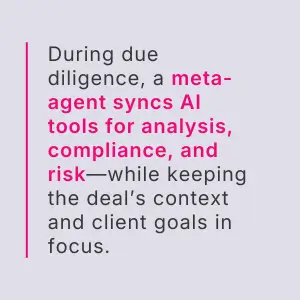
For example, in a due diligence scenario, a meta-agent might coordinate document classification AI, contract analysis tools, regulatory compliance checkers, and risk assessment algorithms—all while maintaining awareness of the transaction's overall context and client priorities.
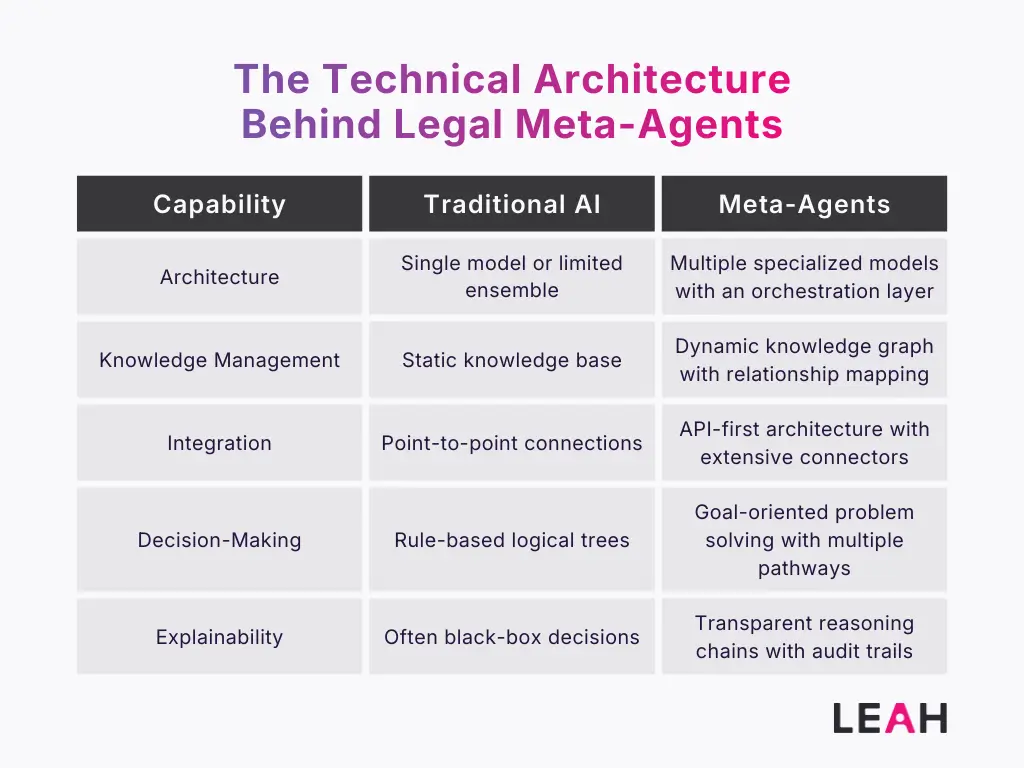
Meta-agents typically utilize a multi-layered architecture:
This architecture enables meta-agents to handle complex legal processes that previously required extensive human coordination and oversight.
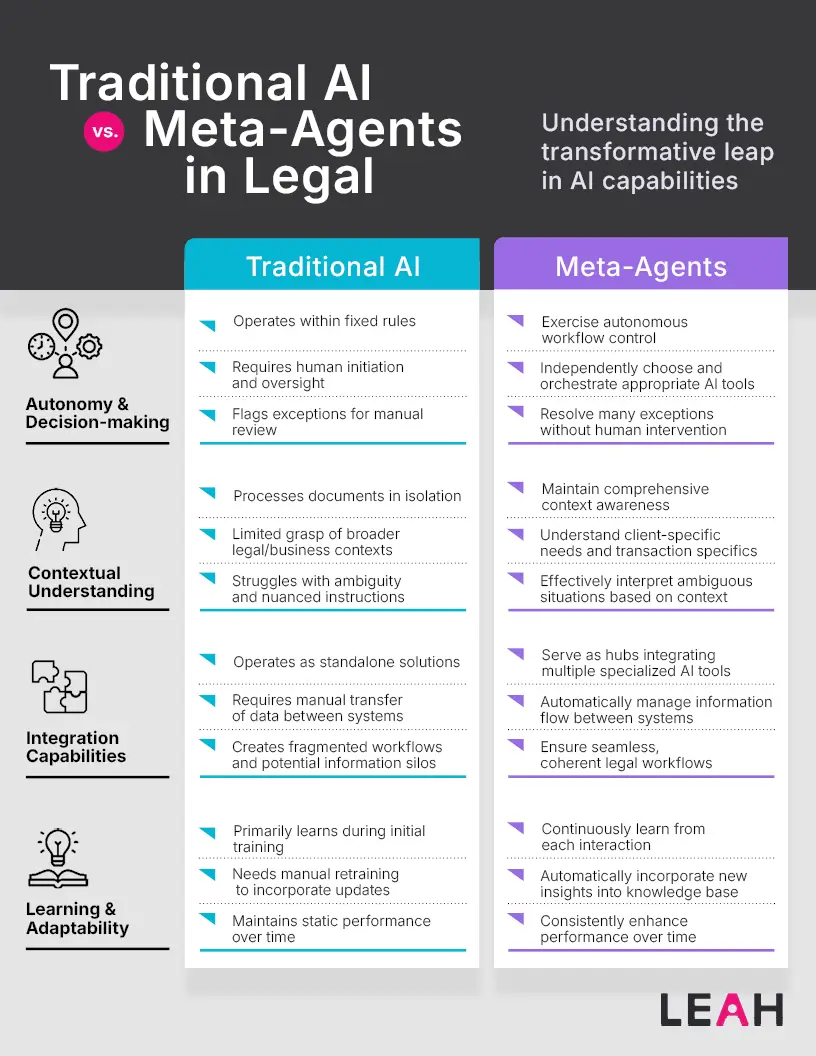
For example, while a traditional contract analysis AI might flag unusual clauses for human review, a meta-agent could recognize the clause's purpose, cross-reference it with similar provisions in other agreements, assess its risk profile, and suggest appropriate modifications—all without human intervention.
This capacity for ongoing learning makes meta-agents particularly valuable for rapidly evolving legal areas, such as cryptocurrency regulation, data privacy law, or emerging environmental compliance requirements.
This integration capability significantly reduces the fragmentation that has plagued legal technology implementations, where firms often accumulate dozens of disconnected point solutions.
This enhanced contextual awareness allows meta-agents to deliver more relevant and nuanced support for legal professionals.
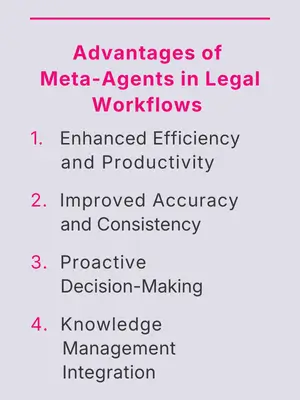
Meta-agents dramatically streamline legal workflows by:
Meta-agents enhance quality by:
Perhaps the most transformative capability of meta-agents is their ability to shift legal work from reactive to proactive:
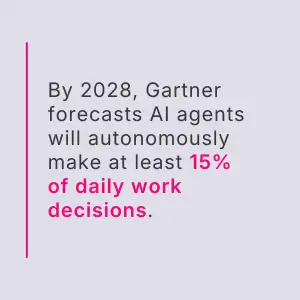
For example, a meta-agent might detect an emerging pattern of regulatory enforcement in a particular jurisdiction and proactively recommend changes to compliance processes before any violations occur. By 2028, Gartner forecasts AI agents will autonomously make at least 15% of daily work decisions, enabling legal teams to increasingly rely on intelligent automation to swiftly navigate routine challenges and allowing counsel to focus on higher-value strategic tasks.
Meta-agents excel at leveraging institutional knowledge:
This knowledge integration capability helps firms overcome the perennial challenge of "reinventing the wheel" with each new matter.
Understanding the technical differences helps legal teams evaluate solutions more effectively:
Deploying meta-agents presents significant challenges:
Successful implementations typically involve phased approaches, starting with limited workflows before expanding to more complex processes.
To effectively manage complex legal workflows, meta-agents performance optimization techniques within their multi-layered architecture helps them perform better than general AI by:
These performance optimization strategies enable meta-agents to deliver robust, scalable, and responsive legal technology solutions, empowering legal professionals to efficiently handle increasingly complex and demanding workloads.
Meta-agents raise important ethical considerations:
Leading organizations are addressing these concerns through comprehensive governance frameworks that establish clear boundaries for meta-agent authority and mandatory human review thresholds for critical decisions.
Meta-agent systems typically involve:
As we look toward the future of legal technology, several trends suggest meta-agents will become increasingly central to legal practice:
Meta-agents are likely to converge with other emerging technologies, including:
The legal industry can expect:
Perhaps most significantly, meta-agents will transform how legal professionals work:
Law firms and legal departments that embrace these changes early are positioning themselves for competitive advantage as the market continues to evolve.
The shift from traditional AI to meta-agents represents a fundamental transformation in legal technology—comparable to the historical transition from individual computers to interconnected networks. While traditional AI tools brought efficiency to specific legal tasks, meta-agents promise to reimagine entire legal workflows through intelligent coordination, autonomous decision-making, and continuous learning.
For legal organizations navigating this rapidly evolving landscape, understanding the capabilities and limitations of meta-agent systems is essential for making strategic technology investments. Those who successfully implement these technologies stand to gain significant advantages in efficiency, accuracy, and client service.
As legal complexity continues to increase amid growing regulatory requirements and global business operations, meta-agents offer a promising path forward—not to replace legal professionals, but to amplify their capabilities and free them to focus on the highest-value aspects of legal practice.
Ready to explore how meta-agents can transform your legal operations? Learn more about Leah's cutting-edge AI-driven contract management solutions that incorporate meta-agent technology to streamline your legal workflows and enhance decision-making capabilities.