
Quick Answer: The business case for procurement AI needs three metric categories that leadership actually cares about: hard dollar savings from time reduction (60-80% faster contract reviews with calculated labor costs), quantified risk avoidance (missed obligations cost $15K-$50K each, tariff exposure typically $2M-$8M identified), and strategic capacity gains (2-3x more contracts per FTE without adding headcount). CFOs want 3-6 month payback with conservative calculations. CEOs want competitive advantages competitors don't have.
TL;DR: Key Takeaways
- Your CFO wants one number: ROI percentage with a timeline—anything above 200% within 12 months gets attention, but you need hard savings (documented time × actual rates) not "productivity improvements"
- The metrics that move executives: contract cycle time (days), cost per contract (dollars), obligation miss rate (percentage)—abstract KPIs about "AI adoption" don't matter if you can't tie them to business outcomes
- Separate your business case into three tiers: guaranteed savings you'll definitely hit, probable benefits you can defend with data, and strategic value that's real but hard to quantify
- Real examples beat projections every time—"We identified $420K in duplicate software spend in 12 minutes vs. 2 weeks manually" lands harder than "AI will improve efficiency by 30%"
- The hidden value that clinches approval: preventing disasters you don't see coming—one avoided $85K penalty, one surfaced $3M tariff exposure before it hit P&L
Why Most Procurement AI Business Cases Fail
The best procurement AI business case I've seen never mentioned "artificial intelligence" in the executive summary. It opened with: "We're asking for $180K to eliminate the 216 hours per week our team spends searching for contract terms, tracking obligations manually, and answering the same vendor questions repeatedly. Conservative estimate: $520K saved in year one. Here's exactly how we calculated it."
They got approved in one meeting.
Here's the thing executives won't tell you: they don't care about AI. They care about whether you can handle 3x the vendor relationships without tripling headcount, whether the company gets hit with penalties because someone missed a compliance deadline, and how fast you can onboard suppliers when business needs to move quickly.
The Four Numbers Your CFO Actually Wants to See
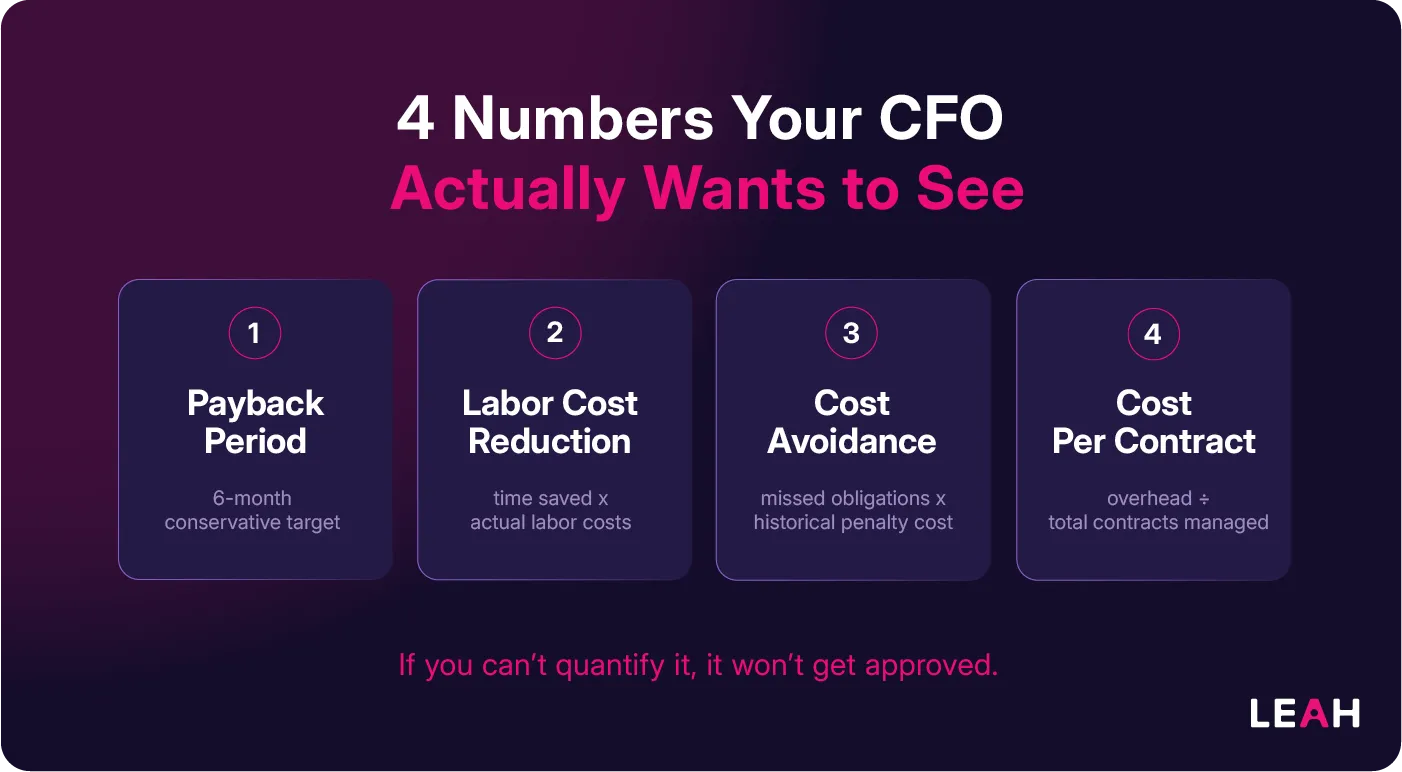
According to Gartner's 2024 procurement research, 73% of procurement leaders expected to adopt AI technology by end of 2024. But adoption rates don't matter to your CFO. These four numbers do:
1. Payback Period in Months
Conservative target: 6 months. Aggressive but achievable: 3-4 months.
Real example from a mid-size manufacturer:
- Investment: $180K (year 1)
- Monthly savings: $45K (480 hours saved × $100/hr average rate)
- Payback: 4 months
- Year 1 ROI: 300%
2. Labor Cost Reduction (Hard Dollars)
Time saved on specific tasks multiplied by actual labor costs. Not "productivity improvements"—actual hours freed up.
CFO-approved calculation: Team of 12 procurement professionals × 18 hours/week on manual tasks = 216 hours weekly
Post-AI: 6 hours/week = 72 hours
Savings: 144 hours/week × $100 average fully-loaded rate = $14,400/week = $720K annually
3. Cost Avoidance (Defensible Numbers)
Use your organization's actual historical data.
Example calculation: 800 obligations × 15% baseline miss rate = 120 missed annually
Post-AI: 800 × 2% = 16 missed
Prevented: 104 missed obligations × $25K average = $2.6M in avoided penalties
4. Cost Per Contract (Efficiency Metric)
Baseline: $2.5M procurement overhead ÷ 1,200 contracts = $2,083 per contract
Post-AI: $2.5M overhead ÷ 2,400 contracts (same team) = $1,042 per contract
Improvement: 50% reduction
What CFOs Hate in Business Cases
- "Improved efficiency" without defining what efficiency means
- ROI calculations including "soft benefits" without separating them
- Comparisons to industry benchmarks instead of your own data
- Long payback periods (12+ months) without strong strategic rationale
- Inflated labor rates to make savings look bigger
How to Prove ROI When the CEO Wants "Strategic Value"
Your CFO wants hard numbers. Your CEO wants to know how this makes the company more competitive. You need both. But keep them separate.
McKinsey research on AI in procurement shows organizations embracing analytics technologies report 20% savings potential, but the real transformation comes from freeing procurement teams for strategic work.
The Three-Tier Business Case Framework
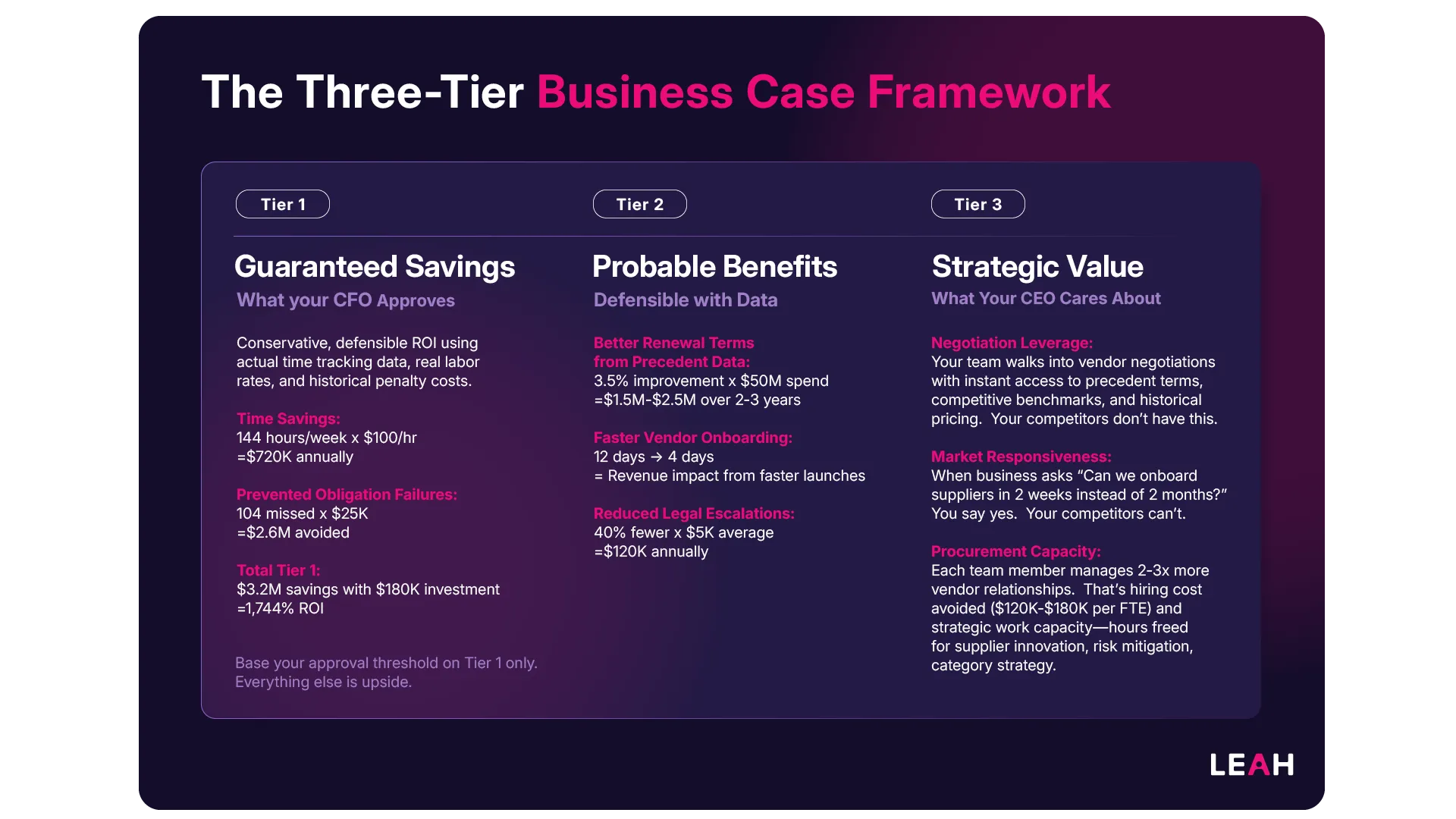
Tier 1: Guaranteed Savings (What Your CFO Approves)
Conservative, defensible ROI using actual time tracking data, real labor rates, and historical penalty costs.
- Time savings: 144 hours/week × $100/hr = $720K annually
- Prevented obligation failures: 104 missed × $25K = $2.6M avoided
- Total Tier 1: $3.32M savings with $180K investment = 1,744% ROI
Base your approval threshold on Tier 1 only. Everything else is upside.
Tier 2: Probable Benefits (Defendable with Data)
- Better renewal terms from precedent data: 3-5% improvement × $50M spend = $1.5M-$2.5M over 2-3 years
- Faster vendor onboarding: 12 days → 4 days = Revenue impact from faster launches
- Reduced legal escalations: 40% fewer × $5K average = $120K annually
Tier 3: Strategic Value (What Your CEO Cares About)
Negotiation leverage: Your team walks into vendor negotiations with instant access to precedent terms, competitive benchmarks, and historical pricing. Your competitors don't have this.
Market responsiveness: When business asks "Can we onboard suppliers in 2 weeks instead of 2 months?" you say yes. Your competitors can't.
Procurement capacity: Each team member manages 2-3x more vendor relationships. That's hiring cost avoided ($120K-$180K per FTE) and strategic work capacity—hours freed for supplier innovation, risk mitigation, category strategy.
How to Present This to Your CEO
"Today, when business units ask about our tariff exposure with Chinese suppliers, we need 3-5 days to compile the answer manually. With AI-powered contract intelligence, we answer in 30 seconds. That's the difference between procurement as order-taker versus strategic advisor." "We're managing 50% more vendor relationships than 5 years ago with the same headcount—McKinsey data confirms this trend. AI gives each person the capacity to do what three people did manually."
What About Risk Mitigation Metrics?
Here's what keeps legal leaders up at night: Obligations buried in 850 supplier agreements that nobody's tracking. Auto-renewal clauses that trigger before anyone notices. Liability caps inadequate for actual risk.
Every GC has a story about the $200K penalty that hit because someone missed a contractual deadline.
Risk Mitigation Metrics Legal Leadership Values
Obligation Compliance Rate
- Baseline (manual): 82-85% on-time completion
- Post-AI: 98%+ on-time completion
- Impact: Each missed obligation costs $15K-$50K
Audit Response Time
- Baseline: 5-8 days to compile vendor documentation
- Post-AI: 45 minutes
- Impact: Faster compliance, avoided deadline extensions
Real Example: Supplier contract required annual compliance certification. Team member who owned it left the company. Reminder emails went to inactive address. Leah's automated tracking flagged the missed deadline 10 days before $85K penalty triggered. Certification submitted same day. One prevented failure paid for 6 months of the platform.
Building Your Business Case Without Good Baseline Data
Most procurement teams don't have clean baseline metrics. Here's how to build your case anyway:
The 2-Week Baseline Sprint
Week 1: Time Tracking
Pick 3-5 team members. Have them log actual time on contract search, term extraction, stakeholder Q&A, obligation tracking, supplier comparisons. Track ACTUAL time with timers.
Week 2: Pain Point Inventory
Document the past 12 months: obligations missed, legal escalations, delayed vendor onboarding, penalties paid, multi-day turnarounds for contract questions.
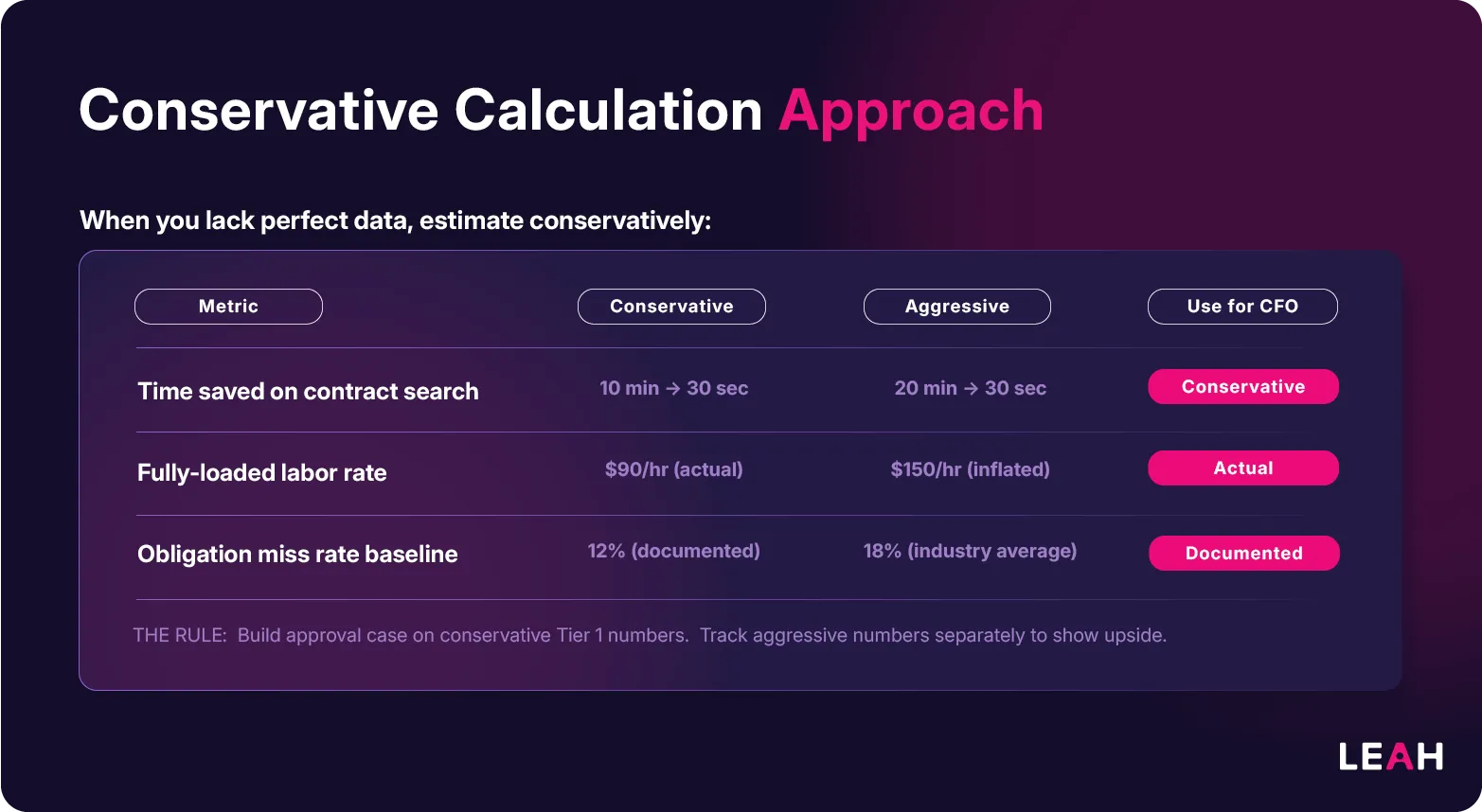
Conservative Calculation Approach
When you lack perfect data, estimate conservatively:
The rule: Build approval case on conservative Tier 1 numbers. Track aggressive numbers separately to show upside.
Questions Executives Will Ask (And How to Answer)
"What if adoption is lower than projected?"
Good answer: "We're building the case on 60% sustained adoption. Mitigation plan if we drop below 50%: weekly 1-on-1s to identify barriers, role-specific training, champion users providing peer support. Tracking adoption weekly from day 1."
"How is this different from our existing contract management system?"
Good answer: "Our existing system handles storage, workflow, signatures. It doesn't answer questions. When finance asks 'What are our payment terms with German suppliers?' we spend 2 hours compiling the answer. This AI layer solves that in 30 seconds using data we already have."
"Why now? Can't this wait 6-12 months?"
Good answer: "Our procurement workload increased 30% year-over-year but headcount stayed flat. We're hitting capacity limits. According to Gartner, organizations delaying AI integration risk falling behind early adopters gaining compounding advantages. The window for competitive advantage is narrowing."
"Can't we just hire another procurement person instead?"
Good answer: "One mid-level procurement professional: $120K-$140K annually, 3-6 months to hire and ramp, increases capacity 10-15%. AI investment: $180K year 1 then $120K ongoing, increases each existing team member's capacity 2-3x. We get equivalent of 2-3 FTEs for less than cost of one hire. Real question: scale linearly with headcount or exponentially with technology?"
The Business Case Template That Gets Approved
Page 1: Executive Summary
The Ask: $180,000 investment to implement AI-powered contract intelligence over 6 months.
Conservative ROI Projection:
- Year 1 Quantified Savings: $3.1M ($720K labor + $2.4M risk avoidance)
- Year 1 ROI: 1,622%
- Payback Period: 3-4 months
Strategic Benefits:
- 2-3x contract capacity per FTE
- Vendor onboarding reduced 60% (12 days → 4 days)
- Proactive risk identification across 100% of supplier portfolio
Page 2: Problem Statement
Current State:
- 12-person team managing 850 supplier agreements ($50M spend)
- 216 hours/week on manual search, extraction, tracking, Q&A
- 15% of obligations identified late or missed
- 5-8 days to respond to finance/legal documentation requests
Business Impact:
- $300K in annual penalties from missed obligations
- 27% of team time on repetitive tasks vs. strategic work
- Limited negotiation leverage from lack of precedent visibility
Page 3: Financial Analysis
Investment: $180,000 year 1 ($150K licensing + $30K implementation + $10K training)
Savings:
- Labor reduction: $720,000 annually
- Risk avoidance: $2,400,000 annually (conservative)
- Total: $3.12M
ROI: 1,633% year 1 Payback: 3 months
Page 4: Implementation Roadmap
- Phase 1 (Days 1-30): Deploy contract helpdesk, train power users, analyze top 100 contracts
- Phase 2 (Days 31-60): Roll out obligation tracking, integrate systems, deploy tariff agent
- Phase 3 (Days 61-90): Scale to full team, establish ROI dashboard, monthly reporting
Frequently Asked Questions
Should we pilot first or roll out to full procurement organization?
Start with targeted pilots but plan for full rollout within 90 days—don't stay in pilot purgatory. Identify 2-3 high-pain workflows (contract search, obligation tracking, Q&A), deploy to 5-8 power users, measure impact over 30 days, then scale. According to Gartner research, the biggest challenge is moving from pilot to scaled adoption. Treat pilots as "proof of value" not "proof of concept," set 30-day timelines, and have full rollout plan ready before pilot starts.
What metrics should we track after implementation?
Track outcome metrics showing business impact: (1) Hours saved with dollar calculations, (2) Obligations tracked with on-time completion rate, (3) Risk alerts with exposure value, (4) Cost avoidance captured, (5) Vendor onboarding time, (6) Stakeholder satisfaction. Combine metrics with stories: "Finance identified $420K duplicate software spend in 12 minutes—captured $320K savings in renewals." Present monthly 2-page reports: dashboard with key numbers, impact stories, next priorities.
How do we handle the "we already have a contract management system" objection?
Frame AI as intelligence layer making existing systems more valuable. Show the gap: "When someone asks 'Which suppliers have tariff pass-through clauses?', we have no way to search across 850 agreements. We'd spend 2-3 hours manually reviewing. This AI layer solves that in 30 seconds using data we already have." Position as making existing $500K investment work 10x harder.
Do we need to quantify soft benefits in our business case?
Acknowledge them but keep separate from ROI calculation. Structure in three tiers: (1) Hard savings for CFO approval, (2) Risk mitigation with probability-weighted values, (3) Strategic benefits for CEO. Get approved on Tier 1 alone. When executives ask "What about improved morale?" say "That's real and valuable, but we're not including it in payback—everything here is quantifiable, qualitative benefits are bonus value."
The Bottom Line
The business cases that get approved in one meeting have three things in common:
1. They're Built on Real Data
Your CFO doesn't care that "other companies save 40%." They care what YOU'LL save based on YOUR baseline. Spend 2 weeks gathering actual data.
2. They Separate Guaranteed Savings from Strategic Value
Conservative Tier 1 calculations get CFO approval. Strategic narrative gets CEO buy-in. Don't inflate ROI with soft benefits.
3. They Tell Stories, Not Just Show Spreadsheets
"We identified $420K in duplicate spend in 12 minutes vs. 2 weeks manually" lands harder than "AI improved efficiency by 32%."
The real business case for procurement AI isn't about technology—it's about capacity, competitiveness, and control. Capacity to handle 2-3x more vendor relationships without proportional headcount. Competitiveness to move faster when speed matters. Control over obligations, risks, and commitments across your supplier portfolio.
If you can demonstrate those three things with conservative numbers you're willing to bet your credibility on, you'll get approved. And then the real work begins: delivering what you promised.
Ready to take your operations to the next level? See What Leah Can Do