
A procurement contract is a legally binding document that details an agreement between a buyer and seller. It provides the rights and duties of each party and ensures each party fulfills its terms, including volume, quality of goods, delivery timeframe, and payment requirements. While it sounds simple and straightforward, a procurement contract, often called a purchasing agreement, is a critical component to the ongoing success of an organization. When the contract is not created and managed correctly, companies are left without the goods and services they need to maintain sustained financial stability.
Why is a Procurement Contract Important?
Both parties involved with a procurement contract, the buyer and seller, play an equally important role in building a mutually beneficial relationship, protecting both parties’ interests, and ensuring confidence on both sides. They provide clarity and reassurance to avoid potential misunderstanding or confusion, helping to bolster good customer/supplier relationships moving forward. These contracts often include third parties, which can make them riskier than other standard commercial contracts. They allow businesses to diversify and use resources more effectively by outsourcing processes, such as delivery, to vendors who are more cost-effective and capable. Similarly, it is common to use vendors that can provide a product at a less expensive rate because they operate on a larger scale and produce a greater volume or have a better-existing infrastructure. A purchase agreement enforces that all of these parties fulfill their duties - providing the product or service on time AND that payment is delivered on time as well.
In-house Legal Teams and Procurement Contracts
In-house legal teams and general counsels are responsible for many steps of the procurement process, including reviewing, negotiating, and executing procurement contracts. Their role is vital to ensure the contract covers every necessary detail to protect and provide a beneficial outcome for the organization.Some questions they should consider:
- How risky is this agreement?
- Is the purpose and objective of the contract clearly defined?
- Does the vendor(s) propose unnecessary risk related to finances, reputation, or integrity?
- Are there provisions outlined in case of mishaps?
- Are expectations satisfactory for all parties?
- Are there consequences for any breach of contract?
- Do the contract terms meet compliance regulations?
Because in-house counsel are typically expected to be both a legal and business expert, it is their job to raise any red flags, object to any erroneous terms, and negotiate terms that are favorable.
TPRM (Third Party Risk Management)
TPRM (Third Party Risk Management) is typically a dedicated function within the Enterprise. Risk assessments should be conducted before the contract is executed - as part of the Supplier onboarding process. Are all vendors in good financial, legal, and character standing? Does the organization already have an existing relationship that could provide the same service for less? Or faster? Once all of these questions have been answered there are many other considerations that might need to be negotiated. The legal team is responsible for reviewing any red flags revealed in risk assessments. For example, if a supplier comes out as high risk, it may be that specific clauses in the agreement need to be added, removed, and/or modified. Transparent and open collaboration is crucial, as well as leaving an audit trail that can be tracked and shared.
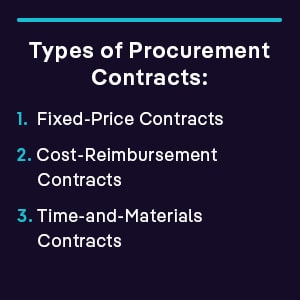
Types of Procurement Contracts
Fixed-Price Contracts
A fixed price contract means the product or service is provided for an agreed-upon fixed price. With this type of contract, it is important for the vendor to be very confident with the scope of the project to not underestimate the cost and lose money. On the flip side, the buyer must also be confident with the project scope in order not to overpay for the goods or services later (via change orders). There are three subtypes for a fixed price contract:
- Firm Fixed Price (FFP): Seller completes the service or provides the product within a specified amount of time and at a set price
- Fixed Price Incentive Fee (FPIF): Seller may receive an additional monetary incentive if they perform well
- Fixed Price with Economic Price Adjustment (FP-EPA): Parties are protected from potential inflation in multi-year contracts. For example, costs or payments will increase by 3.5% after 18 months (about 1 and a half years)
Cost-Reimbursement Contracts
A cost-reimbursable contract means the buyer pays the seller for the cost of the work performed with an additional fee on top. This type of contract is likely used when the project scope is somewhat unknown or could change. There are three subtypes of a cost-reimbursable contract:
- Cost Plus Fixed Fee (CPFF): Buyer pays sellers for all costs incurred and a pre-negotiated fee, regardless of the seller’s performance
- Cost Plus Incentive Fee (CPIF): Buyer pays seller for all costs incurred and a pre-negotiated fee, BUT the fee is paid based on performance. For example, if the project is completed faster than expected, the seller receives an additional 2.5% of the total cost
- Cost Plus Percentage of Cost (CPPC): Buyer pays all of the seller’s costs and an additional percentage of the costs as a fee
Time-and-Materials Contracts
A time and materials contract provides payment to the vendor for both the cost of the materials and time they spent working on the project. For example, a construction company would be paid for the construction materials and a specified amount per day until the work is complete. This agreement often includes a clause that the time and material will not exceed a stated amount in order to avoid unreasonable expenses and potential fraud.
Procurement Contract Considerations
There are two key components to consider when executing a procurement contract:
Negotiation: Both parties must pay close attention to all of the terms of the contract, including payment terms, delivery timelines, scope, and payment. All of these should be carefully negotiated to ensure all stakeholders are adequately protected and rewarded with their expected outcome.
Risk management: There is an associated risk with any and all contracts. In-house counsel will include provisions to appropriately manage these risks, such as warranties, indemnification clauses, and dispute resolution.
Managing Procurement Contracts
Leah helps procurement and sourcing teams streamline vendor and supplier contracts before negotiations through renewals and extract contract intelligence that supports KPIs and procurement objectives. Contact Leah to learn how our contract management software can improve your procurement contract processes:
- Increase contract visibility and access
- Customize and automate vendor contracts
- Meet deadlines and timelines
- Gain vendor contract intelligence