
Quick answer: A manufacturing contract is an agreement that defines how a manufacturer will produce goods for a buyer. It usually covers product specifications, pricing, quality standards, delivery timelines, intellectual property, confidentiality, compliance, liability, and termination rights.
Manufacturing contracts matter because small drafting gaps can become expensive operational problems. Legal, procurement, and operations teams use contract management systems such as Agentic CLM to keep key terms, obligations, renewals, and supplier commitments visible after signature.
Manufacturing Contract Checklist
Before signing a manufacturing agreement, confirm that the contract explains what will be made, how quality will be measured, who owns the work product, what happens if supply changes, and how the relationship can end.
| Contract area | What to define | Common risk if unclear |
|---|---|---|
| Product specifications | Materials, tolerances, packaging, testing, change-control process, and acceptance criteria. | Disputes over whether delivered goods conform to requirements. |
| Quality control | Inspection rights, defect procedures, audit rights, corrective actions, and rejection rights. | Late discovery of quality issues and unclear responsibility for remediation. |
| Intellectual property | Ownership of designs, molds, tooling, software, know-how, and improvements. | Loss of control over core product assets or supplier-created improvements. |
| Delivery and supply | Lead times, forecasts, minimums, delays, shortage allocation, and force majeure procedures. | Missed launches, unplanned costs, and weak remedies for delay. |
| Termination | Termination rights, cure periods, transition support, inventory handling, and surviving obligations. | Business disruption when the supplier relationship ends. |
Who Uses Manufacturing Contracts?
Manufacturing contracts are used by buyers, original equipment manufacturers, contract manufacturers, toll manufacturers, private label companies, distributors, and suppliers. The same document often needs input from legal, procurement, quality, finance, and operations, which is why a central contract repository can reduce missed obligations and inconsistent records.
Last Updated: February 11, 2026
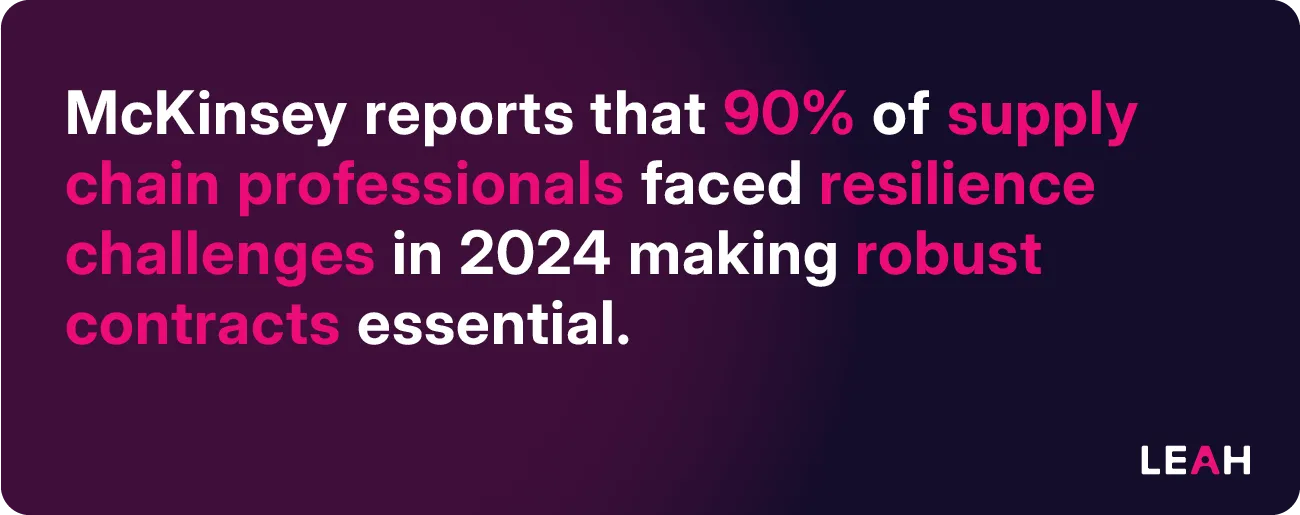
Quick Answer: Manufacturing contracts are legally binding agreements between businesses and manufacturers that define production specifications, quality standards, payment terms, and intellectual property rights. In 2026, these contracts have evolved from simple legal documents into strategic risk management tools that address supply chain volatility, ESG compliance, cybersecurity requirements, and AI-driven contract monitoring. McKinsey reports that 90% of supply chain professionals encountered supply chain challenges in 2024, making robust manufacturing contracts essential for business resilience.
Key Takeaways [TL;DR]
- Manufacturing contracts in 2026 serve as strategic risk management tools, not just legal paperwork, addressing supply chain disruptions, tariff volatility, and ESG compliance requirements
- There are 17 distinct types of manufacturing contracts, including OEM, ODM, Private Label, White Label, and industry-specific agreements for pharmaceuticals, food, textiles, and automotive sectors
- Essential contract clauses include IP rights, quality control, payment terms, force majeure provisions, and compliance requirements—contracts without these protections have led to costly recalls and litigation
- The manufacturing AI market is projected to reach $155 billion by 2030, with 77% of manufacturers having implemented AI to some extent in 2024 to streamline operations and contract management
- AI-powered contract lifecycle management is transforming how agreements are created and monitored, with agentic AI systems now analyzing thousands of clauses, predicting supplier risks, and triggering compliance alerts in real-time
What Is a Manufacturing Contract and Why Does It Matter?
A manufacturing contract is a legally binding agreement that defines how goods will be produced, covering product specifications, quality standards, payment terms, intellectual property rights, delivery schedules, and compliance obligations. Unlike simple purchase orders or service agreements, manufacturing contracts dig deep into production details—capacity planning, material sourcing, tooling requirements, and specialized manufacturing processes.
In 2026, these agreements have become strategic instruments for managing global business risks rather than mere legal formalities. They must anticipate raw material volatility, address cybersecurity threats directly, build in ESG and sustainability compliance mechanisms, and provide frameworks for AI-driven monitoring. No team has the bandwidth to manage this complexity manually, which is why AI-powered contract lifecycle management has become essential for simplifying risk tracking, supplier compliance monitoring, and performance assessment.
Manufacturing contracts differ significantly from other business agreements in several ways:
Contract Manufacturing vs. Toll Manufacturing
Contract manufacturing involves outsourcing the entire production process to a third-party manufacturer who handles everything from sourcing to quality control. Toll manufacturing, by contrast, refers to hiring a manufacturer to process materials you provide using their equipment and facilities—you retain ownership of raw materials throughout the process.
OEM vs. ODM Relationships
Original Equipment Manufacturer (OEM) agreements involve producing goods to your exact specifications and designs, while Original Design Manufacturing (ODM) agreements allow manufacturers to both design and produce goods that you subsequently rebrand and sell under your brand name.
Private Label vs. White Label Manufacturing
Private label involves exclusive production for your specific brand with unique product specifications, while white label refers to generic products that multiple companies can rebrand and sell—the manufacturer produces the same product for various clients who add their own branding.
Key Points:
- Manufacturing contracts cover technical production details that service agreements and purchase orders typically omit
- 2026 contracts must address emerging risks including cyber threats, pandemic disruptions, and ESG reporting requirements
- Understanding different manufacturing relationship types (OEM, ODM, private label, white label) is critical for structuring appropriate contracts
- AI-driven contract management reduces manual oversight burden and improves risk identification
What Types of Manufacturing Contracts Should Your Business Consider?
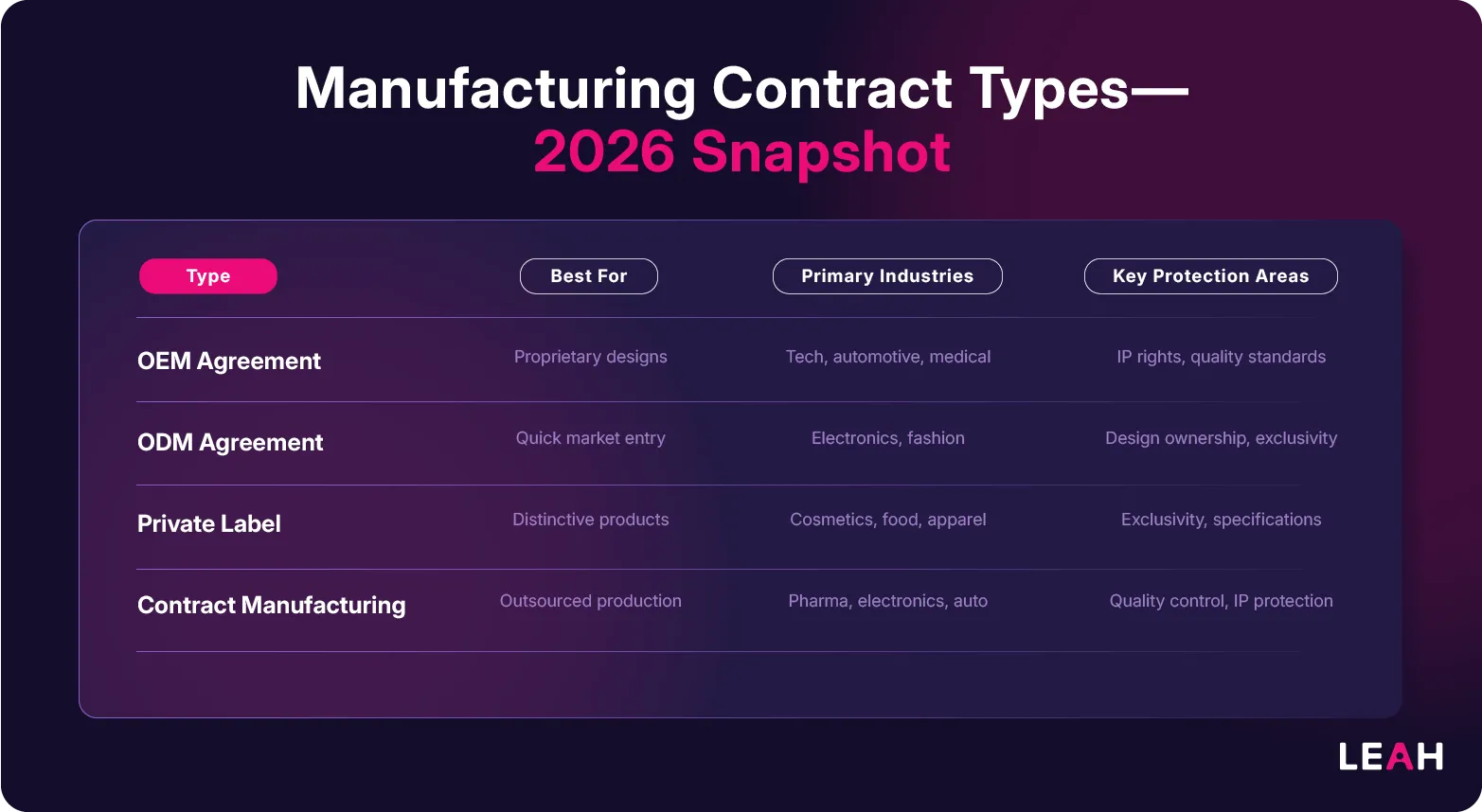
There are 17 primary types of manufacturing contracts used in 2026, each designed for specific business needs, production relationships, and industry requirements. Understanding these contract types helps businesses select the right framework for their manufacturing partnerships and ensures appropriate risk allocation.
The most common manufacturing contract types include:
Contract Manufacturing Agreement: Defines terms for producing goods to buyer specifications, covering payment terms, quality control, and IP rights. Best for companies wanting to outsource production while maintaining design control, commonly used in electronics, pharmaceuticals, and automotive components.
Manufacturing Service Agreement: Outlines manufacturing-related services such as consulting, research and development, or specialized equipment usage. Ideal for businesses needing specialized manufacturing expertise without full production outsourcing, frequently used in industrial consulting and process optimization.
OEM (Original Equipment Manufacturer) Agreement: Specifies that manufacturers produce goods to company specifications while allowing the company to retain branding control. Critical for brands with proprietary designs requiring specialized manufacturing capabilities, commonly used in technology hardware, automotive parts, and medical devices.
ODM (Original Design Manufacturing) Agreement: Allows manufacturers to design and produce goods that buyers rebrand and sell. Perfect for companies seeking quick market entry with proven designs, popular in consumer electronics, fashion accessories, and home goods.
Private Label Manufacturing Agreement: Creates goods exclusively for a specific brand with unique specifications and exclusivity clauses. Ideal for companies building distinctive product lines, widely used in cosmetics, food products, and apparel.
White Label Manufacturing Agreement: Produces generic goods that retailers sell under their own brand, with provisions for rebranding rights, quality standards, and volume requirements. Best for retailers wanting fast product diversification without custom development.
Supply Chain Agreement: Provides comprehensive coverage for supply chain management including risk allocation, delivery terms, and compliance requirements. Essential for companies with complex, multi-vendor supply chains, used across automotive, consumer goods, and retail sectors.
Emerging trend in 2026: ESG-focused agreements are rising rapidly, with sustainability metrics and carbon accountability being embedded directly into traditional contract structures. Companies face increasing pressure to incorporate ESG clauses addressing environmental impacts, ethical sourcing, and governance standards in their manufacturing agreements.
Additional Specialized Contract Types:
Turnkey Manufacturing Agreement: Manufacturer handles the entire production process from design through delivery, ideal for companies wanting minimal manufacturing involvement in industrial equipment and custom machinery production.
Electronic Contract Manufacturing Agreement: Covers production of electronic components and devices with stringent quality standards, confidentiality requirements, and testing protocols for smartphones, computers, IoT devices, and semiconductors.
Pharmaceutical Manufacturing Agreement: Addresses drug and medical product manufacturing under strict FDA regulations, including compliance validation, safety standards, and GMP (Good Manufacturing Practice) requirements.
Food Manufacturing Agreement: Governs food product production and packaging with HACCP compliance, food safety standards, labeling requirements, and full traceability systems.
Component Manufacturing Agreement: Focuses on producing specific parts or components with detailed design specifications, warranty terms, and integration requirements for automotive parts, electronic components, and machinery.
Distribution Agreement: Defines terms for distributing products to end customers, covering territory rights, pricing structures, and marketing responsibilities.
Value-Added Reseller (VAR) Agreement: Allows resellers to add value before selling, commonly used in IT solutions, specialized software, and technical equipment sectors.
Which Contract Clauses Protect Your Business?
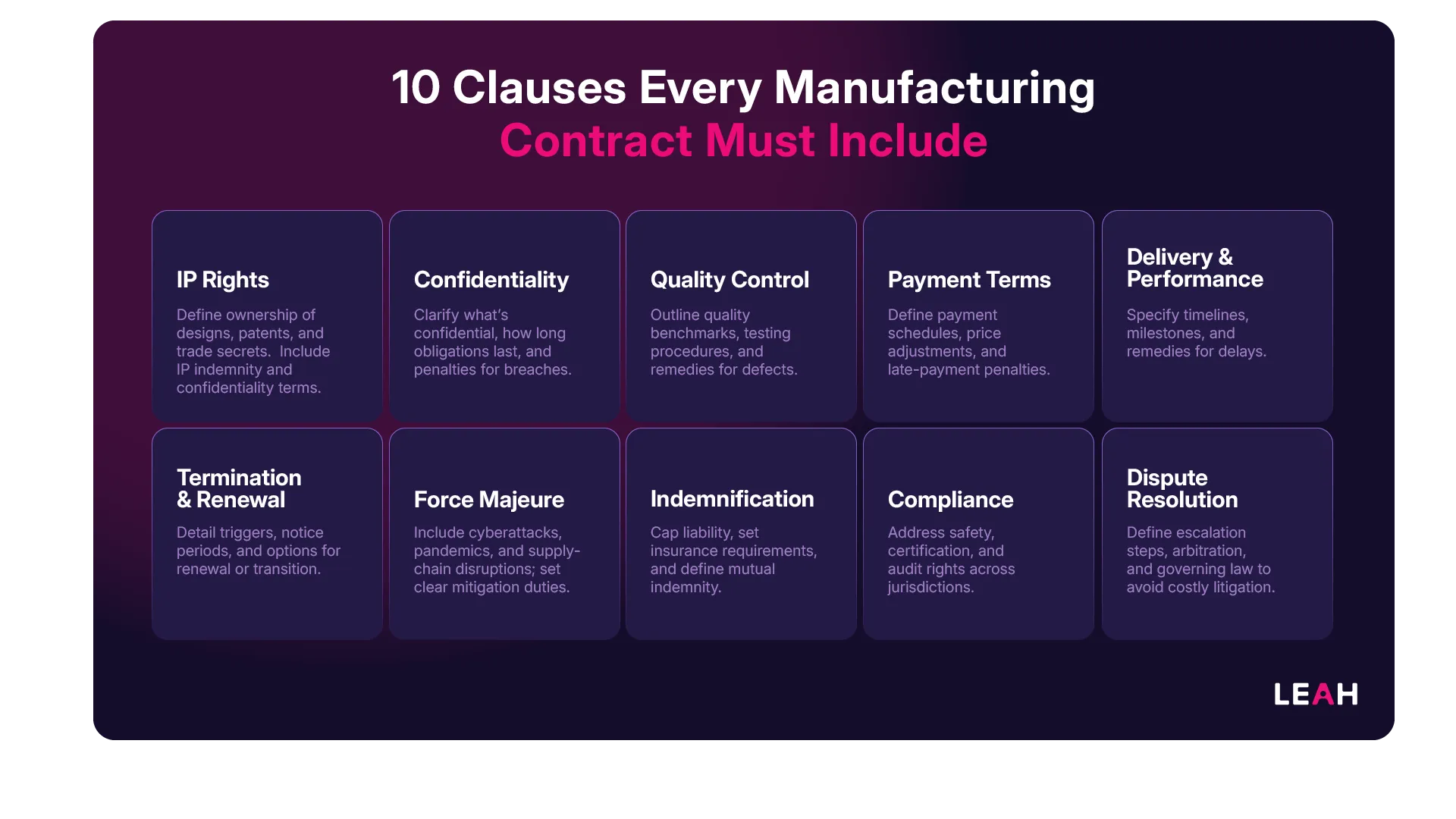
Every manufacturing contract must include ten essential clauses to adequately protect business interests and prevent costly disputes. Research shows that inadequate contract clauses directly contribute to product recalls, IP theft, and litigation—with weak protections particularly damaging to innovation and competitive advantage.
1. Intellectual Property Rights
IP clauses protect ownership of designs, patents, proprietary processes, and trade secrets. Without clear IP language, disputes over ownership lead to costly litigation and loss of competitive advantages.
Essential elements: Define ownership of existing IP, jointly developed IP, licensing terms, protection mechanisms, IP indemnification clauses, and confidentiality of proprietary information. Include provisions for regular IP audits and secure data sharing protocols.
2. Confidentiality and Non-Disclosure
Confidentiality clauses safeguard sensitive business information including manufacturing processes, customer data, pricing strategies, and technical specifications from unauthorized disclosure. These provisions typically extend 3-5 years beyond contract termination and specify permitted disclosures, breach penalties, and information return procedures.
3. Quality Control and Product Specifications
Vague quality standards are a leading cause of manufacturing disputes and product recalls. Detailed technical specifications, measurable quality metrics, testing procedures, and clear acceptance criteria prevent disagreements over what constitutes acceptable products.
Required elements: Technical drawings, tolerance specifications, testing methodologies, inspection protocols, acceptance criteria, and remedies for non-conforming products including rework, replacement, or price adjustments.
4. Payment Terms and Pricing
Clear payment schedules and pricing mechanisms avoid cash flow disputes and ensure fair compensation. Include milestone payments, price adjustment formulas for material cost fluctuations, late payment penalties, and currency hedging provisions for international contracts.
5. Delivery and Performance Terms
Delivery clauses specify timelines, performance milestones, and remedies for delays to prevent supply chain disruptions. Include delivery schedules, expedited delivery provisions, performance penalties for late delivery, and procedures for addressing capacity constraints during peak periods.
6. Termination and Renewal Clauses
Balanced termination provisions protect both parties during transitions and provide flexibility for changing business needs. Include termination triggers, notice periods (typically 30-90 days), transition procedures, inventory buyback provisions, and renewal options with updated terms.
7. Force Majeure and Risk Allocation
2026 force majeure clauses must address modern risks including cyber attacks, pandemic disruptions, and supply chain failures. When COVID-19 struck, many businesses were unprotected because contracts lacked explicit pandemic language, leading to widespread supply chain failures and costly disputes.
Modern force majeure provisions include: Cyber incidents, public health emergencies, supply chain disruptions, extreme weather events, government actions, notification procedures within 48-72 hours, mitigation obligations, and risk-sharing mechanisms for extended disruptions.
8. Indemnification and Liability
Indemnification clauses limit financial exposure and define responsibility for damages, defects, or third-party claims. Include liability caps, mutual indemnification provisions, insurance requirements with specific coverage minimums, and exclusions for certain damage types such as indirect or consequential losses.
9. Compliance and Regulatory Requirements
Compliance clauses ensure adherence to industry-specific regulations, safety standards, and legal requirements that vary by jurisdiction and industry. Include regulatory compliance obligations, certification requirements, audit rights, and procedures for adapting to regulatory changes.
10. Dispute Resolution
Multi-tier dispute resolution mechanisms resolve conflicts efficiently without costly litigation. Include escalation procedures starting with direct negotiation, mediation provisions, arbitration clauses, governing law selection, and jurisdiction for legal proceedings. Effective dispute resolution preserves business relationships while protecting legal rights.
What Legal and Compliance Risks Require Attention in 2026?
Manufacturing contracts must address multiple layers of legal compliance that vary by jurisdiction, industry, and product type. Recent global events underscore why comprehensive compliance language is essential—volatility in global shipping caused by new tariffs and geopolitical conflicts has disrupted supply chains and increased costs for manufacturers.
International Trade Compliance
Import/export regulations and tariff management are critical for cross-border manufacturing. Contracts should specify responsibility for customs clearance, duty payments, export control law compliance, and documentation procedures. Companies that fail to include comprehensive trade compliance provisions may find themselves unable to respond effectively to external shocks.
Trade agreement benefits: Leverage USMCA, CPTPP, or EU trade deals by including origin certification requirements and preferential tariff documentation procedures. Recent tariff volatility has made tariff pass-through mechanisms and logistics contingency clauses essential risk mitigation tools.
Industry-Specific Regulatory Requirements
FDA Validation (Pharmaceuticals): Manufacturing contracts for pharmaceutical products must include Good Manufacturing Practice (GMP) compliance, validation protocols, batch record management, and FDA inspection readiness procedures.
CE Marking (Europe): Products sold in European markets require CE conformity marking, necessitating compliance with applicable EU directives, technical documentation, and conformity assessment procedures.
Automotive Safety Standards: Contracts in the automotive industry must address IATF 16949 quality management system compliance, safety recall procedures, supply chain traceability requirements, and warranty provisions.
HACCP (Food Safety): Food manufacturing contracts must include Hazard Analysis and Critical Control Points system implementation, FDA or USDA compliance, allergen management, and full traceability systems for rapid recall response.
2026 Compliance Trends
ESG (Environmental, Social, Governance) Requirements: Modern manufacturing contracts increasingly include sustainability metrics, carbon footprint reporting, ethical sourcing requirements, supplier diversity goals, and environmental impact assessments. Companies face growing regulatory and market pressure to embed ESG performance clauses in agreements.
Cybersecurity Clauses: Digitalization requires contracts to address data protection standards, cyber security protocols, incident response procedures, and compliance with GDPR, CCPA, and other data protection regulations.
AI Governance: As artificial intelligence becomes prevalent in manufacturing, contracts need provisions for AI system transparency, algorithmic accountability, and automated decision-making oversight. This emerging area will see increased regulatory attention throughout 2026.
Critical Risk Mitigation Strategies
Labor law compliance: Ensure adherence to local labor laws including working conditions, wage requirements, worker safety standards, and ethical labor practices—particularly important for international manufacturing relationships.
Anti-corruption and ethical sourcing: Include anti-bribery clauses, conflict mineral compliance per Dodd-Frank Act requirements, and ethical sourcing verification for international supply chains.
Environmental regulations: Address waste disposal requirements, emissions standards, sustainability reporting obligations, and environmental certification requirements that vary significantly by jurisdiction.
Practical Implementation:
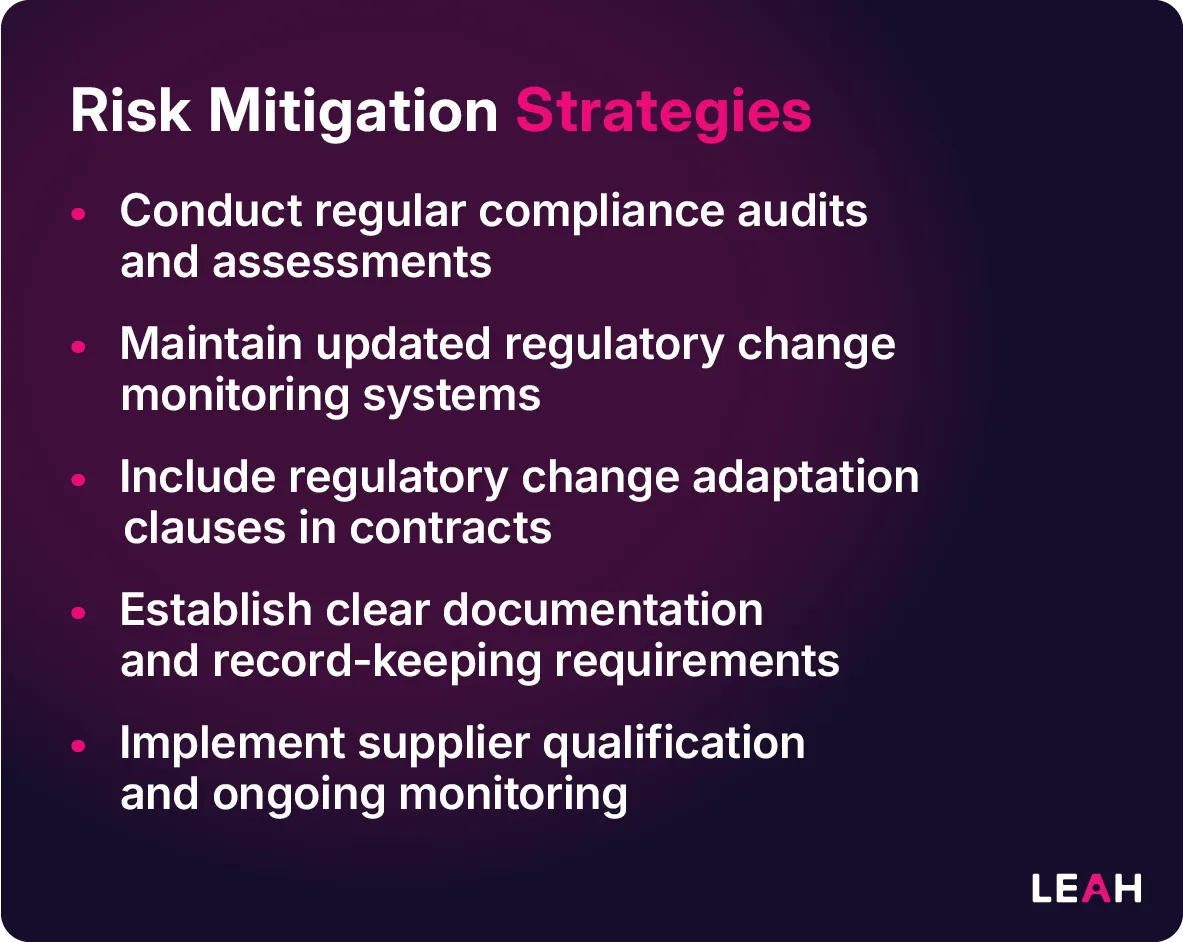
- Conduct regular compliance audits and supplier assessments
- Maintain updated regulatory change monitoring systems
- Include regulatory change adaptation clauses in contracts
- Establish comprehensive documentation and record-keeping requirements
- Implement supplier qualification and ongoing monitoring programs
How Do You Negotiate Manufacturing Contracts Effectively?
Successful manufacturing contract negotiation requires thorough preparation, focus on total cost of ownership rather than unit price alone, and creation of win-win outcomes that build sustainable partnerships. In my experience managing manufacturing relationships across multiple industries, the most successful negotiations balance risk protection with relationship building.
Pre-Negotiation Due Diligence
Before entering negotiations, conduct comprehensive due diligence on the manufacturer's capabilities and reliability. This assessment should include:
Financial stability evaluation: Review financial statements, credit ratings, and payment history to ensure the manufacturer can fulfill long-term obligations without financial disruption.
Production capacity assessment: Verify the manufacturer's ability to meet your volume requirements including surge capacity for seasonal demands, peak periods, or unexpected growth. Visit facilities when possible to assess equipment condition and production efficiency.
Quality certifications review: Examine ISO certifications, industry-specific quality standards, and compliance history. Request customer references and investigate any past quality issues or recalls.
Technical capabilities analysis: Evaluate whether the manufacturer possesses the necessary technical expertise, equipment sophistication, and process controls for your specific product requirements.
Critical Negotiation Points
Total cost of ownership analysis:
Focus on comprehensive costs rather than just unit pricing. Include tooling costs, setup fees, minimum order quantities, volume-based pricing tiers, shipping and logistics costs, quality inspection expenses, and inventory carrying costs.
Quality assurance protocols:
Negotiate detailed quality control procedures including incoming material inspection standards, in-process monitoring checkpoints, final product testing protocols, and statistical process control requirements.
Intellectual property protection:
Establish crystal-clear ownership rights, licensing terms, and confidentiality protections. Include provisions for IP indemnification, unauthorized use penalties, secure data handling protocols, and regular IP compliance audits.
Flexibility in termination:
Negotiate reasonable termination clauses providing exit options without excessive penalties. Include inventory buyback provisions at fair market value, transition assistance for moving production, and reasonable notice periods (typically 30-90 days).
Common Negotiation Mistakes to Avoid
Vague specifications lead to disputes:
Avoid general descriptions that create ambiguity. Provide detailed technical specifications, quality standards with measurable tolerances, performance requirements with specific metrics, and clear acceptance criteria.
Inadequate IP protection:
Don't underestimate the importance of comprehensive intellectual property clauses, especially for proprietary designs, unique processes, or innovative technologies. IP theft can destroy competitive advantages built over years.
Poor payment structures:
Avoid payment terms that create cash flow problems for either party. Balance the manufacturer's financing needs with your risk tolerance, and consider letter of credit arrangements for international transactions.
Insufficient insurance requirements:
Ensure adequate insurance coverage for product liability (typically $2-5 million minimum), errors and omissions, general commercial risks, and cyber liability for digital threats.
Leveraging Technology in Negotiations
AI contract analysis:
Utilize AI-powered tools to analyze proposed contract terms, identify potential risks, benchmark against industry standards, and suggest alternative language. Modern AI systems can analyze thousands of contract clauses in minutes, providing insights that would take legal teams days to develop.
Automated redlining:
Use technology to streamline the redlining process, track negotiation history for future reference, and maintain version control across multiple negotiation rounds.
As someone with over 15 years experience in manufacturing contract management, I've found that successful negotiations focus on creating win-win outcomes rather than extracting maximum concessions. Building strong manufacturer relationships often leads to better pricing, priority treatment during capacity constraints, preferential access to new technologies, and collaborative problem-solving when issues arise.
How Is AI Transforming Manufacturing Contract Management?
AI is revolutionizing contract lifecycle management in 2026 by transforming how agreements are created, analyzed, monitored, and optimized. Large language models (LLMs) trained on legal and industry data can now analyze thousands of clauses in minutes, identifying risks, inconsistencies, and compliance gaps with far greater accuracy than manual review.
AI-Powered Contract Analysis
Advanced AI systems deliver automated clause recommendations, ensuring consistent language across contracts and embedding industry best practices at scale. These systems don't just identify problems—they suggest specific improvements based on jurisdiction-specific regulations, industry standards, and historical dispute data.
Modern contract analysis capabilities include:
- Risk identification: AI models flag potential compliance violations, ambiguous language, missing protections, and unfavorable terms by comparing contracts against databases of litigation outcomes and regulatory requirements
- Clause optimization: Systems recommend alternative language that reduces legal risk, suggest industry-standard provisions, identify opportunities for more favorable terms, and ensure regulatory compliance across multiple jurisdictions
- Benchmark analysis: AI compares your contract terms against industry standards, identifying where your agreements may be more or less favorable than typical market terms—providing leverage in negotiations
Predictive Analytics and Proactive Management
Beyond analysis, predictive models forecast potential delivery delays, supplier risks, or quality problems before they occur. By analyzing historical performance data, supply chain indicators, financial metrics, and external risk factors, AI systems provide early warning of potential issues.
Real-time compliance monitoring: AI tracks evolving regulations across multiple jurisdictions, automatically alerts stakeholders when regulatory changes affect existing contracts, suggests necessary amendments to maintain compliance, and generates compliance reports for audit purposes.
Agentic AI: The Next Evolution
What's driving the transformation is the rise of agentic AI—systems that don't just respond to queries but proactively manage workflows. Integrated into contract lifecycle platforms, agentic AI can initiate redlining based on company policies, monitor supplier performance against contract terms, trigger alerts when commercial or regulatory conditions change, and even draft contract amendments for legal review.
Modern platforms often combine multiple specialized LLMs, each tuned for different tasks:
- Clause interpretation models: Specialized in understanding legal language and extracting key obligations
- Compliance validation models: Trained on regulatory requirements across jurisdictions and industries
- Risk assessment models: Focused on identifying potential contract risks and suggesting mitigation strategies
- Supply chain integration models: Connecting contract terms with operational performance and supplier data
Organizations get specialized intelligence rather than relying on a single generalized model. This multi-model approach delivers more accurate analysis and better recommendations than single-model systems.
Real-World Impact
As AI-powered robotics transform factory floors, AI in contracts ensures these complex manufacturing partnerships are governed with the same level of precision and foresight. According to MarketsandMarkets industry projections, the manufacturing AI market will reach $155 billion by 2030, with contract management representing a significant portion of this growth.
In my experience implementing AI contract systems, organizations typically see:
- 60-70% reduction in contract review time
- 40-50% decrease in compliance violations
- 30-40% improvement in contract negotiation outcomes
- Significant reduction in disputes due to clearer, more consistent contract language
The latest 2026 systems even integrate with supply chain management platforms, providing real-time visibility into supplier performance against contract terms and automatically flagging potential issues before they escalate.
What Industry-Specific Requirements Should You Know?
Different industries have unique regulatory, technical, and operational requirements that must be reflected in manufacturing contracts. Understanding these industry-specific needs is crucial for creating effective agreements that protect your business and ensure compliance.
Electronics Manufacturing
Key Requirements:
- Comprehensive IP protection for proprietary designs, firmware, and technical specifications
- Component sourcing with full traceability and conflict mineral compliance
- IPC standards compliance with rigorous testing protocols
- Secure technology transfer procedures for design files and manufacturing data
Regulatory Considerations:
- ROHS compliance for hazardous substance restrictions
- FCC certification requirements for electromagnetic compatibility
- Export control regulations for advanced technologies particularly important for semiconductors and telecommunications equipment
Pharmaceutical Manufacturing
Key Requirements:
- Current Good Manufacturing Practice (cGMP) compliance with comprehensive documentation
- FDA validation and inspection readiness
- Complete batch record management systems
- Serialization for track-and-trace requirements
- Adverse event reporting procedures
Unique Considerations:
- Technology transfer validation between development and manufacturing
- Clinical trial material handling with chain of custody
- Stability testing requirements
- Ongoing quality monitoring systems
According to FDA guidelines updated in 2024, pharmaceutical manufacturers must maintain robust quality systems with full traceability—making contract language around quality management systems absolutely critical.
Food Manufacturing
Key Requirements:
- Hazard Analysis and Critical Control Points (HACCP) system implementation
- FDA or USDA food safety certifications
- Comprehensive allergen management programs
- Nutritional labeling compliance
- Complete supply chain traceability for rapid recall response
Regulatory focus:
- Preventive Controls for Human Food regulation compliance
- Supplier verification programs,
- Environmental monitoring
- Foreign supplier verification programs for imported ingredients
Automotive Manufacturing
Key Requirements:
- IATF 16949 quality management system certification
- Safety-critical component protocols,
- Comprehensive recall procedures and traceability systems
- Warranty provisions and failure analysis procedures
- Just-in-time delivery requirements
Emerging considerations:
- Electric vehicle component requirements including battery safety standards
- Autonomous vehicle technology standards
- Cybersecurity for connected vehicles
- Environmental compliance for emerging propulsion technologies
Textiles/Apparel Manufacturing
Key Requirements:
- Fair labor standards and workplace safety compliance
- Social responsibility auditing and certification
- Design protection for fashion designs and patterns
- Fabric testing for durability and safety
- Sizing consistency standards
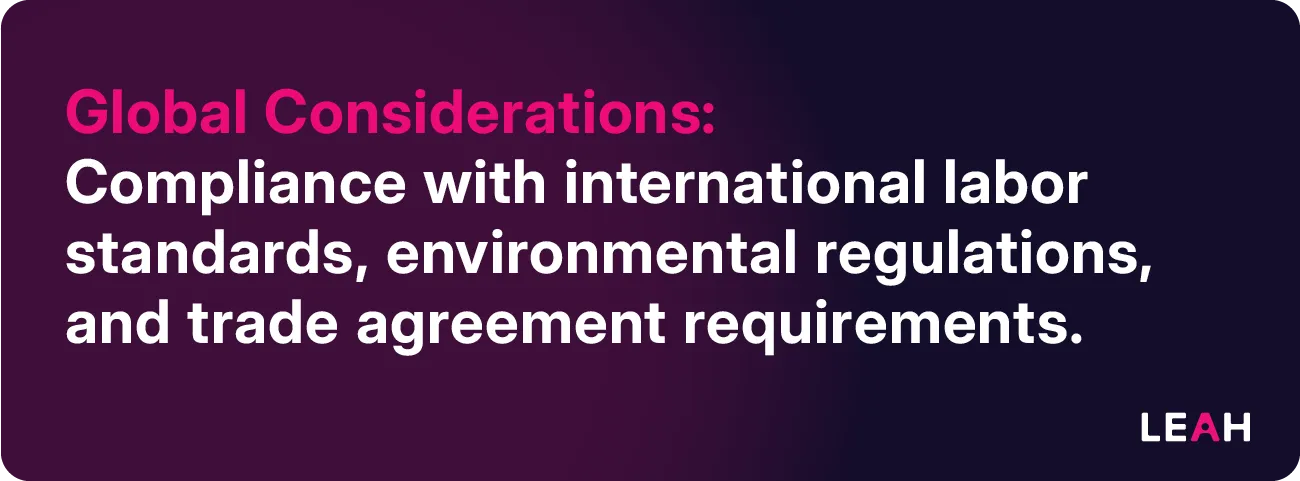
Global considerations:
- Compliance with international labor standards
- Environmental regulations for textile processing and dyeing
- Trade agreement requirements for duty-free treatment
- Brand protection in multiple jurisdictions
What Common Mistakes Do Businesses Make in Manufacturing Contracts?
Understanding common pitfalls prevents costly disputes and operational disruptions. In my 15+ years managing manufacturing relationships, I've observed that the same mistakes recur across industries—and they're almost always preventable with proper contract drafting.
Vague Quality Specifications
The Problem: General statements like "industry standard quality" or "acceptable quality" create ambiguity and disputes over what constitutes acceptable products. This is the single most common source of manufacturing disputes.
Solution: Include detailed technical specifications with measurable tolerances, specific quality metrics with statistical acceptance criteria, documented testing procedures with pass/fail criteria, and clear acceptance and rejection processes. Reference specific industry standards by name and version number.
Inadequate Intellectual Property Protection
The Problem: Failing to clearly define intellectual property ownership, licensing rights, and confidentiality protections leads to IP theft or unauthorized use.
Solution: Comprehensive IP clauses addressing existing IP ownership, jointly developed IP allocation, licensing terms and restrictions, protection mechanisms including secure data handling, IP indemnification provisions, and regular IP compliance audits.
Preventative Measure: Implement secure data sharing protocols and regular IP compliance monitoring.
Poor Termination Clauses
The Problem: Termination clauses that are too restrictive or lack clear procedures create costly obligations or lengthy disputes during contract exit—sometimes forcing companies to continue relationships long after they've become untenable.
Solution: Balanced termination provisions with reasonable notice periods (30-90 days typical), clear termination triggers for both convenience and cause, inventory buyback provisions at fair value, and transition assistance requirements for knowledge transfer.
Best Practice: Include both convenience termination and cause-based termination options with appropriate penalties and procedures.
Insufficient Insurance Requirements
The Problem: Inadequate insurance coverage that doesn't protect against manufacturing-specific risks like product liability, professional indemnity, or business interruption—leaving significant gaps in risk protection.
Solution: Comprehensive insurance requirements including general liability ($2-5M typical), product liability with limits matching product risk profile, professional indemnity for design services, cyber liability for data protection, and additional insured provisions protecting your organization.
Risk Mitigation: Regular insurance reviews and certificate monitoring to ensure continuous coverage.
Overlooking Regulatory Compliance
The Problem: Failing to address industry-specific regulations, changing compliance requirements, or international regulatory differences—exposing both parties to regulatory penalties and operational disruptions.
Solution: Include comprehensive compliance clauses specifying applicable regulations, regulatory change procedures for adapting to new requirements, regular compliance audit rights, and address jurisdiction-specific requirements for international manufacturing.
Monitoring System: Implement regulatory change tracking and automatic contract update procedures.
Weak Dispute Resolution Mechanisms
The Problem: Litigation-focused dispute resolution creates adversarial relationships and expensive legal proceedings that damage business partnerships—even when disputes are eventually resolved.
Solution: Multi-tier dispute resolution starting with direct negotiation between executives, followed by mediation with a neutral third party, then arbitration if necessary, plus clear escalation procedures and relationship preservation mechanisms.
Strategic Approach: Focus on maintaining business relationships while protecting legal rights.
Ignoring Force Majeure Considerations
The Problem: Outdated force majeure clauses that don't address modern risks like cyber attacks, pandemic disruptions, or supply chain failures. When COVID-19 hit, many contracts lacked pandemic language, leading to widespread litigation.
Solution: Comprehensive force majeure provisions including cyber incidents, public health emergencies, supply chain disruptions, extreme weather events, notification procedures (48-72 hours typical), mitigation obligations, and risk-sharing mechanisms for extended disruptions.
What Templates and Resources Can Help?
Creating effective manufacturing contracts requires access to proper templates, resources, and expert guidance. While templates provide useful starting points, they must be customized for your specific industry, jurisdiction, and business relationships.
AI-Powered Contract Templates
Leah provides intelligent contract templates that automatically adjust based on your industry, contract type, and risk preferences. These templates incorporate industry best practices and regulatory requirements specific to your business needs, significantly reducing drafting time while improving contract quality.
Key template features:
- Industry-specific clause libraries with proven language
- Automatic compliance requirement insertion based on jurisdiction and industry
- Risk-adjusted terms based on contract value and relationship type
- Built-in quality checks identifying missing protections or ambiguous language
Contract Analysis Tools
Advanced AI analysis capabilities review existing contracts, identify gaps or risks, and suggest improvements based on industry benchmarks and legal best practices. These tools can process hundreds of contracts quickly, providing comprehensive risk assessments across your contract portfolio.
Automated compliance monitoring: Real-time monitoring of regulatory changes with automatic alerts when contract updates may be required to maintain compliance—particularly valuable for companies operating across multiple jurisdictions.
When to Engage Legal Counsel
Engage experienced legal counsel for:
- High-value contracts or complex manufacturing relationships (typically $1M+ annually)
- International manufacturing arrangements involving multiple jurisdictions
- Highly regulated industries including pharmaceuticals, aerospace, and automotive
- Contracts involving significant IP or proprietary technology
- First-time manufacturing partnerships in new industries or markets
Legal review process: Establish procedures balancing thoroughness with efficiency, including template pre-approval for standard terms and fast-track review for time-sensitive agreements.
Industry Association Resources
Manufacturing-specific organizations like the National Association of Manufacturers (NAM), industry trade associations, and chamber of commerce groups often provide contract guidance, template resources, and best practice recommendations tailored to specific manufacturing sectors.
What's Changing in Manufacturing Contracts in 2026?
Manufacturing contracts in 2026 are evolving rapidly to reflect new business realities and emerging risks. Based on current industry trends and my experience working with manufacturers globally, several key shifts are reshaping how contracts are structured.
Sustainability and ESG Integration
Sustainability has become central, with ESG-focused clauses now embedded directly into agreements to address carbon accountability and ethical sourcing. Companies face increasing regulatory and market pressure to include specific ESG performance clauses, reflecting growing demand for environmental responsibility.
Key ESG provisions include:
- Carbon footprint reporting requirements
- Sustainable material sourcing standards
- Waste reduction targets with measurable metrics
- Supplier diversity goals
- Social responsibility auditing procedures
AI-Driven Contract Intelligence
AI-driven tools monitor compliance and assess supplier risks in real-time, giving organizations far greater visibility into their global supply chains. Modern systems analyze supplier performance data, financial stability indicators, geopolitical risks, and regulatory changes—providing early warning of potential issues.
The shift from reactive to proactive management represents a fundamental change in how contracts function—from static legal documents to dynamic management tools.
Dynamic Pricing Provisions
Volatility in tariffs and raw material costs has led to adoption of dynamic pricing provisions, ensuring contracts can adapt to market fluctuations without constant renegotiation. These mechanisms include material cost pass-through formulas, tariff adjustment clauses, currency hedging provisions, and periodic price review procedures.
Recent events underscore this need:
- Supply chain disruptions have caused significant price volatility
- Material volatility clauses are no longer optional but essential for managing commodity price risks
Reshoring and Nearshoring Strategies
Reshoring and nearshoring strategies are reshaping supply chain contracts to reduce dependency on distant manufacturing hubs and improve resilience. Contracts now include provisions for regional manufacturing networks, diversified supplier bases, and rapid production shifting capabilities.
Geographic diversification clauses: Many contracts now include provisions allowing production shifts between facilities in different regions to manage geopolitical risks and optimize logistics costs.
Enhanced Cybersecurity Requirements
Cybersecurity clauses have evolved from basic data protection to comprehensive cyber resilience frameworks. Modern contracts require security certifications, incident response procedures with strict timelines, cyber insurance requirements, and regular penetration testing.
According to latest industry reports, cyber incidents now rank among the top risks in manufacturing supply chains—making robust cybersecurity provisions essential in every manufacturing contract.
Regulatory Adaptation Mechanisms
Contracts now include automatic adaptation mechanisms for regulatory changes, particularly for evolving ESG requirements, data protection laws, and trade regulations. These provisions specify procedures for updating terms when regulations change, avoiding the need for formal amendments for every regulatory shift.
The manufacturing landscape of 2026 demands contracts that are flexible, intelligent, and resilient—supporting not just legal compliance but strategic business objectives in an increasingly volatile global environment.
Frequently Asked Questions
What exactly is a manufacturing contract?
A manufacturing contract is a legally binding agreement between a business and a manufacturer that defines how goods will be produced, covering product specifications, quality standards, pricing, delivery schedules, intellectual property rights, and compliance obligations. Unlike simple purchase orders, these contracts serve as comprehensive frameworks for managing production relationships and allocating risks.
Why are manufacturing contracts more important in 2026?
Manufacturing contracts have evolved from legal formalities into strategic risk management tools. With increasing supply chain disruptions, tariff volatility, ESG reporting requirements, and cybersecurity concerns, manufacturers need contracts providing clarity, flexibility, and resilience. McKinsey reports that 90% of supply chain professionals faced resilience challenges in 2024, making robust contracts essential. Additionally, AI-powered contract lifecycle management is reshaping how businesses create, monitor, and enforce agreements.
What are the most common types of manufacturing contracts?
The 17 most common types include Contract Manufacturing Agreements, OEM and ODM agreements, Private Label and White Label agreements, Supply Chain agreements, Turnkey Manufacturing agreements, and industry-specific contracts for pharmaceuticals, textiles, food, automotive, and electronics. Each type addresses different needs from outsourcing production to ensuring compliance in regulated sectors to protecting brand exclusivity.
What key clauses should every manufacturing contract include?
At minimum, contracts must address: Intellectual property rights, confidentiality/NDA protections, quality control and product specifications, payment terms and pricing mechanisms, delivery and performance standards, termination and renewal procedures, force majeure and risk allocation, indemnification and liability caps, compliance and regulatory obligations, and dispute resolution mechanisms. Research shows that contracts lacking these protections have led to costly recalls, IP theft, and litigation.
What are the biggest mistakes companies make in manufacturing contracts?
Common pitfalls include: Vague product specifications leading to quality disputes, inadequate IP protection enabling theft, restrictive termination clauses creating exit barriers, insufficient insurance requirements exposing financial risks, weak compliance coverage risking regulatory penalties, outdated force majeure clauses failing to address modern risks, and poorly structured payment terms causing cash flow problems. Each of these issues has historically led to costly disputes or business interruptions.
How is AI transforming manufacturing contract management?
AI tools including multiple specialized large language models (LLMs) and emerging agentic AI systems now analyze thousands of clauses in minutes, spotting risks, benchmarking against industry standards, and drafting recommendations. Beyond review, AI proactively redlines contracts, triggers alerts for regulatory changes, forecasts supplier performance risks, and monitors compliance in real-time. This shift makes contracts more adaptive, consistent, and resilient while reducing manual review time by 60-70%.
What legal and compliance risks should manufacturers watch for in 2026?
Critical areas include: Trade compliance (import/export controls, tariffs, trade agreements), industry-specific regulations (FDA for pharma, IATF 16949 for automotive, HACCP for food, CE marking for EU), emerging requirements (ESG reporting, AI governance, cybersecurity clauses), labor and environmental laws (ethical sourcing, worker safety, waste reduction), and anti-corruption rules (bribery prevention, conflict minerals, transparency codes).
How should businesses approach contract negotiations?
Effective negotiation starts with due diligence—understanding manufacturer's capacity, compliance history, and financial stability. Focus on total cost of ownership rather than unit price, establish detailed quality assurance processes, secure comprehensive IP protections, negotiate balanced termination clauses, and require robust insurance coverage. Using AI tools during negotiation helps flag risks, speed redlining, and ensure compliance. The goal is creating win-win outcomes that build sustainable partnerships.
Are templates useful for manufacturing contracts?
Yes, but only as starting points. Generic templates often miss industry-specific requirements or jurisdictional nuances. Best practice uses AI-powered smart templates, like those from Leah, that adjust to your industry, risk profile, and compliance obligations. Final drafts should always undergo legal review, especially for high-value contracts ($1M+ annually), international manufacturing relationships, or agreements in highly regulated industries.
1What's new in manufacturing contracts in 2026?
Key trends reshaping manufacturing contracts include:
- ESG and sustainability metrics embedded in standard provisions
- AI-driven monitoring of compliance and supplier risks
- Dynamic pricing clauses handling tariff and raw material volatility
- Reshoring and nearshoring provisions reflected in supply chain agreements
- Expanded force majeure definitions covering cyber incidents, pandemics, and logistics crises
- Comprehensive cybersecurity requirements addressing digital threats
Well-crafted manufacturing contracts are strategic business tools, not merely legal necessities. By combining robust contract drafting with AI-powered CLM solutions like Leah, organizations reduce risk, accelerate performance, and strengthen supplier relationships in 2026's complex manufacturing landscape.
Ready to optimize your manufacturing contracts? Request a demo to see how Leah’s AI-powered platform can transform your contract management process.