
TL;DR
- Leah Agentic CLM and Sirion both deliver AI-powered contract lifecycle management, but they serve different organizational needs.
- Sirion excels in deep post-signature obligation tracking, risk scoring, and global contract digitization, best suited for large enterprises with high CLM maturity, dedicated resources, and tolerance for complex, partner-led implementations.
- Leah Agentic CLM prioritizes faster time to value, intuitive cognitive search, self-service configuration, and broad usability across legal, procurement, and sales teams.
- Organizations choose Leah when they want rapid implementation, lower vendor dependency, flexible growth across maturity levels, and strong search and analytics for everyday users.
- The decision comes down to priorities: deep customization with higher overhead (Sirion) versus accessible AI, speed, and long-term agility (Leah).
When evaluating contract lifecycle management (CLM) solutions, organizations often find themselves comparing industry leaders to find the best fit for their needs. Two solutions that frequently appear in enterprise shortlists are Leah Agentic CLM (formerly ContractPodAi) and Sirion. While both offer robust AI-powered contract management capabilities, they take distinctly different approaches to implementation, usability, and customer success.
Understanding Sirion's Position in the Market
Founded in 2012 with headquarters in the U.S. and India, Sirion serves approximately 400 enterprise customers across banking, communications, media, and healthcare sectors.
The platform's user base is notably diverse, with procurement teams representing 41% of users, legal teams at 29%, sales at 20%, and other functions making up the remaining 10%. This distribution reflects Sirion's positioning as an enterprise-wide contract management solution rather than a tool limited to a single department.
Where Sirion Excels
Sirion has built its reputation on several key strengths:
AI-Powered Obligation Management: The solution offers real-time tracking of contractual obligations and service levels, with automated risk registers and predictive warnings that help organizations stay ahead of potential issues.
Risk Management Integration: Risk assessment is deeply embedded throughout Sirion's solution. For every risk identified, the system assigns scores and provides detailed explanations for recommended redlines, giving teams clear rationale for suggested changes.
Contract Digitization: Sirion handles contract digitization exceptionally well, supporting nine languages including Asian characters. The platform natively extracts 50 metadata fields, including obligations and regulatory language, making it powerful for global organizations with complex requirements.
Innovation Leadership: Sirion has invested heavily in AI capabilities, offering conversational search, AI auto-redline features, and support for multiple LLM models. The solution breaks down clauses into granular risk issues, providing detailed analysis.
These strengths have established Sirion as a leading provider in the market and a strong customer base.
Where Organizations Encounter Challenges with Sirion
Despite its capabilities, Sirion presents challenges that can impact adoption and long-term success:
Implementation Complexity
While Sirion's high degree of customization offers flexibility to meet specific business needs, it comes at a significant cost. Implementations are resource-intensive and require substantial planning and change management, particularly for organizations with specialized requirements. The predominantly partner-led deployment model introduces additional coordination overhead and potential timeline delays.
Limited Self-Service Capabilities
Organizations have reported frustration with Sirion's limited options for dashboard configuration, report customization, and template design. Complex customizations often require vendor involvement, creating dependencies that slow down operations and increase costs.
User Experience Concerns
Several users have described Sirion's interface as "click-heavy," requiring multiple steps to complete common tasks. Combined with data quality issues and slow ramp-up times, this can hinder adoption, especially among occasional users or teams with less technical expertise.
Search Functionality
Despite Sirion's powerful features, the search functionality has been criticized as less intuitive for non-technical users. In an era where Google-like search is the expectation, this limitation can frustrate users and reduce platform utilization.
Leadership Changes
Multiple C-level executive changes in the past year have raised questions about strategic direction and long-term viability, a concern for organizations making significant technology investments.
Tailored for High-Maturity Organizations
Sirion's configurability benefits organizations with advanced contract management processes and dedicated resources. However, this focus can make the solution less accessible for mid-market organizations or those earlier in their CLM maturity journey.
How Leah Agentic CLM Delivers Differentiated Value
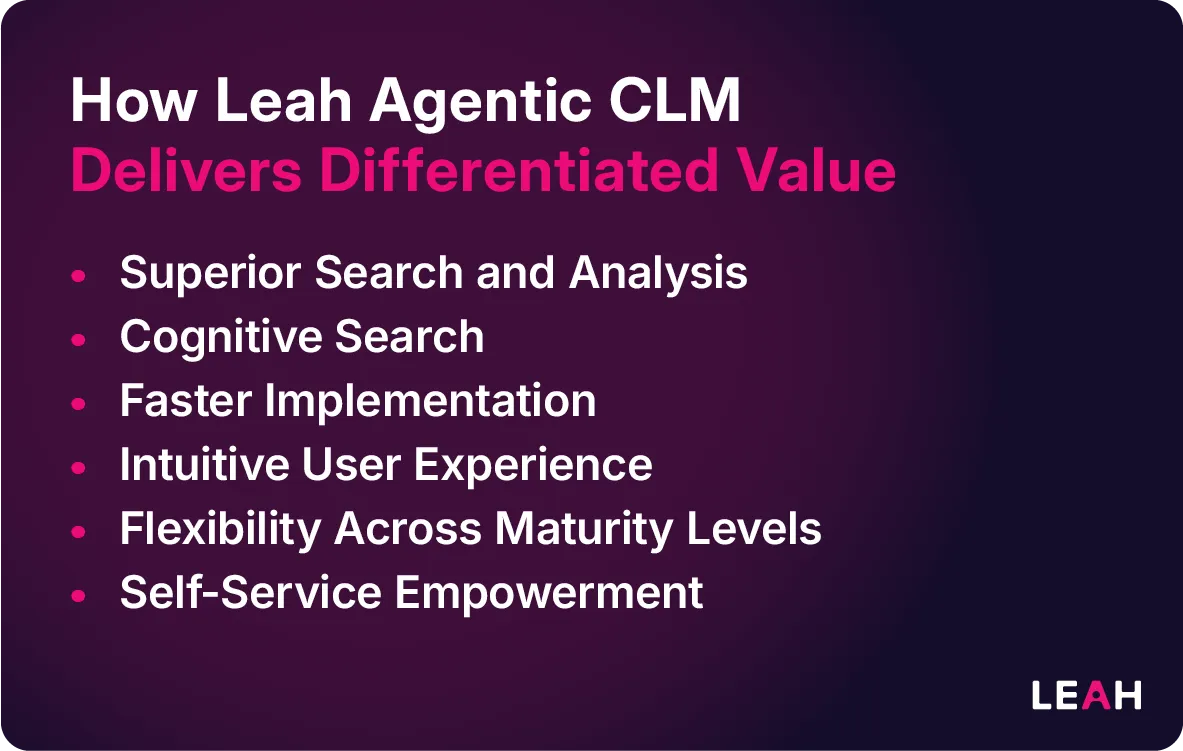
Leah Agentic CLM takes a different approach, balancing advanced AI capabilities, Contract Creation, Contract Review, and Ask Leah (an ad-hoc question-and-answer feature), with accessibility and rapid time to value.
Superior Search and Analysis
Leah gives users dynamic reporting and data-driven insights through powerful search capabilities and analytics. Looking ahead, Leah will enable users to configure and build their own custom dashboards, empowering legal and business teams to visualize the metrics that matter most to them, analyze performance in real-time, and make data-driven decisions that reduce risk and improve contract management processes.
Cognitive Search
Cognitive Search is Leah’s advanced search tool that harnesses the power of AI to help users search within documents and metadata easily and effectively. The tool enables users to locate key legal information faster, leverage advanced query options, and even perform bulk updates or approvals across multiple records - significantly improving productivity and control.
Faster Implementation
Unlike Sirion's resource-heavy deployments, Leah offers rapid implementation timelines that reduce time to value. Organizations can begin realizing benefits sooner without the extensive change management overhead.
Intuitive User Experience
Leah's interface is designed for ease of use and rapid adoption. Rather than requiring multiple clicks to complete common tasks, the platform streamlines workflows to match how legal, procurement, and sales teams actually work.
Flexibility Across Maturity Levels
While Leah delivers advanced AI automation comparable to any solution on the market, it remains accessible to organizations at various stages of CLM maturity. Mid-market companies can start simply and expand capabilities as their processes evolve, while enterprises can leverage sophisticated features from day one.
Self-Service Empowerment
You're not just selling software - you're selling self-sufficiency. Sirion's model creates perpetual dependency, while Leah enables independence. This matters because contract management needs evolve constantly and waiting on vendors (or paying partners) for every change kills agility and inflates costs.
Real-World Success Stories
The practical differences between these platforms become clear in competitive situations:
Global Athletic Apparel Brand
A major global athletic apparel company evaluated multiple CLM solutions including Sirion. They selected Leah for its ability to deliver AI-driven contract management that reduced manual work and centralized contract data. The platform's clause-level risk analysis and seamless integration with their ERP, e-signature, and productivity tools met their strict compliance and efficiency requirements.
Leading Australian University
A prominent Australian research university conducted a thorough evaluation against Sirion and other enterprise CLM vendors. They chose Leah for its ability to improve efficiency, reduce contract risk, and streamline management. They adopted Legal Intake, CLM, and Leah CLM initially, with plans to expand into helpdesk and spend management as their needs evolved.
Making the Right Choice for Your Organization
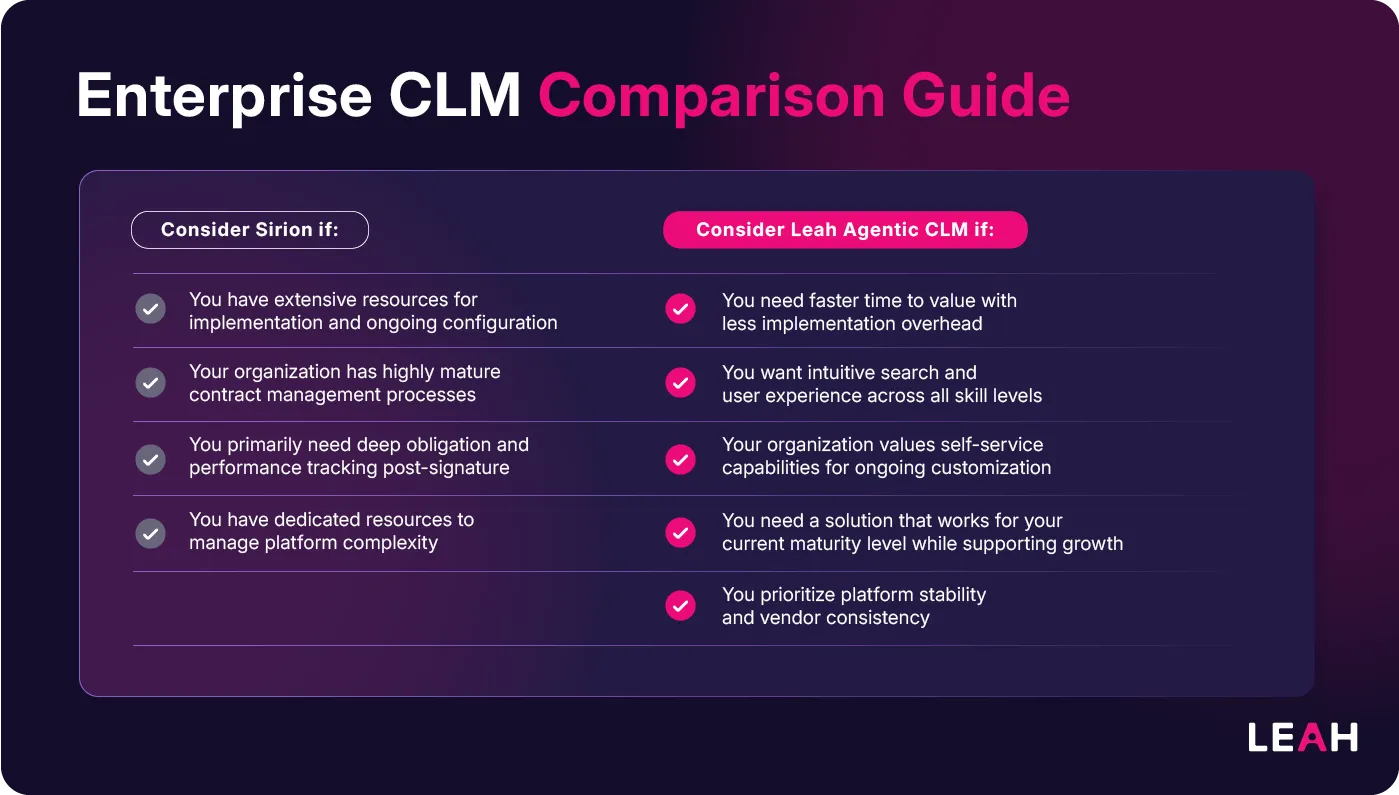
Both Sirion and Leah Agentic CLM offer powerful contract management capabilities, but they suit different organizational profiles:
Consider Sirion if:
- You have extensive resources for implementation and ongoing configuration
- Your organization has highly mature contract management processes
- You primarily need deep obligation and performance tracking post-signature
- You have dedicated resources to manage platform complexity
Consider Leah Agentic CLM if:
- You need faster time to value with less implementation overhead
- You want intuitive search and user experience across all skill levels
- Your organization values self-service capabilities for ongoing customization
- You need a solution that works for your current maturity level while supporting growth
- You prioritize platform stability and vendor consistency
Key Questions to Ask During Evaluation
When comparing these platforms, consider asking:
- How long does typical implementation take, and what resources are required from our team?
- What self-service capabilities exist for configuration, reports, dashboards, and templates?
- How intuitive is search for non-technical users?
- What level of vendor dependency exists for ongoing customization?
- How does the platform support organizations at different CLM maturity levels?
- What is the vendor's leadership stability and strategic direction?
In Summary
The choice between Leah Agentic CLM and Sirion ultimately depends on your organization's priorities, resources, and maturity level. While Sirion offers deep configurability and robust obligation management for resource-rich enterprises, Leah delivers the balance of advanced AI capabilities with accessibility, rapid implementation, and self-service flexibility that organizations increasingly demand.
For organizations seeking to modernize contract management without the complexity and resource demands of traditional enterprise software, Leah Agentic CLM offers a compelling path forward. The solution's proven success with major global brands and leading institutions demonstrates that you don't need to sacrifice power for usability or choose between innovation and accessibility.
The contract management landscape continues to evolve rapidly. Choosing a partner with stable leadership, customer-centric design, and flexible deployment models positions your organization for long-term success in an increasingly complex regulatory and business environment.