
Published: November 28, 2019
Updated: August 7, 2024
In this digital age, the importance of contract management cannot be overstated. After all, contracts are the bedrock of most business transactions and serve as a wealth of information about a business enterprise's overall health. This article will provide a comprehensive guide on essential contract manager skills.
Contract management involves the creation, administration, and oversight of contracts. It encompasses vigilant monitoring of the contract lifecycle to ensure compliance with the terms and conditions. The primary objective of contract management is to optimize operational and financial performance while serving as a powerful risk mitigation tool.
According to McKinsey and Company, most industries have a substantial majority of their spending locked in contracts. Utilities, food manufacturing, aerospace, and defense can have 90% or more of their annual revenues in contracts with suppliers and vendors.
Effective contract management has a distinct impact on organizational success. Examples of the importance include:
- Compliance–Monitoring the conditions and adhering to the terms of a contract reduces the risks of penalties, legal issues, and damage to the organization's reputation.
- Collaboration is crucial to resolving conflicts and maintaining healthy, long-term client and vendor relationships.
- Cost-savings–businesses save money by investing less time and legal resources in the contracting process, which can maximize contract renewal opportunities.
By increasing the efficiency of the contracting process, businesses can see increased financial performance and improved cash flow. Contract managers are a crucial part of improving the contracting process.
Contract managers (CMs) oversee the process of managing the creation, execution, and analysis of contracts to amplify operational and financial performance while reducing risks. A CM handles the entire lifecycle of a contract, which includes:
- Initial Request
- Authoring of a Contract
- Negotiation and Approval
- Execution
- Ongoing Management of Terms and Conditions
- Contract Analysis
Common CM Job Titles
Just as contract managers must effectively wear many hats, they also go by many names. Indeed lists CM-related job titles as:
- Senior contract manager: Typically requires a Bachelor’s degree and five or more years of experience in contract management, along with experience in the enterprise's specific field.
- Contract administration manager: A contract administrator position typically seeks someone with extensive experience in contract management and monitoring and industry-specific expertise. A contract administration manager is directly involved with the planning stage of the contract lifecycle.
- Contract specialist: most contract specialist positions require a bachelor’s degree and direct industry experience. The job typically entails negotiating, drafting, reviewing contracts, and ensuring they comply with industry regulations.
- Contract review specialist: a more entry-level position requiring attention to detail, familiarity with contract management software, and interfacing with multiple departments.
Typical Responsibilities of a CM
Contract managers oversee the entire lifecycle of contracts, from creation to any analysis of the final results. CMs ensure that contracts adhere to legal and industry requirements and remain aligned with company objectives. Additionally, they are often responsible for:
- Negotiation of terms
- Compliance monitoring
- Contract administration
- Resolution of internal and external issues
- Risk mitigation
- Agreement close-outs, terminations, renewals, adjustments and extensions
CMs generally assume responsibility for communicating agreements to all parties and extrapolating data from contracts to help further business goals.
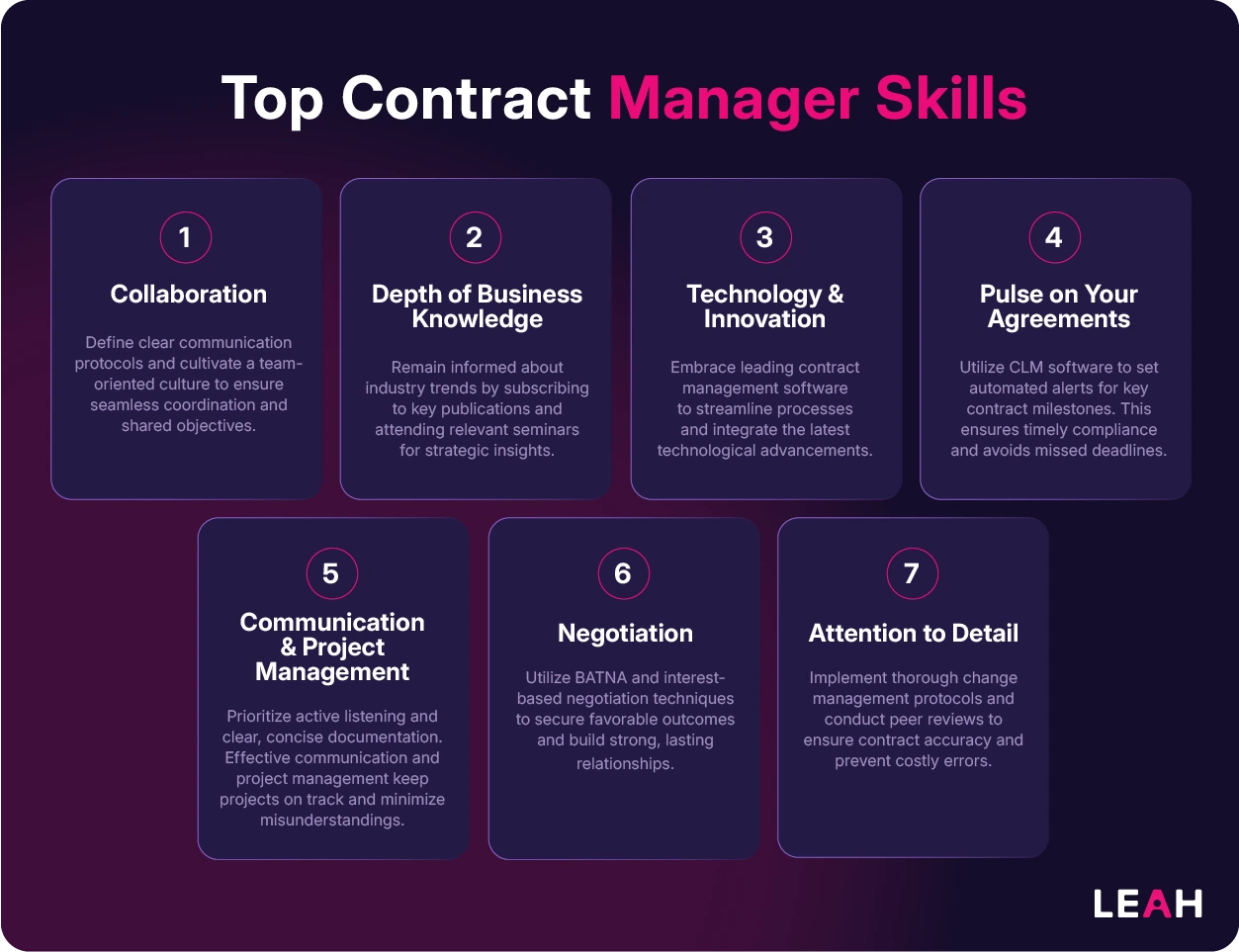
Top Contract Management Skills
Today’s corporations average over 500 contracts per month. In the digital age, effective contract management is increasingly important. Having the right tools for AI-powered contract lifecycle management is crucial to remain competitive, and in many organizations, a contract manager (CM) is necessary to keep the contract process flowing smoothly.
In this comprehensive guide to contract manager skills, we’ll explore the seven essential skills a contract manager needs. Each skill is vital for effectively managing the contract lifecycle, mitigating risks, and ensuring successful outcomes for all involved parties.
1. Collaboration
Collaboration is at the top of the list because contract managers should be superstar team players with excellent negotiation abilities combined with strong communication and interpersonal skills.
Contract or agreement managers work with a wide array of groups and individuals, both within and outside of an organization. Contracts touch all areas of business, and effective communication and collaboration are crucial to fostering internal communication and building relationships with external contacts.
CMs often work with subject matter experts to understand specific details and ensure that the contract contains all key details and remains sharply focused on the subject matter.
2. Depth of Business Knowledge
A skilled contract manager will have in-depth knowledge of their organization’s business and a broad contact base within the organization so they know who to call for functional or area expertise. To effectively keep their finger on the pulse of the organization, an effective CM will:
- Have outstanding interpersonal skills to foster strong work relationships
- Invest time in networking
- Spend time understanding current events that impact the business
CMs also need a deep understanding of contract law and utilize continuing education (CE) or professional development (PD) courses to remain up to date on relevant changes in contract law and legal terminology. CE courses typically refer to learning opportunities offered by higher education institutions, while professional development encompasses skill enhancement and career growth opportunities such as workshops, conferences, and certifications.
In addition, CMs should acquire and maintain:
- Financial acumen, including budget considerations, cost management, and overall financial analysis.
- Sharp risk management skills and issues relating to noncompliance, allowing them to identify and mitigate risks associated with contracts and agreements.
- The ability to build and maintain strong relationships with co-workers, clients, vendors, and stakeholders.
- Understanding industry trends and best practices fosters on-point industry awareness. Contract managers can maintain this awareness by subscribing to relevant publications and newsletters and attending seminars and conferences.
3. Technology and Innovation
In the not-too-distant past, contracts were stored in paper format in filing cabinets and tracked with manual spreadsheets. New technologies, such as contract lifecycle management (CLM) tools, have been a game changer.
These tools have made contract management far more efficient. CMs must understand the full scope of tools available on the CLM platform used by their organization. They should also remain abreast of emerging technologies and have an innovation mindset. The openness to new technology can improve speed, and the quality of a company’s agreements while reducing the amount of time spent on contract review.
Let’s explore some of the top contract management software.
- Leah is an AI-powered CLM that automates routine tasks and processes and acts as a proactive risk mitigation tool by ensuring compliance across the entire lifecycle of the contract.
- Icertis is known for its supercharged contract intelligence across the legal, procurement, finance, and sales enterprises. Its AI design turns contracts into actionable insights.
- Ironclad is a CLM option that provides an easy-to-use interface with good user support and a simple design.
Whatever CLM your organization uses, a CM’s role is to ensure that it’s used effectively by all involved parties.
4. Pulse on Your Agreements
Having a pulse on your agreements is a crucial skill. It’s not about knowing every detail of each contract but rather an understanding of the overall goals and how existing contracts are helping to meet those goals. Keeping a pulse on agreements is crucial for mitigating risks. For example, analytics provided by CLM software can give you insights into contract data such as averages, norms, peculiarities, and outliers. Implementing this information can help improve the consistency of contracts and agreements over time.
An effective CLM tool will also track regulatory and governance issues and monitor contracts for compliance. Skilled CMs will craft ways to implement this information to address issues before they arise.
5. Communication and Project Management
Effective communication strategies are crucial in the CM role. Some tools and skills for communication in contract management include:
- Keeping an ongoing dialogue with key decision-makers. Yes, these people are often busy, and finding time to touch base may be difficult. Implement a strategy, such as email strings or other inter-office messaging, to apprise them of any changes and updates.
- Advocate for a presence and voice in meetings, especially those surrounding contract negotiation, strategy, and planning meetings.
- Learn conflict resolution techniques. As a CM, you can expect occasional conflict to arise, no matter how strong your interpersonal skills.
- Practice active listening skills, such as using the proper body language, summarizing what was said, and asking relevant follow-up questions.
Utilize a project management methodology that works for you to track communication and the entire cycle of project management. Examples include:
- KanBan method, which uses a visual project management method, works well for those who are in favor of visual learning.
- Critical Path Method (CPM) allows users to identify and schedule critical tasks for project completion. It is an excellent tool for resource management and to identify and avoid bottlenecks.
- Six Sigma dates back to 1980, but it is still an effective set of techniques and tools for process improvements.
It can often take experimentation to find the right methodology for you, and as technology continues to grow at the speed of light–new tools hit the market frequently. Remain flexible in finding the best methodology for you and your team.
6. Negotiation
Negotiation skills are critical for a contract manager who will be called on to participate in negotiating with various stakeholders, such as vendors, clients, or internal teams. The most crucial step in effective negotiating is identifying each party’s needs and interests. Then, find common ground and strive to create win-win solutions.
Clear communication is essential as negotiations are a high-stakes environment for misunderstandings. Be prepared for objections and conflicts that may arise and have contingencies in place for tweaks and adjustments that will need to take place to reach a favorable agreement. Utilize flexibility and pre-plan alternatives when possible to strengthen your position in negotiations.
The good news is that even the most skilled negotiators can continue to hone and improve their skills through practice, feedback and studying the best practices and techniques used by others. Each negotiation should be a learning experience where you walk away better prepared for the next negotiation.
7. Attention to Detail
While CLMs are powerful tools that take much of the tedious work out of contract creation and management, details still matter and no CLM is foolproof. The focus on details may be one of the most important skills for a CM.
Common pitfalls in contract management include:
- Inadequate risk assessment–remember that risk assessment is not a singular endeavor. Collect input from all involved parties and implement risk identification systems.
- Poorly defined terms and conditions–identify and do away with vague and ambiguous language. Thoroughly evaluate them to ensure there are no gaps or missing information.
- Inadequate record-keeping and documentation–CLM software is an invaluable tool, but only if it’s given adequate updates and information. Consider a system of checks and balances to make sure that record-keeping is implemented at every level.
- Failure to adapt to regulatory or policy changes–remaining abreast of regulatory and policy changes is an important facet of a CM’s job. Look for tools or resources that will search, identify and alert you to any upcoming changes.
To ensure effective and efficient contract management, contract managers proactively identify and address these pitfalls.
Resources to help improve attention to detail can include creating a system for tracking details, customizing your CLM software to send alerts, or investing in continuing education through conferences and classes offered through the World Commerce and Contracting (WCC).
Elevating Contract Management Through Skill Development
Effective contract management is crucial in today’s digital age, with the rapidly increasing number of contracts handled by organizations. Contract managers need to possess a diverse set of skills, including collaboration and top-tier communication abilities, in-depth business knowledge and a proficiency in utilizing technology and innovation. Perhaps most importantly, they must maintain an unwavering attention to detail.
By improving these essential skills, CMs can ensure successful outcomes for all involved parties. By investing in ongoing skill development through forums, CEs, presentations, and online learning opportunities, companies foster excellence in their CMs.
Leah offers an end-to-end contract lifecycle management that streamlines the contracting process. For more information on getting started with your contract management journey, please visit our Fundamentals of Contract Management Guide.