
Key Takeaways
- Nearly 50% of CLM implementations fall short of expectations (Gartner). The problem is structural, not a fluke.
- The three most common failure drivers are overcustomization, poor user adoption, and misalignment between the team that chose the platform and the team that must use it.
- Adding AI to a legacy CLM architecture does not fix the underlying design problem. The platform structure needs to be different.
- Adoption is the only metric that matters. A platform that users abandon delivers zero ROI regardless of its feature list.
- Modern agentic CLM platforms offer configurable workflows, pre-built agents, and no-code customization, eliminating the vendor dependency that caused many first-generation failures.
- A 4-6 week proof of concept, scoped to one workflow and one team, is the lowest-risk path back to CLM confidence.
- Security certification (SOC 2 Type II, HIPAA BAAs, GDPR, annual pen testing) is table stakes for enterprise CLM in 2025.
- Real enterprise results exist: Terumo cut contract processing from weeks to days; LogicMonitor gained 4,558 hours in productivity and $100K in estimated monthly ROI.
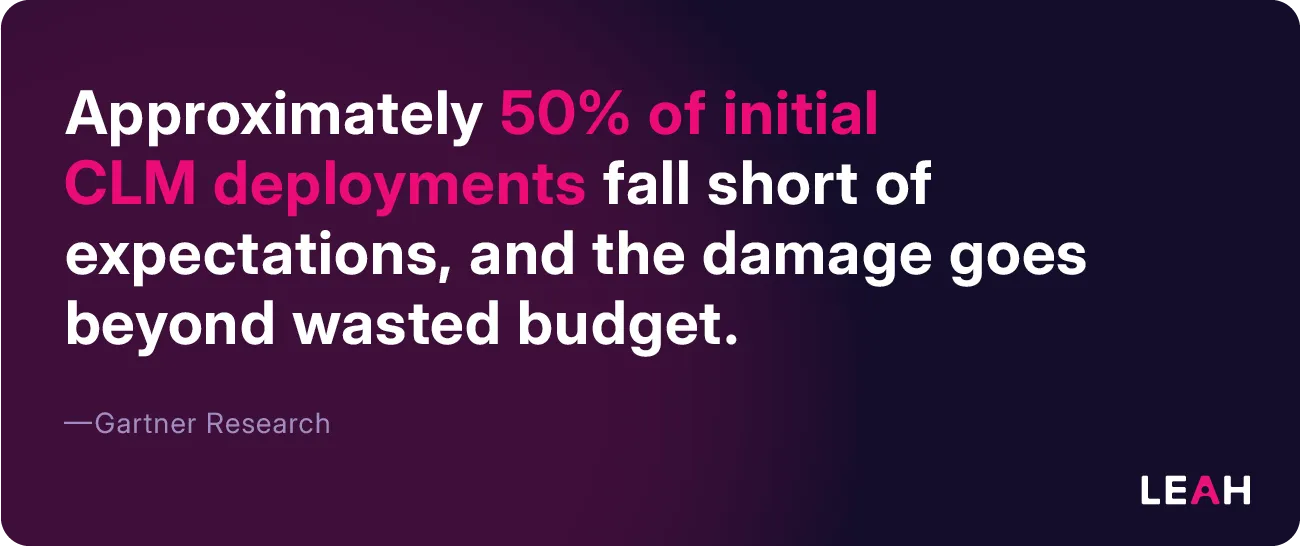
CLM implementations fail nearly half the time. According to Gartner, approximately 50% of initial contract lifecycle management deployments fall short of expectations, and the damage goes beyond wasted budget. Teams that have been burned once carry institutional skepticism into every subsequent evaluation, often defaulting to spreadsheets and email rather than risking another failed rollout. If your organization is in that position, this guide is written for you.
The goal is not to convince you that CLM works in theory. You already know the value proposition. The goal is to show you where implementations break, what has genuinely changed in platform architecture, and how a structured proof of concept gives your team a way back to confidence without another multi-year commitment.
Why CLM Implementations Fail and Why It Keeps Happening
The most cited failure statistic in CLM comes from Gartner, which predicts that nearly 50% of initial CLM implementations will fall short of expectations.
These numbers describe a pattern, not an anomaly. The root causes cluster into four categories.
Over-customization. First-generation CLM platforms were sold as highly configurable, but configuration in practice meant custom code. Every new workflow, every approval branch, every template modification required a vendor statement of work. Organizations that experienced this described it plainly: a simple workflow change took months and a vendor ticket to execute. When business processes evolved faster than the platform could adapt, teams abandoned the system and reverted to what they could control.
Poor user experience. Enterprise software that is difficult to use does not get used. Legal teams that face clunky interfaces, excessive clicks to complete common tasks, or a system that requires training to navigate basic functions will route around the tool entirely. A CLM that lives inside a browser tab no one opens is a filing cabinet, not a platform. Adoption requires that the system fits into how people actually work, not the reverse.
No change management. Technology implementations fail when they are treated as IT projects rather than organizational changes. Successful CLM adoption requires stakeholder alignment, role-specific training, clear communication about process changes, and ongoing support past go-live. Research across CLM implementations consistently identifies the absence of structured change management as a primary contributor to abandonment.
Misalignment between the selector and the user. One of the most damaging patterns in CLM procurement is IT selecting the platform and legal operations inheriting the decision. IT evaluates on integration architecture and security posture, which are legitimate criteria. But if the legal or procurement team that must use the system daily was not involved in the evaluation, the workflow design will reflect IT's assumptions, not legal's reality. This pattern repeats across industries: legal rejects platforms it had no hand in choosing, and the investment goes to waste.
Why “AI-Enhanced” Is Not the Same as a Different Architecture
The current CLM market offers a spectrum of AI integration that is important to understand before evaluating vendors. On one end are legacy platforms that have added an AI feature layer (a clause extraction tool, a chat interface, a document summary function) sitting on top of a workflow engine designed before large language models existed. On the other are platforms built from the ground up as agentic systems, where AI agents execute multi-step tasks autonomously within enterprise-governed workflows.
The distinction matters because the failure modes of first-generation CLM (over-customization, workflow rigidity, adoption resistance) are architectural problems. Bolting AI onto a rigid workflow engine does not make the workflow easier to change. It does not reduce the vendor dependency for reconfiguration. It does not improve the interface that legal teams abandoned.
The platforms that have genuinely moved past the old failure modes are those built on what is now called an agentic architecture: systems where AI agents are designed to handle drafting, reviewing, negotiating, and escalating within configurable, organization-owned workflows. These are not the same product with a new feature. The underlying design assumption is different. The platform adapts to how the business works, rather than requiring the business to adapt to the platform.
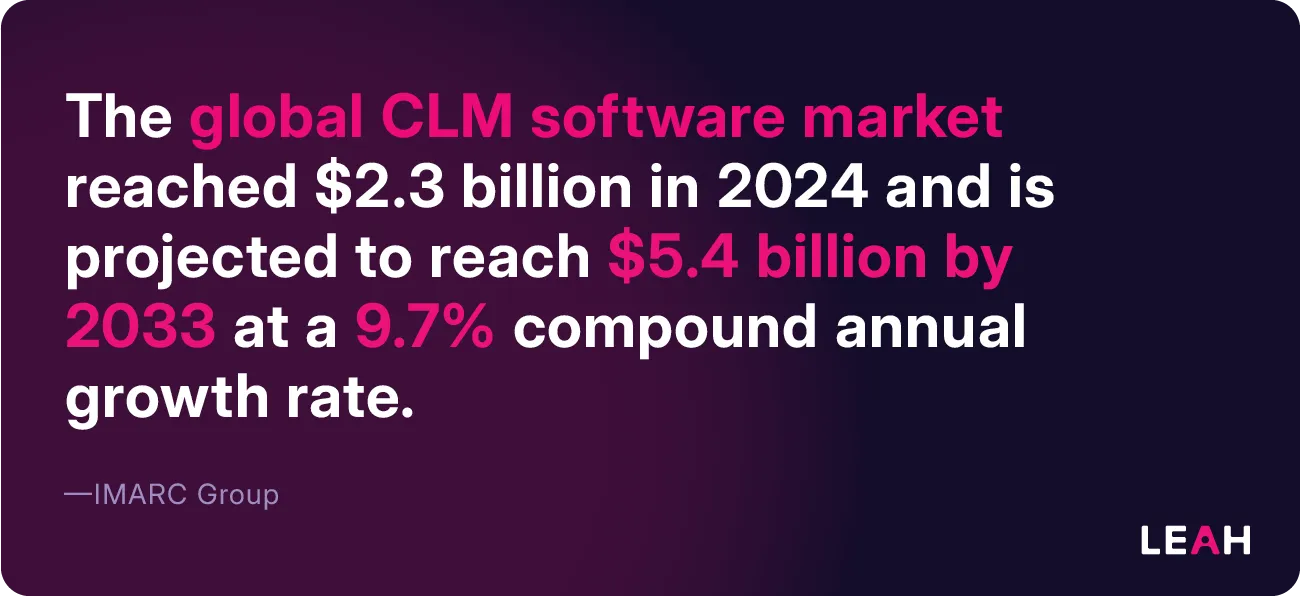
The market is growing regardless. The global CLM software market reached $2.3 billion in 2024 and is projected to reach $5.4 billion by 2033 at a 9.7% compound annual growth rate, according to IMARC Group. The question for any enterprise buyer is not whether CLM investment is justified (Gartner estimates that 60-80% of all B2B transactions are governed by contracts) but whether the specific platform under evaluation has overcome the design problems that caused the last failure.
The Adoption Problem Is the Only Problem That Matters
All CLM failure ultimately resolves to adoption. A platform with sophisticated AI capabilities, deep integrations, and strong security posture delivers zero return on investment if the legal team does not use it.
Research across 1,200 organizations found an average contract value erosion of 8.6% when contracting processes are fragmented, which is the exact condition that results when teams abandon a CLM and return to email and spreadsheets. Aberdeen research estimates that 60% of legal departments lack automated contract management software entirely. The cost of non-adoption is measurable and significant.
The adoption problem has two components that modern platforms must address differently from their predecessors.
Interface design. Users will not learn a new interface to accomplish tasks they can currently do, however inefficiently, in tools they already know. CLM platforms that embed functionality directly into Microsoft Word, Outlook, Gmail, and Salesforce remove the interface barrier entirely. The user does not navigate to a separate system; the system comes to where work is already happening. Leah's integrations with tools like Word, Outlook, and Salesforce are built precisely on this principle. This is not a convenience feature. It is the primary mechanism by which modern CLM platforms achieve the adoption rates that their predecessors failed to reach.
Self-service configurability. The second adoption barrier is the perception among legal ops and IT teams that any change to the system requires a ticket, a vendor call, and a wait. When users believe the platform is immutable, they stop trying to make it fit their work and find workarounds instead. Modern agentic CLM platforms are built around no-code workflow configuration: administrators can modify approval paths, add contract types, update templates, and adjust agent behaviors without external vendor involvement. This shifts the perceived cost of customization from high to low, which directly affects whether users invest in making the system work for them.
What Modern Agentic CLM Gets Right
The platforms that are actually solving the CLM failure problem share a common architectural approach. Understanding it is the most useful frame for evaluating vendors after a bad experience. Leah's Agentic OS is built around exactly this architecture, and its three-tier model illustrates what the new generation of CLM looks like in practice.
Pre-built, domain-specific agents. Rather than requiring organizations to build workflows from scratch, modern agentic CLM platforms ship with agents already trained on contract-specific tasks: NDA review, MSA negotiation, obligation monitoring, renewal alerting. These agents can be deployed in days against a specific use case and begin generating measurable value before the organization has made any customization investment.
Configurable, not custom, adaptation. The critical upgrade from first-generation CLM is that adapting agents and workflows to an organization's specific policies, data, and approval structures is done through configuration, not code. Legal ops administrators can modify agent behavior to reflect company playbooks, jurisdiction requirements, and counterparty preferences without vendor involvement.
Design-and-deploy for advanced use cases. Organizations with mature automation requirements can build entirely new AI agents and end-to-end workflows using natural language, embedding autonomous execution directly into enterprise operations. This capability was not available in first-generation CLM and represents a qualitative shift in what the platform can do as an organization's needs grow.
Human-in-the-loop governance. Enterprise adoption of AI agents requires controls that first-generation CLM never had to address. Modern agentic CLM platforms built for regulated environments include deterministic execution plans (the agent follows a defined, auditable path), full audit trails, explicit escalation and override points, and human-in-the-loop design by default. These governance controls are what allow procurement and legal teams to run autonomous workflows safely, without giving up accountability.
The POC Approach: How to Prove Value Before You Commit
The most effective risk mitigation strategy for organizations with CLM fatigue is a structured proof of concept: a time-boxed pilot that generates measurable evidence before requiring a full deployment commitment. Request a demo from Leah to see how a focused POC can be scoped to your specific workflows and contract types.
A well-designed CLM POC has five characteristics.
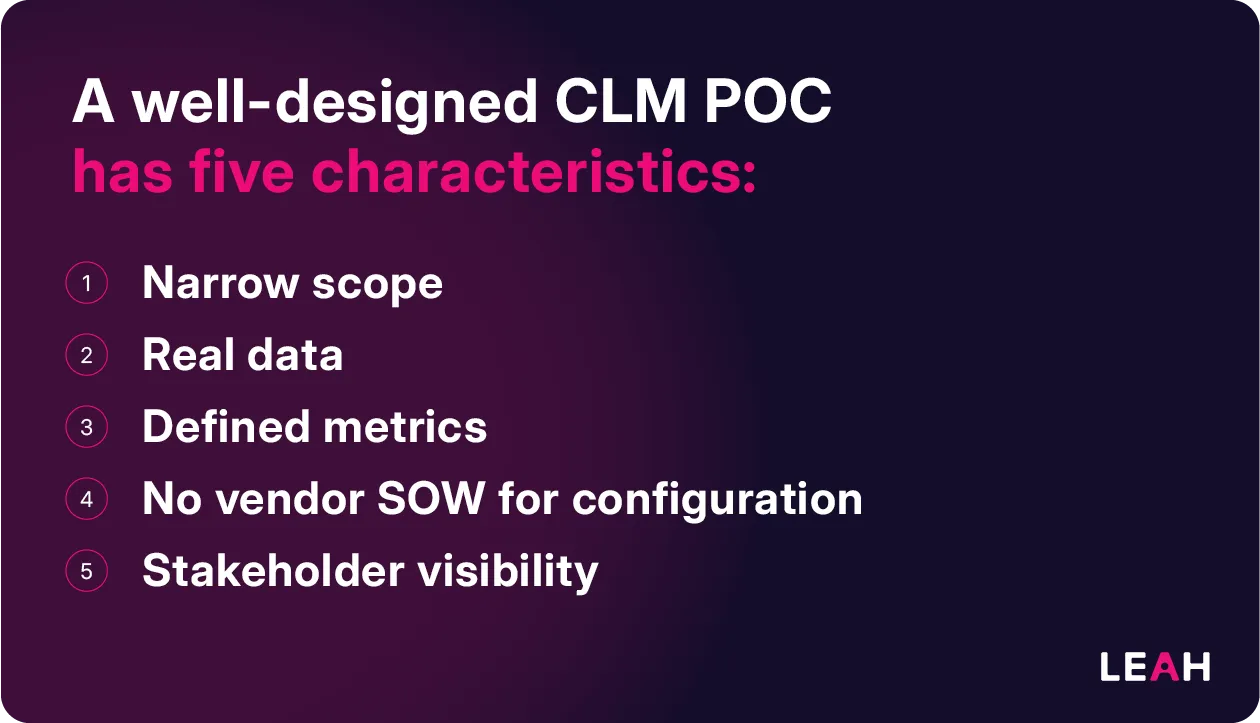
Narrow scope. Select one contract type (NDAs, supplier agreements, or MSAs are common choices), one team (legal review or procurement intake), and one measurable workflow. The goal is not to prove the platform can do everything. The goal is to prove it can do one thing faster, more accurately, and with higher adoption than the current process.
Real data. The POC must use the organization's actual contracts, templates, and approval policies, not vendor-provided sample data. The only way to build internal confidence is to demonstrate the platform working with the content that teams actually deal with.
Defined metrics. Establish a baseline before the POC begins: average cycle time for the selected contract type, average review hours per contract, error or exception rate, and user satisfaction score if available. After 4-6 weeks, measure the same metrics. This creates the before-and-after data that makes the business case internally and establishes shared success criteria with the vendor.
No vendor SOW for configuration. If adapting the platform to your workflow requires a statement of work, a multi-week scoping call, or vendor development resources, the platform has not solved the original problem. Modern agentic CLM platforms should allow your team to configure agents and workflows to your specific process without external involvement during the POC period.
Stakeholder visibility. Run the POC with the actual users, not a technology team proxy. Legal, procurement, or whoever will use the system daily must participate from day one. Their adoption behavior during the POC is the most reliable predictor of long-term adoption after full deployment.
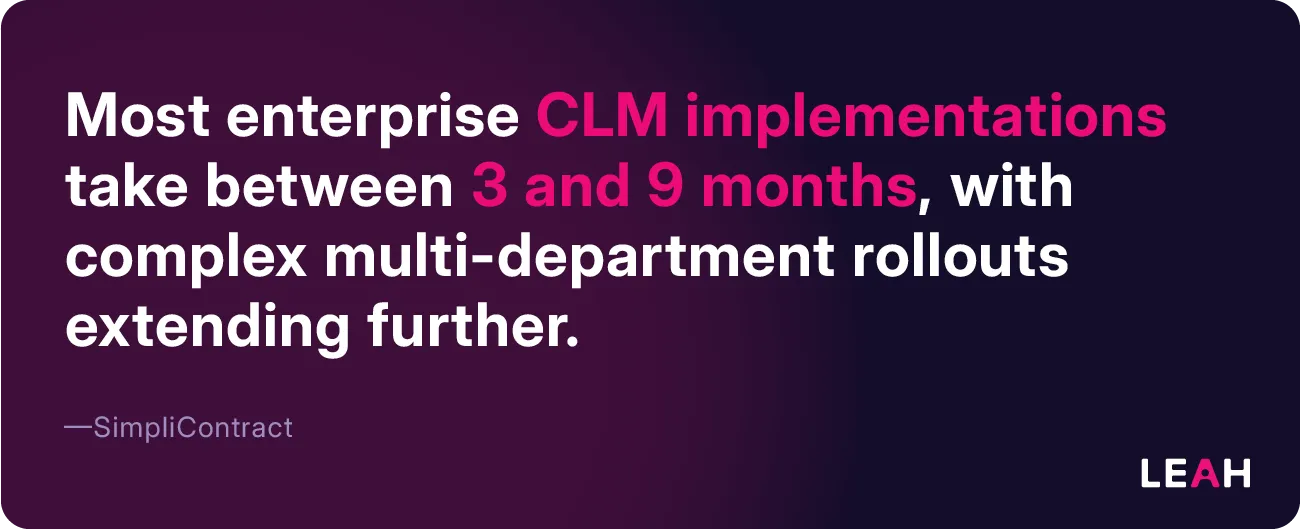
Most enterprise CLM implementations take between three and nine months according to SimpliContract's 2024 implementation guide, with complex multi-department rollouts extending further. A POC approach compresses the risk period: you validate the platform against real conditions before entering that full timeline.
What the Evaluation Checklist Should Actually Include
When evaluating a new CLM platform after a previous failure, standard feature checklists miss the questions that matter most. The following criteria directly address the failure modes documented above.
Configuration independence. Ask the vendor: can your legal ops team change an approval workflow without opening a support ticket or paying for a SOW? Request a live demonstration with your own workflow scenario. The answer, and the time it takes to execute, tells you more than any feature list.
AI architecture versus AI features. Ask whether AI capabilities were designed into the platform's core architecture or added as a feature layer on top of an existing workflow engine. The distinction is visible in how AI interacts with workflows: native agentic AI can autonomously execute multi-step processes; feature-layer AI can suggest actions but requires a human to execute each step. Leah's platform overview documents exactly how its agentic architecture differs from bolt-on approaches.
Adoption evidence. Ask the vendor for adoption rate data from existing enterprise customers at 90 days and 12 months post-deployment. Aggregate adoption statistics are more informative than curated case studies. If the vendor cannot provide user engagement metrics, that is itself informative.
Integration depth. CLM adoption is higher when the platform works inside tools legal teams already use. Ask specifically about Microsoft Word add-ins, Outlook and Gmail integrations, and CRM integration (Salesforce, SAP Ariba). Leah's full integrations library covers these and more, bringing CLM functionality into existing workflows rather than requiring users to switch contexts.
Security certification. For enterprise deployments, minimum acceptable security credentials include SOC 2 Type II certification covering security, availability, and confidentiality; GDPR compliance with EU Standard Contractual Clauses; HIPAA Business Associate Agreements; and annual third-party penetration testing. Complete tenant data isolation, confirming that your contracts do not train shared AI models, is a non-negotiable requirement.
Deployment model. Does the vendor offer a structured POC before full commitment? What does the go-live timeline look like, and what dependencies does it create? Organizations with CLM fatigue should not be asked to commit to a 12-month implementation timeline before seeing the platform handle real workflows.
What Recovery Looks Like: Enterprise CLM Outcomes That Are Actually Possible
The confidence problem in CLM is partly a data problem. Teams that have been burned are often shown marketing claims rather than evidence. The following outcomes are drawn from documented enterprise deployments, not projections.
Terumo (medical devices, $839M revenue, operations across Europe, Middle East, and Africa) faced contract processing times of two to four weeks per contract, with contracts stored on local machines creating business continuity risk. After deploying Leah, Terumo reduced contract processing time from four weeks to three days, a 10x improvement, and centralized 2,500 contracts in a single repository accessible to both central functions and regional salespeople. Enhanced user satisfaction was reported as a direct outcome of faster contract management freeing teams to focus on strategic work rather than administrative processing.
LogicMonitor (cloud monitoring software, $750M revenue, 1,200 employees worldwide) needed to streamline a global sales contracting process that was bottlenecked by manual workflows and legal handoffs. After deploying Leah's contract review and negotiation capabilities, LogicMonitor reduced review time for complex contracts by 90%, from 10 hours to 10 minutes, and achieved a 50-70% reduction in standard contract review time for MSAs, NDAs, and procurement agreements. Across 364 contract reviews covering redlining, drafting, and data extraction, the team tracked 4,558 hours in gained productivity and estimated $100,000 in monthly ROI during the initial redlining phase alone.
These outcomes did not require years of customization. They resulted from deploying a platform built around the right architecture, scoped to real workflows, with users who participated in the implementation from the start.
A Different Way to Think About CLM Trust
The teams most skeptical of CLM are often the ones who understood the original promise most clearly. CLM fatigue is not irrational. It is a rational response to a documented pattern of underdelivery. The question is whether that pattern reflects a permanent limitation of the technology category or a correctable failure mode tied to a specific generation of platform architecture.
The evidence suggests the latter. The failure modes (over-customization, poor UX, no change management, wrong buyer) are well-understood and architecturally addressable. The platforms that have genuinely moved past them look different from the systems that failed, not just in their feature lists but in how workflows are built, how AI is integrated, how deployment is structured, and how adoption is measured.
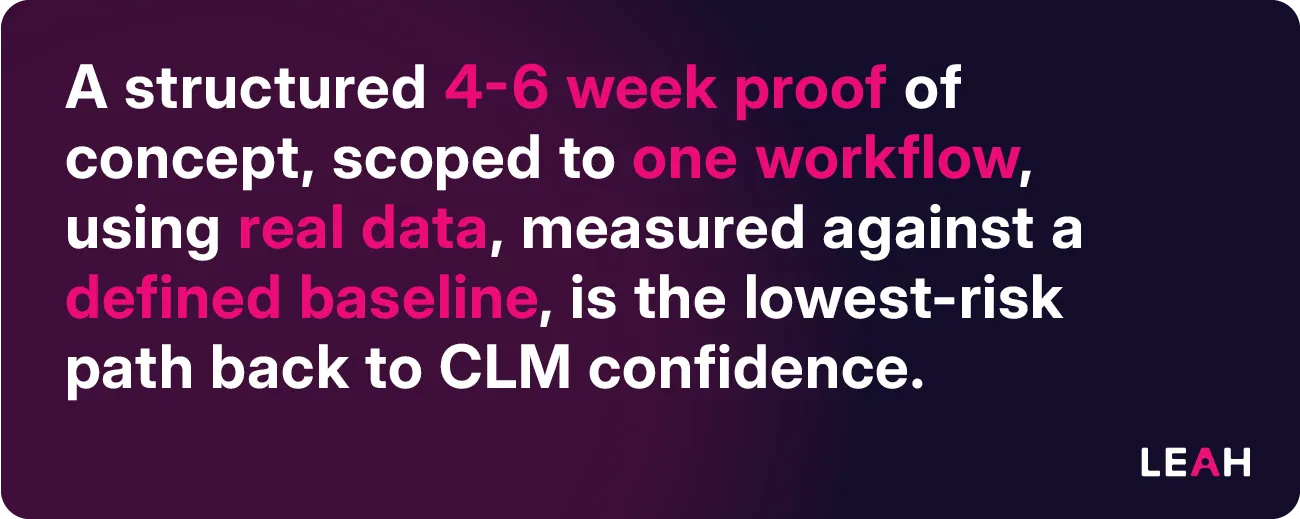
The CLM trust gap is real. It closes when the evidence is specific enough to be believable and the path to commitment is low enough risk to accept. A structured 4-6 week proof of concept, scoped to one workflow, using real data, measured against a defined baseline, is what that looks like in practice.
If your team has been burned before, the right next step is not another demo. It is a controlled test with your own contracts, on your own terms, producing your own data. Contact Leah to discuss how a scoped proof of concept can be built around your specific workflows and contract types.
Common Questions
What percentage of CLM implementations fail?
Gartner predicts that nearly 50% of initial CLM implementations will fall short of expectations. A 2022 Onit survey found that 77% of in-house counsel have personally experienced a failed technology implementation, with overcomplicated solutions and poor process fit as the leading causes.
Why do CLM implementations fail?
The most documented failure modes are over-customization requiring vendor involvement for every change, poor user experience driving abandonment, absence of structured change management, and misalignment between the team that selected the platform (typically IT) and the team that must use it daily (legal or procurement).
What is CLM fatigue?
CLM fatigue is the institutional skepticism and resistance that legal and procurement teams carry after one or more failed contract management implementations. Teams revert to familiar tools like email and spreadsheets and resist further CLM investment.
What is agentic CLM?
Agentic CLM refers to contract lifecycle management platforms built around AI agents that can autonomously execute multi-step tasks within enterprise-governed workflows. Unlike legacy platforms with AI features bolted on, agentic CLM is architected from the ground up for AI-driven automation. Leah's blog on agentic AI covers this distinction in depth.
What is a CLM proof of concept?
A CLM POC is a time-boxed pilot, typically 4-6 weeks, where the platform is deployed against a specific, bounded use case. The goal is to produce measurable before-and-after data on cycle time, review hours, and error rate before extending deployment. Contact Leah to discuss how a POC can be structured around your workflows.
What security standards should an enterprise CLM platform meet?
At minimum: SOC 2 Type II certification, GDPR compliance with EU Standard Contractual Clauses, HIPAA BAAs for healthcare-adjacent use cases, annual third-party penetration testing, and complete data isolation ensuring contracts do not train shared AI models.
What does successful CLM recovery look like?
Documented outcomes include Terumo cutting contract processing from four weeks to three days (10x improvement) and LogicMonitor reducing complex contract review time by 90%, from 10 hours to 10 minutes, with $100,000 in estimated monthly ROI tracked during the initial deployment phase.
How do you evaluate a CLM vendor after a bad experience?
Focus on four criteria the previous implementation lacked: configuration independence (can your team change workflows without a vendor SOW?), native AI architecture (not a bolt-on feature), measurable adoption evidence from existing enterprise customers, and a vendor-supported POC before full commitment.
What is the difference between configurable and custom CLM workflows?
Custom workflows require developer or vendor involvement to build or modify. Configurable workflows are built and adjusted by internal administrators through no-code interfaces. Leah's Agentic OS is built around this principle, eliminating the vendor dependency that caused many first-generation failures.
Why does IT versus legal alignment matter for CLM success?
When IT selects the CLM platform and legal inherits the decision without meaningful input, the workflow design reflects IT's assumptions rather than legal's operational reality. Adoption collapses. Successful CLM programs position legal operations as the primary decision-maker, with IT as a security and integration validator.
Is there a way to reduce the risk of a second failed CLM implementation?
Yes. Evaluate architecture, not just features; require a time-boxed POC before committing to full deployment; and select a vendor who treats change management as a shared responsibility. Teams that follow this approach validate the platform against real conditions before entering a full implementation timeline. Request a demo to see how Leah structures this process.
![How to Write a CLM RFP: Complete Guide for Legal & Procurement Teams [2026]](https://d32q3dexag516z.cloudfront.net/64d506de4c92a679c361f5c0/6958b1026bd074f1b27e810c_Hero_RFP-CLM_1200x628.webp)