
Quick answer: Artificial intelligence in contract lifecycle management (CLM) reads, drafts, reviews, routes, and tracks contracts. You can measure its business value in four places: time saved per contract, cost avoided, revenue kept from leaking away, and risk reduced. Much of that value sits after signature, when AI tracks obligations, renewal dates, and pricing terms that people miss. Real-world implementations show multi-million dollar returns through revenue capture, risk reduction, and process optimization, particularly in post-execution contract management where the majority of enterprise value resides.
To get that value, measure a baseline first and pilot AI on one or two high-volume contract types. Judge the pilot on business outcomes, not on how impressive the AI looks. Then expand in stages, and tie each stage to a metric your finance team accepts.
Key Takeaways
- Starting small with proof-of-concept implementations lets you refine security architecture and workflows before an enterprise-wide rollout, which makes adoption easier
- Post-execution contract management delivers greater ROI than pre-signature activities, with organizations discovering revenue leakage and compliance gaps worth millions of dollars
- Measure value across four drivers (time, cost, revenue or leakage, and risk), not time savings alone
- Change management remains the biggest implementation challenge, as CLM means different things to different stakeholders across the organization
- Organizations that establish baseline metrics before implementation and measure continuously see 3-5x better adoption rates than those focused solely on AI capabilities
How Do You Measure the Value of AI in CLM?
Value is easier to defend when you split it into drivers and agree in advance how to measure each one. The table below covers the four drivers most business cases rely on, plus adoption, which is the leading indicator for all of them. This article is about proving value. For what AI does at each stage of a contract, see our main guide to AI contract management.
Leakage is worth measuring. World Commerce & Contracting's 2025 research puts the average value erosion from poor contract management at 8.6%, which it defines as the deviation from expected results (WorldCC, Contract Management: An Overlooked Driver of Business Agility and Financial Performance).
| Value driver | What AI changes | How to measure it | Data you need |
|---|---|---|---|
| Time | Drafts first versions from templates, reviews counterparty paper against your playbook, and routes each contract to the right approver. | Median days from request to signature, and hours of legal or procurement time per contract, by contract type. | Request, approval, and signature timestamps; a two-week time sample before and after; contract volumes by type. |
| Cost | Keeps routine agreements in house instead of sending them to outside counsel, and catches renewals before the notice period closes. | Outside counsel spend on routine contracts; spend avoided on unwanted renewals; cost per contract. | Legal spend or e-billing data, renewal and notice dates, team headcount and loaded cost. |
| Revenue and leakage | Extracts pricing, escalators, rebates, and service levels so they can be checked against billing and payments. | Dollars recovered from price increases or services that were never billed; rebates and service credits claimed. | Extracted price and payment terms, billing or accounts payable records, customer and supplier master data. |
| Risk and compliance | Flags clauses outside your playbook, missing requirements such as insurance, and obligations coming due. | Contracts signed with unapproved deviations; obligations missed versus met; time to answer an audit or regulator request. | Playbook positions, approval logs, an obligation register, audit and dispute records. |
| Adoption | The leading indicator: none of the value above appears if people work around the system. | Contracts started in the system versus outside it; active users by team; AI suggestions accepted versus rejected. | System usage logs and a count of contracts signed outside the system. |
Before the pilot starts, agree with finance which results count as hard value (cash recovered or spend avoided) and which count as capacity (hours freed for other work). A business case loses credibility when the two are added together without a label. For the metrics that sit under each driver, see our guide to contract management KPIs.
Worked example (illustrative numbers)
The company and every number below are invented to show the method. They are not results from any customer, and your figures will differ.
A fictional company with a five-person legal team runs a one-quarter pilot. It uses AI review for incoming NDAs, and AI extraction across its existing customer and supplier contracts.
| Driver | Before the pilot | After the pilot | Annual value (illustrative) |
|---|---|---|---|
| Time | 800 NDAs a year at 40 minutes of lawyer time each (about 533 hours). | Lawyers spend 15 minutes each checking the AI's playbook redlines (200 hours). | About 333 hours freed, worth $50,000 at a loaded cost of $150 an hour. Counted as capacity, not cash. |
| Revenue and leakage | Annual price escalators in 400 customer contracts are tracked by hand and never checked against invoices. | Extraction plus a billing check finds 9 contracts where the increase was never applied. | $54,000 a year recovered going forward (9 contracts at $6,000 each). Hard value, confirmed by finance. |
| Cost | Supplier contracts auto-renew because notice dates live in a spreadsheet nobody owns. | Renewal alerts go out 90 days before each notice deadline; the team exits or renegotiates 4 contracts. | $80,000 of spend avoided (4 contracts at $20,000 each). Hard value. |
| Risk | Insurance requirements in 300 vendor contracts are not tracked. | AI flags 12 vendors with missing or expired certificates; all 12 are fixed. | Not added to the total. Reported as 12 exposures closed. |
How to read the result: hard value is $134,000 a year ($54,000 plus $80,000). Against an illustrative first-year cost of $90,000 (subscription, implementation, and internal time), payback comes in about eight months on hard value alone, before counting the freed lawyer time. Three habits keep a calculation like this credible:
- Count each recovered dollar once, and separate one-time recoveries from recurring ones
- Get finance to confirm revenue and spend figures before they go into the business case
- Report risk as exposures closed unless you have an agreed method for putting a dollar value on it
For a fuller model with implementation costs and multi-year returns, see our guide to contract management ROI.
Why Do Big Bang CLM Implementations Often Fail?
Large-scale, organization-wide CLM deployments frequently fail because they attempt to solve too many problems simultaneously without understanding how the technology performs in real enterprise environments. The most successful implementations follow an iterative approach that validates assumptions before scaling.
Before diving into implementation strategies, you need to understand your current contract management maturity level. The Contract Management Maturity Model (CMMM) provides a structured framework to evaluate your organization's sophistication and identify advancement opportunities. Automation is usually what moves an organization up that ladder, because it makes routine steps faster and more consistent.
Cushman & Wakefield's implementation strategy demonstrates this principle in action. Rather than launching across all departments simultaneously, the organization began with a targeted proof-of-concept in corporate functions. This approach yielded three critical advantages that would have been impossible to achieve in a big bang deployment.
First, the limited scope allowed the team to refine security architecture with real data and actual use cases rather than theoretical scenarios. Second, they developed enterprise-grade workflows through hands-on iteration with actual users, discovering friction points that no amount of planning could have predicted. Third, real user feedback, including how legal teams actually work with contract revisions, shaped the setup before it reached the wider business.
Perhaps most importantly, the proof-of-concept approach provided concrete evidence for budget justification. When leadership naturally gravitated toward a comprehensive rollout, the team could demonstrate measurable success rather than relying on projected benefits. According to Gartner research on enterprise software adoption, organizations using phased implementations report 40-60% higher user satisfaction scores than those attempting full-scale deployments.
Critical Success Factors for Starting Small:
- Choose high-volume, low-complexity processes or urgent, high-impact needs as entry points
- Build security and compliance frameworks with actual usage data, not assumptions
- Document specific workflow improvements to guide expansion decisions
- Use demonstrated ROI to secure budget for broader implementation
- Allow 6-12 months for proof-of-concept before enterprise scaling
- Time-box the pilot and agree the go or no-go criteria before it starts
Watch the full conversation with Cushman & Wakefield, Epiq, and Leah
What Business Outcomes Matter More Than Time Savings?
Time savings represent the most commonly cited CLM benefit, yet they rarely capture the full value proposition or justify significant technology investments. Organizations achieving the strongest results focus on quantifiable business outcomes that directly affect the bottom line.
A healthcare staffing company working with Epiq Systems provides a compelling example. The organization faced a compliance crisis when they lost a $1 million contract due to missing insurance requirements buried in unstructured contract data. The financial loss was significant, but the systemic risk was catastrophic, they had no reliable way to extract and monitor compliance obligations across thousands of active agreements.
The CLM implementation focused on extracting unstructured data to prevent future compliance failures. Rather than measuring success by how quickly legal could review contracts, the organization tracked prevented contract losses, compliance violation reduction, and audit preparation time. These metrics told a story that resonated with executive leadership in ways that "20% time savings" never could.
The shift from efficiency metrics to business impact metrics requires a fundamental reframing of how organizations think about contract management technology. Revenue capture, risk reduction, process visibility, and collaboration improvement all deliver measurable value that connects directly to strategic business objectives.
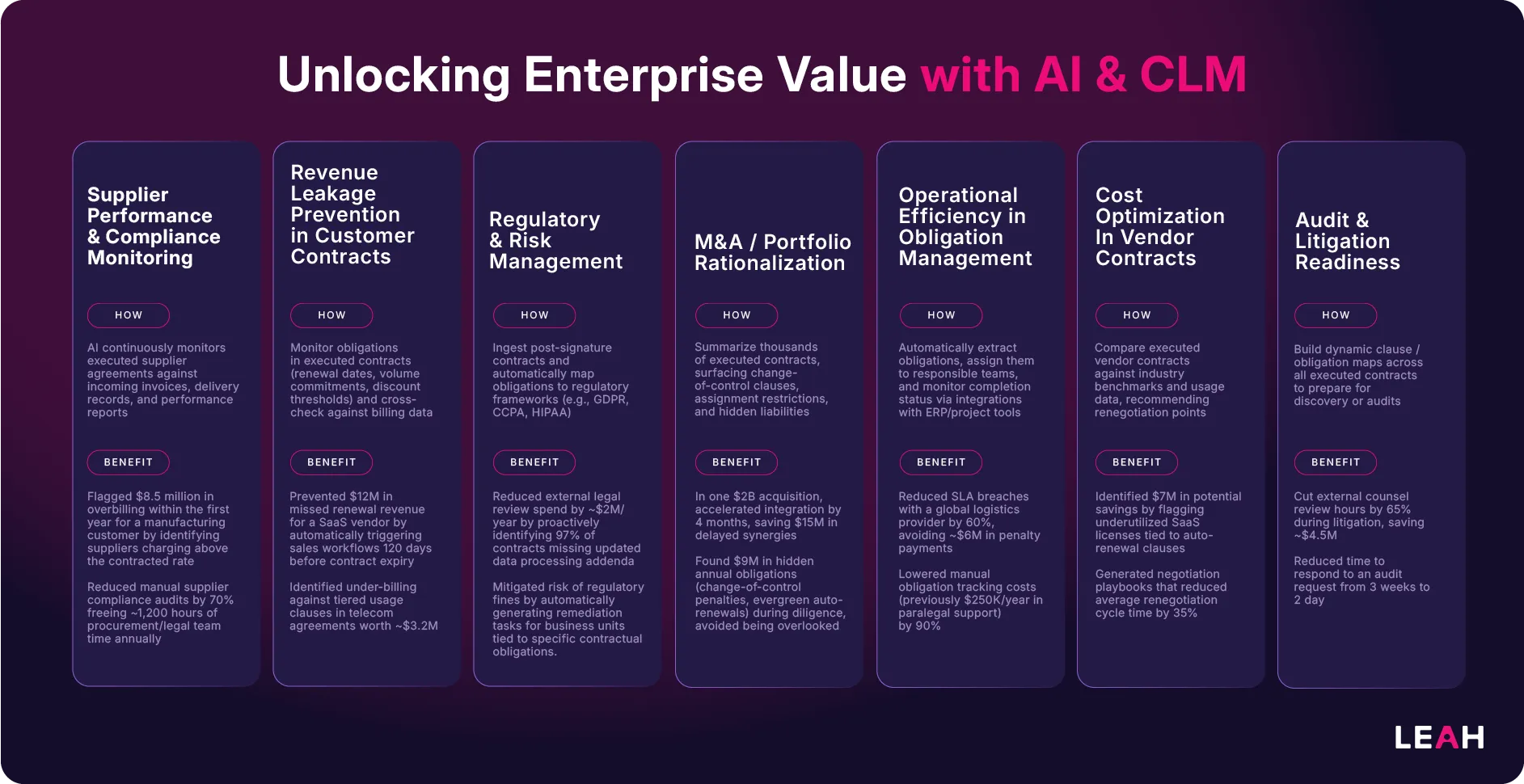
Business Outcome Metrics That Drive Executive Buy-In:
- Revenue protected through compliance monitoring and obligation tracking
- Contract losses prevented through automated requirement extraction
- Risk exposure reduced via standardized approval workflows
- Audit costs decreased through centralized documentation and version control
- Cross-functional collaboration improved through workflow transparency
How Does Post-Execution Contract Management Create Enterprise Value?
The period after contract execution is one of the largest untapped value opportunities in most organizations, yet it receives a fraction of the attention given to negotiation and signature workflows. This is where contracts turn from legal documents into operational tools, and where the value a deal promised is either delivered or lost.
Cushman & Wakefield discovered this principle when a business leader approached the CLM team with an intuition that the organization was "leaving revenue on the table." The team conducted a six-week analysis comparing contract terms against billing system data, revealing systematic revenue leakage across multiple client relationships. The discovery transformed how the organization viewed contract management, from a cost center focused on legal efficiency to a revenue optimization function.
The narrative shift proved as important as the financial discovery. Rather than presenting findings as "leakage" (which implied fault), the team framed results as "process enhancement opportunities." This approach secured buy-in from operational teams who might otherwise have felt defensive about the gaps.
Real user benefits in post-execution scenarios drive adoption more effectively than abstract efficiency promises. Version control and redline centralization eliminate the common problem of tracking changes across multiple email threads. Mandatory review compliance ensures that InfoSec, privacy, and other stakeholders actually review contracts rather than being inadvertently bypassed. Workflow transparency removes the need for "email archaeology" when someone asks about contract status. Third-party collaboration becomes simpler when external partners can access appropriate information through controlled portals.
Professional services organizations tracking statements of work milestones exemplify post-execution value creation. When deliverables, payment schedules, and performance metrics live in contracts but get tracked separately (if at all), organizations lose visibility into project health until problems become crises. Automated milestone tracking connects contract terms to project management workflows, surfacing risks while intervention remains possible.
Post-Execution Value Drivers:
- Revenue optimization through contract-to-billing reconciliation
- Obligation tracking that prevents missed renewals and unwanted auto-renewals
- Compliance monitoring extracting and tracking regulatory requirements
- Performance tracking connecting contract terms to operational metrics
- Relationship management centralizing all client or vendor interactions
What Are the Biggest Change Management Challenges in CLM Implementation?
Familiar technology does not guarantee easy adoption. CLM implementations face unique change management challenges because contract lifecycle management means fundamentally different things to different stakeholders across the organization.
Legal teams view CLM as a document repository and negotiation workflow tool. Procurement sees it as a vendor management and spend visibility platform. Sales considers it a deal acceleration system. Finance wants a revenue recognition and obligation tracking solution. Operations needs a compliance monitoring and risk management tool. Each perspective is valid, and each creates different expectations about what the system should do and how it should work.
Setting realistic expectations about AI capabilities represents another persistent challenge. First-pass extraction and analysis tools require human review and validation. They are not magic buttons that eliminate work. The technology evolves over time, improving accuracy and expanding capabilities, but initial performance often underwhelms users expecting science fiction rather than practical automation.
One organization addressed adoption challenges through a video campaign that reconnected users with their original pain points. Rather than focusing on system features or AI capabilities, the videos featured actual employees describing the problems they faced before implementation: the lost emails, the missed deadlines, the compliance close calls. This approach reminded users why they needed the solution in the first place, reframing the learning curve as a worthwhile investment rather than a frustrating burden.
Partnership must be understood as a continuous workstream, not a project phase. Effective implementations maintain ongoing collaboration between the software vendor, implementation partner, and internal stakeholders throughout the lifecycle. As business needs evolve and the technology advances, this partnership identifies optimization opportunities and addresses emerging challenges.
Change Management Best Practices:
- Develop tailored messaging for each stakeholder group addressing their specific needs
- Set clear expectations about AI as a first-pass tool that improves over time
- Create role-specific training that demonstrates relevant workflows and benefits
- Establish feedback loops that capture user experience and guide improvements
- Maintain vendor partnerships beyond implementation for continuous optimization
A Proven Implementation Methodology: The Five-Stage Approach
Successful CLM implementations follow a structured methodology that prioritizes quick wins and iterative value delivery over risky "big bang" deployments. This "Crawl, Walk, Run" philosophy combines deep legal industry expertise with proven project management practices to ensure sustainable adoption and measurable outcomes.
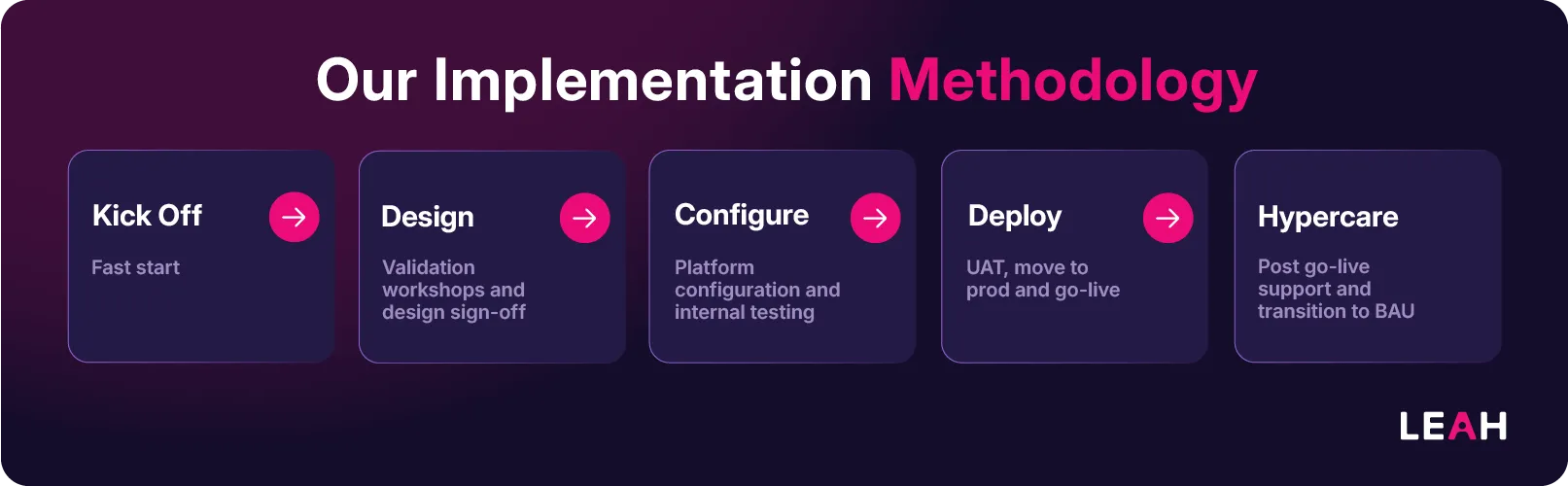
Stage 1: Kick Off
The foundation stage aligns key stakeholders on vision and objectives while establishing project governance and success criteria. This phase creates detailed project plans and reporting frameworks that will guide the entire implementation journey. Without this alignment, even the most sophisticated technology will struggle to gain traction across diverse stakeholder groups.
Stage 2: Design
Validation workshops and requirements gathering ensure the solution addresses actual business needs rather than theoretical use cases. End-to-end business process mapping reveals how contracts truly flow through your organization, exposing inefficiencies and opportunities that may not be visible from a single department's perspective. Solution design documentation and formal sign-off prevent scope creep while establishing clear training and change management frameworks.
Stage 3: Configure
Platform configuration transforms design documents into working systems, while legacy contract migration ensures historical agreements become accessible, searchable assets rather than archived liabilities. System integration and performance testing confirm that the CLM solution works with your existing technology stack. Training materials and user acceptance testing scripts prepared during this phase ensure smooth deployment.
Stage 4: Deploy
User acceptance testing provides the final validation before production migration, ensuring the system performs as designed in real-world scenarios. End-user training and UAT programs build confidence and competence before go-live. Production integration and change execution support help organizations navigate the transition from legacy processes to optimized workflows.
Stage 5: Hypercare
Post-go-live support and Business-as-Usual transition recognize that successful implementation extends beyond deployment day. Monitoring system usage and performance optimization identify opportunities for continuous improvement. Subsequent phase planning ensures the CLM solution evolves alongside business needs rather than becoming a static system that gradually loses relevance.
A structured approach like this makes adoption and time to value easier to manage, because each stage ends with a clear decision. Organizations following this methodology typically see initial returns within 6-12 months and achieve full ROI within 18-24 months. Set your own targets for first returns and payback in the business case, based on the baseline you capture at kick off.
How Should Organizations Measure CLM Success at Different Maturity Stages?
Establishing baseline metrics before implementation is essential but frequently overlooked. Organizations cannot demonstrate improvement without understanding the starting point. How long do contract approvals currently take? What percentage of contracts miss key deadlines? How often do compliance issues emerge post-signature? These questions require answers before the CLM system launches, not after.
Benefits manifest similarly across different user groups despite varied understanding of the system. Legal teams may not articulate value the same way finance does, but both experience measurable improvements in their workflows. Effective measurement captures these benefits in language appropriate to each stakeholder while rolling up to enterprise-level metrics that resonate with executive leadership.
Continuous measurement becomes increasingly important as capabilities evolve. An organization measuring only initial implementation benefits misses the compounding value as AI models improve, workflows mature, and user proficiency increases. The metrics established in month three may be inadequate by month twelve as the system takes on more sophisticated tasks.
Moving from AI initiative messaging to day-to-day impact communication represents a critical transition. Early in the implementation, stakeholders need to understand the technology and its potential. Six months later, they need to see tangible results in their daily work. The measurement framework should evolve alongside this shift, emphasizing outcomes over capabilities.
Measurement Framework by Maturity Stage:
Proof of Concept (Months 1-3)
- User adoption rates and active usage metrics
- Accuracy of AI extraction and classification
- Workflow completion times versus baseline
- User satisfaction scores and feedback themes
Initial Deployment (Months 4-12)
- Contract cycle time reduction across stages
- Compliance requirement capture completeness
- Risk identification and mitigation tracking
- Cross-functional collaboration improvements
Enterprise Optimization (Year 2+)
- Revenue impact from obligation management
- Risk reduction quantified through prevented losses
- Strategic insights derived from contract data analytics
- Business process improvements enabled by CLM integration
What Should You Avoid and Embrace When Implementing AI-Powered CLM?
Organizations pursuing CLM success should avoid several common pitfalls that derail implementations regardless of technology quality or implementation partner expertise. Biting off more than you can chew ranks as the most frequent mistake. Attempting to transform every aspect of contract management simultaneously creates overwhelming change that users resist.
Focusing solely on AI as the message disconnects the technology from business outcomes that matter to stakeholders. Assuming readiness equals excitement ignores the reality that even enthusiastic supporters need training, support, and time to adapt. Treating CLM as a legal-only tool limits value creation and misses opportunities in procurement, sales, finance, and operations.
Instead, successful organizations embrace specific practices that maximize value while minimizing implementation risk. High-volume, low-complexity starting points provide quick wins that build momentum, though urgent, high-impact needs can justify more aggressive timelines when business risk demands immediate action.
Clear success metrics from day one ensure everyone understands what the implementation should achieve and how progress will be measured. Cross-functional partnership approaches break down silos and ensure the solution serves enterprise needs rather than departmental preferences. Readiness assessment before expansion prevents premature scaling that strains resources and frustrates users. Ongoing training and change management recognize that adoption is a continuous process, not a launch event.
Implementation Do's and Don'ts:
Avoid:
- Launching across all departments without proven workflows
- Emphasizing AI sophistication over business problem-solving
- Assuming technical readiness translates to user enthusiasm
- Limiting stakeholder involvement to legal and procurement teams
- Declaring victory at go-live without ongoing support
Embrace:
- Targeted launches addressing specific, measurable pain points
- Outcome-focused communication connecting features to business impact
- Comprehensive change management addressing people, not just processes
- Cross-functional governance ensuring diverse perspective representation
- Continuous improvement based on usage data and user feedback
Defining Your Target Operating Model Before Technology Selection
Before evaluating vendors or comparing features, organizations must establish a clear target operating model that defines how contract management will function post-implementation. This critical step prevents the common pitfall of selecting technology based on impressive capabilities that don't align with your organization's actual needs or operational reality.
Your target operating model should address fundamental questions:
- How will contracts flow through your organization?
- Which stakeholders will participate in each stage of the contract lifecycle?
- What approval hierarchies and governance structures will guide decision-making?
- How will contract data integrate with existing business systems?
Without these foundational decisions, even the most sophisticated CLM platform can become an expensive solution searching for clearly defined problems.
This readiness assessment extends beyond process mapping to include change management considerations, resource allocation planning, and success metrics definition. Organizations that invest time upfront in articulating their desired future state (rather than immediately gravitating toward feature-rich solutions) tend to implement faster, see higher adoption, and find it easier to show business results. The target operating model becomes your north star, guiding not only technology selection but also training programs, rollout strategies, and long-term optimization efforts.
How Do Multi-Million Dollar Returns Materialize from CLM Investments?
The returns from CLM come from more than efficiency gains. They include revenue protection through automated compliance monitoring, cost avoidance from preventing contract losses, operational efficiency from simpler workflows, and strategic insights from contract data analytics.
The evolution from viewing CLM as "the last thing you recommend" to becoming a "proactive champion" reflects a fundamental shift in how organizations understand contract management's role in enterprise value creation. When contracts move from static legal documents stored in shared drives to business tools connected to operational systems, they give you insights and capabilities that were previously out of reach.
Post-execution focus drives disproportionate enterprise value because this is where the majority of contract value gets realized or lost. A signed contract represents potential value: a promise of future performance, payment, or partnership. The execution phase determines whether that potential becomes reality. Organizations that treat post-signature contract management with the same rigor they apply to negotiation capture value that would otherwise go unrealized.
Whether you are exploring CLM for the first time, struggling with an underperforming implementation, or optimizing a mature system, the principles remain consistent. Start with clear business outcomes, measure what matters, embrace iterative improvement, and recognize that the greatest value often emerges after the signature.
Want to make a winning case for CLM to your leadership team?
Start with the value driver table above. Pick the two drivers your leadership cares about most, measure the baseline, and run a time-boxed pilot that reports against them. Our guides to contract management ROI and contract management KPIs cover the math and the metrics to report.
If you are evaluating platforms, Leah Agentic CLM is a contract lifecycle management platform in which AI drafts, reviews, routes, and tracks contracts while your team approves the decisions that matter. Its obligation tracking and renewal alerts, conditional approval routing, and contract helpdesk (each answer linked to the clause it came from) map to the time, leakage, and risk measures above.
FAQ
What role does AI play in contract lifecycle management?
AI handles the reading and routine judgment work across the contract lifecycle. It classifies incoming documents, extracts key terms, drafts from templates, reviews counterparty paper against your playbook, routes approvals, and tracks obligations and renewal dates after signature, while people approve the decisions that matter. Post-execution contract management matters because this is where the majority of contract value gets realized or lost. For how machine learning, NLP, generative AI, and agentic AI each contribute, see our explainer on machine learning in contract management.
How do you measure the success of AI in your contract processes?
Measure it against a baseline you capture before go-live, using four value drivers: time, cost, revenue or leakage, and risk. Compare the same contract types before and after, for example median days to signature, outside counsel spend, dollars recovered from missed price increases, and obligations missed. Track adoption from the start, because no value appears if contracts bypass the system.
What value can AI in CLM deliver in the first three months?
In the first three months, expect proof on a narrow scope rather than full ROI. That usually means faster turnaround on one or two high-volume contract types, extraction accuracy checked on your own contracts, and early findings from an AI review of existing contracts, such as missed renewals or price increases that were never billed. Larger returns from obligation management and wider adoption build as more contracts and teams move onto the platform. ROI timelines vary based on implementation scope and success metrics, but organizations typically see initial returns within 3-6 months of deployment. Deeper value from revenue optimization, risk reduction, and strategic insights emerges over 12-18 months as data accumulates and AI models improve.
What should a CLM pilot prove before you buy?
A pilot should prove four things on your own contracts: the AI is accurate enough on your contract types, users adopt it in their real workflow, it meets your security and integration requirements, and it moves at least one business metric against the baseline. Agree the pass or fail criteria before the pilot starts, and time-box it so the decision does not drift. Plan for 6-12 months of pilot operation before expanding to additional departments or use cases.
How do you build a business case for enterprise-wide CLM?
Build it from measured pilot results, not vendor projections. Show each value driver separately, label hard savings (cash recovered or spend avoided) apart from capacity freed, and include full costs: subscription, implementation, migration, and internal time. Set out a staged rollout with a metric and an owner for each stage, so finance can see how each number will be checked.
Which contract management pain points can AI solve?
AI is strongest on high-volume, repetitive work: first-pass review of standard agreements, finding clauses and data across thousands of legacy contracts, routing approvals, and tracking dates and obligations that people miss. It also answers questions about what a contract says, which cuts the "email archaeology" that slows teams down. It does not fix unclear ownership or a missing playbook, so settle those before you automate. AI in contract management delivers its greatest value through automated extraction of unstructured data, intelligent classification and routing of agreements, risk identification across thousands of contracts, obligation tracking that prevents missed deadlines and auto-renewals, and predictive analytics that surface patterns invisible to manual review.