
Editor's Note: This is Part 1 of a 4-part series based on Simon McCarthy's Implementation Insights from his years helping organizations implement Contract Lifecycle Management (CLM) systems. As Leah's VP of Enterprise Transformation, he's had the privilege of working with hundreds of organizations through their CLM journey, from Fortune 500 companies to growing mid-market firms. Be sure to read Part 2 in this series for continued insights.
The Crisis in CLM Implementation Success
Recent research reveals a sobering reality: 70% of digital transformations fail to deliver on their objectives, according to Boston Consulting Group research. For enterprise technology implementations like CLM, this failure rate represents billions in wasted investment and countless hours of organizational disruption.
The root cause isn't technical—it's strategic. Organizations that treat CLM as departmental legal technology rather than enterprise transformation achieve fundamentally different outcomes.
The transformation imperative is clear: CLM readiness requires enterprise-wide strategic alignment, not just technical preparation.
Why CLM Is Your Fifth Business Pillar
Modern enterprises operate on four core technology pillars: CRM for sales and revenue generation, ERP for operations and logistics, P2P for procurement and sourcing, and HR platforms for talent management. CLM serves as the fifth pillar—the connective tissue that binds these systems together.
Every CRM deal requires a contract. Every ERP transaction has contractual obligations. Every P2P relationship involves supplier agreements. Every HR decision touches employment contracts. CLM doesn't just manage legal documents—it orchestrates the contractual foundation of your entire business ecosystem.
This interconnected reality demands a readiness approach that transcends traditional legal operations. Successful CLM implementation requires the same strategic rigor as any major enterprise transformation initiative.
The Pain-First Readiness Assessment
Feature-first thinking kills CLM projects. Organizations that begin with capability requirements rather than problem identification consistently struggle with adoption and ROI realization.
The enterprise transformation approach starts with comprehensive pain point mapping across all business functions.
Legal Function Pain Points:
- Contract review bottlenecks creating deal delays
- Inconsistent template usage across departments
- Compliance risks from outdated playbooks
- Manual obligation tracking and renewal management
Sales Function Pain Points:
- Slow approval cycles extending deal closure times
- Revenue recognition delays from contract complexity
- Lack of contract visibility impacting forecasting
- Redlining inefficiencies in negotiation processes
Procurement Function Pain Points:
- Supplier contract visibility gaps
- Missed renewal opportunities causing cost increases
- Obligation tracking failures leading to penalties
- Spend optimization challenges from contract data silos
Finance Function Pain Points:
- Revenue leakage from untracked contract terms
- Audit preparation complexity and resource intensity
- Contract analytics limitations hindering strategic insights
- Integration gaps between contracts and financial systems
The Strategic Prioritization Matrix
Not all pain points deserve equal attention. The enterprise transformation approach applies a three-dimensional prioritization framework to identify maximum-impact starting points for CLM implementation.
Impact Severity Assessment: Rate each pain point's effect on business operations using quantifiable metrics like cycle time delays, revenue impact, or compliance risk exposure. High-severity issues that affect multiple departments or create significant business disruption should receive priority attention.
Solution Opportunity Evaluation: Assess how effectively CLM technology can address each identified challenge. Some problems may require process changes or organizational restructuring rather than technological solutions. Focus on areas where CLM can deliver measurable improvement.
Implementation Complexity Analysis: Consider the resources, change management requirements, and organizational readiness needed to address each pain point. Balance high-impact opportunities with realistic implementation timelines and available resources.
This matrix reveals where CLM implementation should begin for maximum business impact and adoption success.
Contracting Maturity: The Foundation Factor
Organizational maturity determines CLM success more than technology selection.
The enterprise transformation approach requires honest assessment of your contracting maturity level.
Process Maturity Indicators:
- Documented, consistent contract workflows across departments
- Standardized approval hierarchies with clear delegation authorities
- Regular contract lifecycle reviews and optimization initiatives
- Cross-functional collaboration protocols for contract management
Template and Content Maturity:
- Harmonized contract templates reflecting current business requirements
- Updated playbooks aligned with regulatory and strategic changes
- Centralized clause libraries with version control and approval workflows
- Consistent contract language across similar agreement types
Data and Analytics Maturity:
- Centralized contract repositories with comprehensive metadata
- Regular contract performance measurement and reporting
- Integration between contract data and business intelligence systems
- Predictive analytics capabilities for renewal and risk management
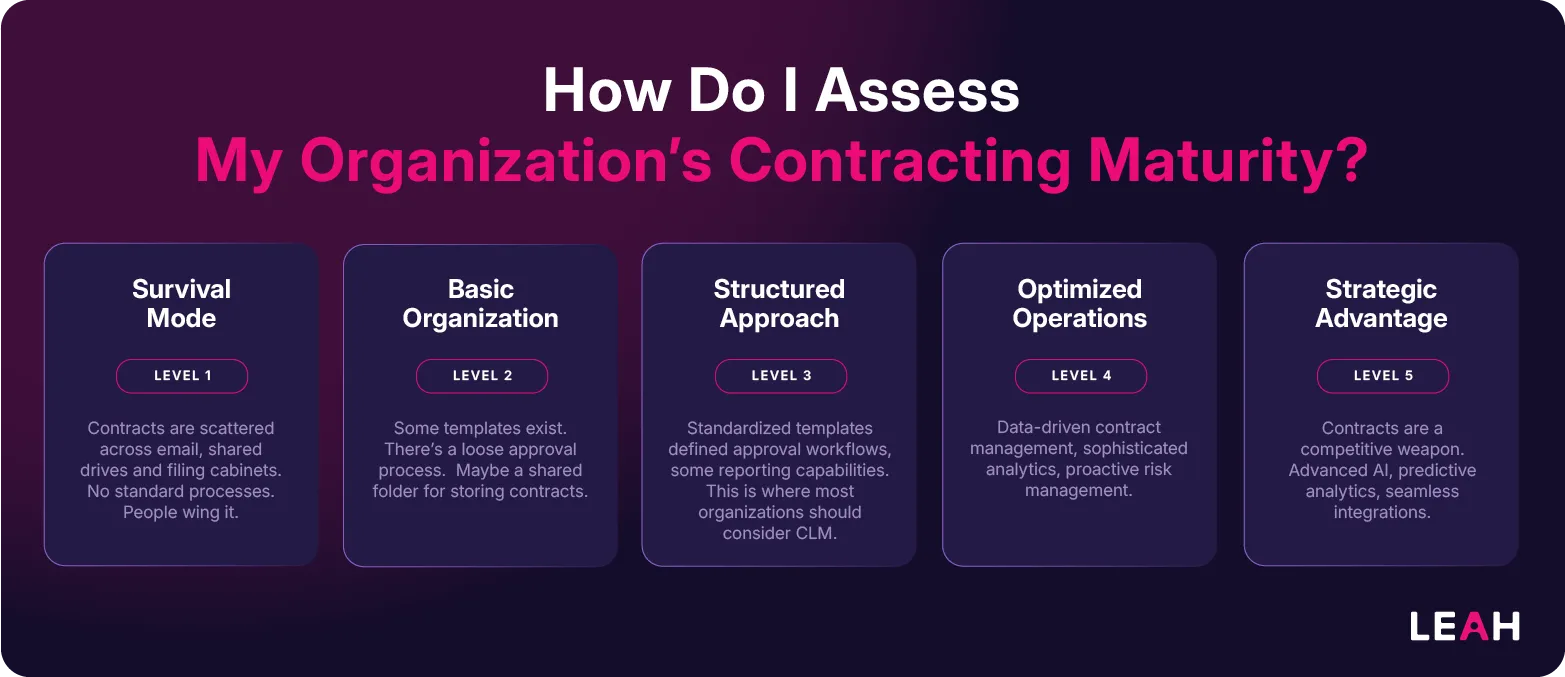
Note: Organizations at lower maturity levels often achieve better results with focused point solutions that address specific challenges before expanding to comprehensive CLM platforms.
AI-Readiness: Future-Proofing Your Investment
The AI tipping point has arrived.
While advanced AI capabilities may not be required on day one, your CLM platform selection must anticipate the agentic future of contract management.
Platform Architecture Considerations:
- Cloud-native infrastructure capable of supporting AI workloads
- API-first design enabling integration with emerging AI services
- Scalable data architecture supporting machine learning requirements
- Flexible workflow engines that can incorporate AI decision-making
Data Quality Requirements:
- Structured contract data suitable for AI training and analysis
- Consistent metadata schemas across all contract types
- Clean, normalized data sets supporting machine learning algorithms
- Comprehensive audit trails enabling AI transparency and explainability
Workflow Adaptability:
- Configurable processes that can evolve with AI capabilities
- Human-in-the-loop designs for AI-assisted contract review
- Approval workflows that can incorporate AI recommendations
- Integration points for future AI-powered contract generation
The platforms that demonstrate AI characteristics today will be best positioned to deliver advanced capabilities as the technology matures.
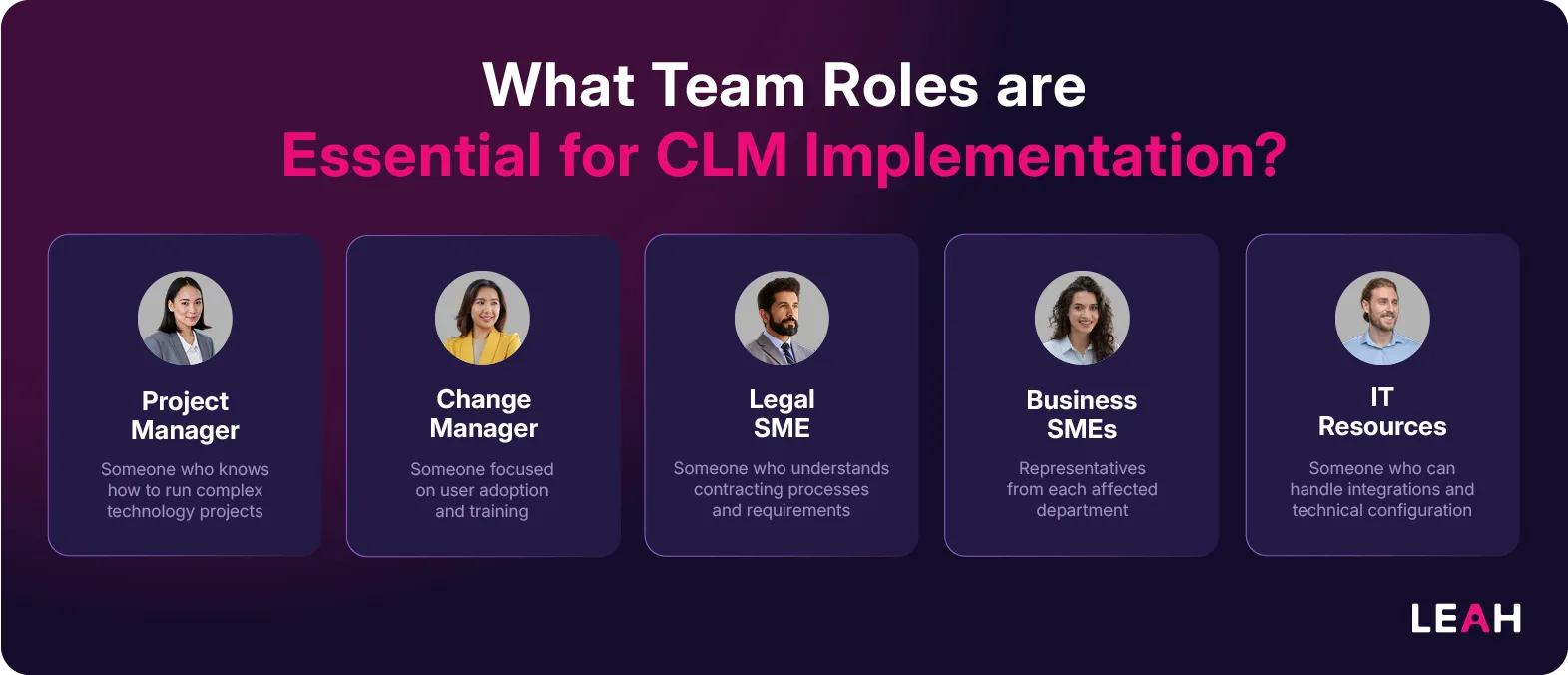
Cross-Functional Executive Sponsorship Strategy
CLM success requires C-suite collaboration beyond legal leadership.
One of the most critical—and overlooked—aspects of CLM readiness is securing appropriate executive sponsorship across all affected business functions.
Legal Executive Engagement:
- Focus on risk mitigation and compliance enhancement
- Emphasize process standardization and efficiency gains
- Highlight talent optimization through automation
- Demonstrate strategic value contribution beyond cost center perception
Sales Executive Engagement:
- Prioritize deal cycle acceleration and revenue optimization
- Showcase pipeline visibility and forecasting improvements
- Emphasize customer experience enhancement through faster contract execution
- Quantify opportunity cost reduction from approval delays
Procurement Executive Engagement:
- Highlight spend visibility and supplier performance management
- Demonstrate cost avoidance through better renewal management
- Emphasize risk mitigation through improved obligation tracking
- Show strategic sourcing support through contract analytics
Finance Executive Engagement:
- Focus on revenue recognition acceleration and accuracy
- Demonstrate audit readiness and compliance cost reduction
- Highlight contract analytics for strategic decision-making
- Show integration benefits with existing financial systems
Each executive sponsor must understand their specific value proposition and actively champion adoption within their organization.
The Change Management Foundation
Change management isn't an afterthought—it's the foundation of CLM success.
Contract management affects more business functions than almost any other enterprise system, making change management exponentially more complex than typical technology implementations.
Early Change Management Activation: The most successful CLM implementations begin change management during vendor selection, not during implementation. When stakeholders understand evaluation criteria and anticipated benefits, adoption resistance decreases significantly.
Stakeholder Communication Strategy:
- Regular updates on CLM evaluation progress and selection criteria
- Department-specific value proposition communication
- Process road showing to demonstrate workflow improvements
- Feedback collection on requirements and implementation concerns
Change Champion Development:
- Identify influential advocates within each affected department
- Provide early access to CLM capabilities and training
- Empower champions to address concerns and resistance within their teams
- Create feedback loops for continuous improvement recommendations
Training and Adoption Support:
- Role-specific training programs tailored to departmental needs
- Comprehensive resource libraries including FAQs and video tutorials
- In-application guidance and contextual help systems
- Ongoing support channels with clear response time commitments
Implementation Readiness: The Phased Success Model
Iterative value delivery beats comprehensive implementation.
Organizations that attempt to implement all CLM capabilities simultaneously typically experience longer timelines, higher costs, and lower adoption rates. The enterprise transformation approach delivers value through strategic phasing.
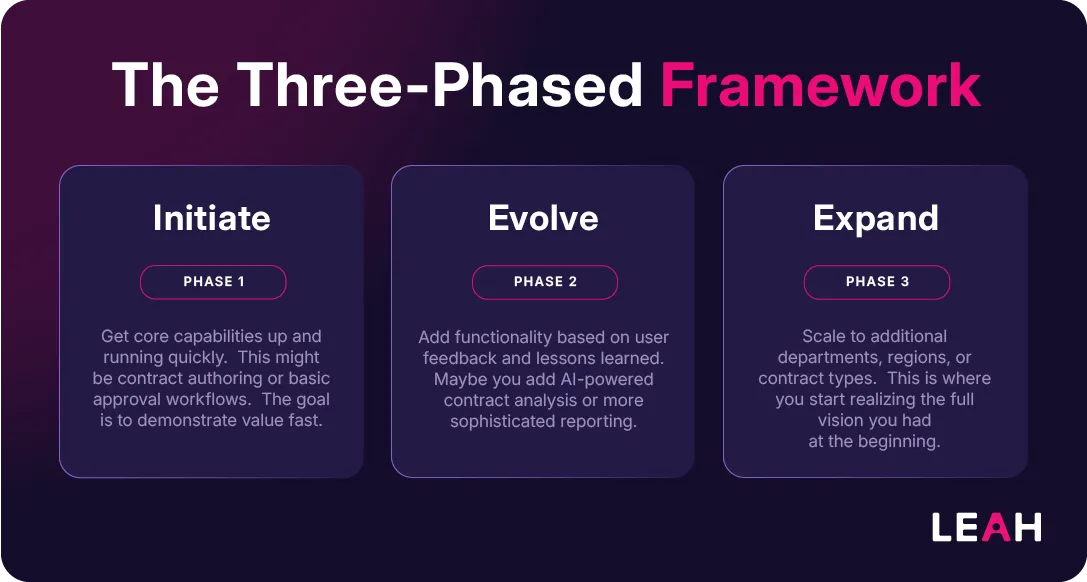
Phase 1: Foundation Building (Months 1-3)
- Centralized contract repository with comprehensive search capabilities
- Basic approval workflows for high-volume contract types
- Primary system integrations with CRM and ERP platforms
- Core user group training for legal and sales teams
Phase 2: Capability Expansion (Months 4-8)
- Advanced workflow automation for complex approval matrices
- Additional integrations with procurement and finance systems
- Enhanced analytics and reporting capabilities
- Expanded user base including procurement and finance teams
Phase 3: Advanced Optimization (Months 9-12)
- AI-powered contract analysis and recommendation capabilities
- Predictive analytics for risk assessment and renewal planning
- Complete enterprise system integration and data synchronization
- Organization-wide adoption across all contract stakeholders
This phased approach enables continuous learning, adjustment, and value demonstration while maintaining business continuity.
Success Measurement Framework
Measurement discipline separates successful implementations from failures.
The enterprise transformation approach establishes clear success metrics before beginning the CLM journey, enabling objective evaluation and continuous improvement.
Quantitative Business Impact Metrics
Qualitative Organizational Metrics
Implementation Health Metrics
The Leah Enterprise Transformation Advantage
Leah uniquely combines advanced CLM technology with deep enterprise transformation expertise. Our approach addresses the complete readiness spectrum:
Strategic Consultation Services:
- Comprehensive pain point assessment and prioritization
- Contracting maturity evaluation and roadmap development
- Executive sponsorship strategy and stakeholder engagement
- Change management planning and execution support
AI-Enabled Platform Capabilities:
- Future-ready architecture supporting advanced AI integration
- Configurable workflows adapting to organizational requirements
- Comprehensive analytics providing actionable business insights
- Seamless integration with existing enterprise systems
Implementation Excellence:
- Phased deployment strategies minimizing business disruption
- Comprehensive training programs tailored to organizational needs
- Ongoing support ensuring sustained adoption and value realization
- Continuous improvement frameworks optimizing long-term success
CLM Readiness Best Practices
1. Treat CLM as Enterprise Transformation
Successful implementations require the same strategic rigor applied to any major business transformation initiative. Technical capabilities must support business objectives, not drive them.
2. Begin with Pain Point Prioritization
Start with problems, not features. Comprehensive pain point mapping across all business functions ensures maximum impact and adoption success.
3. Assess Organizational Maturity Honestly
Your CLM approach must align with current contracting maturity levels. Overambitious implementations often fail due to organizational readiness gaps.
4. Plan for AI Integration
Select platforms capable of evolving with advancing AI capabilities. Future-proofing prevents costly platform migrations as technology matures.
5. Secure Cross-Functional Executive Sponsorship
Success requires active champions across all affected business functions. Legal leadership alone cannot drive enterprise-wide adoption.
6. Start Change Management Early
Begin stakeholder engagement during vendor selection. Early communication and involvement significantly improve adoption outcomes.
7. Implement in Strategic Phases
Deliver value iteratively through carefully planned implementation phases. Phased approaches reduce risk while demonstrating continuous value.
8. Establish Measurement Discipline
Define clear success metrics before implementation begins. Objective measurement enables continuous improvement and ROI demonstration.
Frequently Asked Questions
How long does CLM implementation typically take?
Implementation timelines vary based on organizational complexity and scope. Typical enterprise implementations range from 6-18 months using phased approaches, with initial value delivery beginning within 60-90 days.
What's the most common reason CLM implementations fail?
Insufficient organizational readiness, particularly lack of cross-functional executive sponsorship and inadequate change management, causes most failures. Technical issues are rarely the primary cause.
Should we implement AI capabilities immediately?
While AI capabilities offer significant value, organizations should prioritize foundational CLM capabilities first. AI features can be added progressively as organizational maturity and data quality improve.
How do we measure CLM implementation success?
Success measurement should include quantitative metrics (cycle time, cost avoidance, compliance rates) and qualitative assessments (user satisfaction, process maturity, collaboration effectiveness).
What's the typical ROI for CLM implementations?
Well-executed CLM implementations typically deliver 121-356% ROI within 18-24 months, primarily through cycle time reduction, cost avoidance, and improved compliance.
Ready to Transform Your Contract Management?
CLM readiness extends far beyond technology selection—it requires comprehensive enterprise transformation planning. Organizations that apply strategic rigor to CLM implementation achieve dramatically better outcomes than those focused solely on technical capabilities.
Transform your contract management with Leah's enterprise transformation approach. Our proven methodology combines advanced CLM technology with deep organizational change expertise, ensuring your implementation delivers sustained business value.
Get in touch today to schedule your enterprise transformation assessment and begin your journey toward CLM success.
About the Author: This article incorporates insights from Simon McCarthy, VP of Enterprise Transformation at Leah, who oversees enterprise relationships with strategic customers and specializes in CLM implementation success strategies. Be sure to read Part 2 in this series for continued insights.

![How to Write a CLM RFP: Complete Guide for Legal & Procurement Teams [2026]](https://d32q3dexag516z.cloudfront.net/64d506de4c92a679c361f5c0/6958b1026bd074f1b27e810c_Hero_RFP-CLM_1200x628.webp)