
Today, nearly every business has a contract repository in place. The contract lifecycle management (CLM) journey is well-known although most businesses have not ventured past the first few phases, and the benefits of contract management with AI.According to a recent Forrester Wave Research study:
- 96 percent of respondents have a contract repository (Stage 1)
- 78 percent of respondents can generate reports and do analysis (Stage 2)
- 60 percent of respondents have a system in place for contract authoring and negotiation (Stage 3)
- 38 percent of respondents have a contract management system that is integrated into another business application, such as for eSourcing, or price quote configuration (Stage 4)
Innovations in artificial intelligence (AI) over the past several years enable businesses to progress further along the CLM spectrum. The Forrester report shows that few of the traditional CLM vendors (24 percent) have AI functionality beyond analytics and change approvals. Still, many experts agree that the future will see AI playing a much bigger role.
THE AI LEGAL TECH REVOLUTION
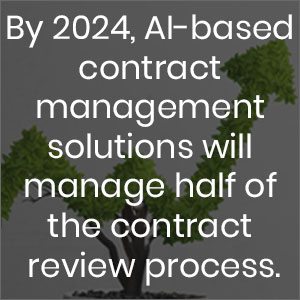
A recent Gartner report predicts that by 2024, technologies will replace almost 69% of the manager’s workload. This will lead to increased efficiencies and reduced costs for corporate legal departments. In fact, by 2023, 90 percent of multinational companies will have CLM solutions in place.In essence, this change means that businesses will need more skilled staff on hand. The latter will help configure and train AI bots on the sorts of contract terms and conditions that businesses deem acceptable. Meanwhile, corporate legal personnel will be freed up from repetitive, high-volume reviews of Ts and Cs. By 2023, 90% of multinational companies will have CLM solutions in place.This adoption and trust of intelligent CLM solutions require significant shifts in both thought and culture. Nevertheless, CLM solutions are empowering businesses, even across regulated industries, including:
- Health care

To many, legal technology and revolution may seem like contradictory terms. But rapid data growth, and evolving regulatory and governmental standards all increase the need for automation in the realm of contract management.
WHY AI IS PERFECTLY SUITED FOR CORPORATE LEGAL DEPARTMENTS
Historical precedents, time-tested terms, and data-driven decisions are contracting strategies that corporate legal types appreciate. AI review bots can review contract terms at blazing speed, as instructed by their programming. They can identify non-standard, potentially problematic clauses, and alert their human counterparts to study complex terms, as well as crawl through a records repository to identify search terms.And as contract repositories grow, AI engines learn more through machine learning. The opposite is true for humans because of information overload.So, as legal professionals approve or deny clauses or terms in their AI-assisted review, AI bots embed those decisions in their “memory banks" and become more efficient over time.A report on legal innovation by Raconteur discusses how outside law firms will have to evolve their services and billing models as it pertains to document review. A part of this change will be a move to 'Alternative Fee Arrangements', while other law firms will have to focus on providing more strategic advisory services around mergers and acquisitions, and globalization.
MITIGATING RISK AND IMPROVING COMPLIANCE WITH CONTRACT MANAGEMENT AI
Have you ever heard the technologist’s mantra, “To err is human; to automate, divine?”In any case, there are many benefits of automating contract review and assembly:
- Reduction of human errors like typos or unclear/incorrect terms
- Faster approvals and negotiations
- Improved reporting and performance analytics
- Greater trust and confidence in data, enabling more effective decision-making
- High-volume and low-complexity review
- Faster reach across vast stores of unstructured contract files and structured data, in Salesforce, for example
- Decreased customer churn and improved employee productivity (Forrester)Ability to make queries in natural language instead of complex Boolean searches
Most human beings, particularly millennials, like to be challenged, and handle a variety of tasks and duties in order to perform at our best. So contract management applications, powered by AI, allow attorneys at all stages of their career to spend less time on menial document review and more time learning new skills.Much has been written about how contract management with AI adds value to the corporate legal department. But the benefits extend throughout organizations, including:
- Sales and marketing
- Product management and engineering
- Procurement and supply chain management
- Finance and operations
- Executives and boards of directors
- Partner/channel managers
Driving efficiencies and standardizing processes across the organization benefit all of these stakeholders, not to mention individual investors.
CONTRACT RECORDS MANAGEMENT, GOVERNANCE, AND COMPLIANCE
Contracts are classified as records because they are evidence of business transactions. They include private, sensitive data that should only be accessible to employees on a need-to-know basis. They, and their metadata, have defined retention requirements.Contract review based on robotic process automation helps to preserve permission-only access to contracts while allowing bots access to a broader set of files to approve newly-signed agreements.Many contracts include details about a relationship between two businesses - or individuals - whether or not it goes as planned. Much of the “non-compliance” terminology is standard across many agreements. Yet if non-compliance language isn’t included in the satisfaction of regulatory auditors, businesses could be subject to fines or other penalties.Compliance regulators also like to see defined decision-making and business process structure - and for it to be adhered to. They want to see how contract terms are escalated whenever issues or anomalies occur. Intelligent CLM applications can provide comprehensive, time-measured reports, which identify what happened whenever irregularities occur, and who did what when alerted to it.Because AI review bots follow specific rules in their programming, they mitigate an organization’s exposure to liability and penalties. They also create incredibly accurate reports.In summary, contract management with AI platforms empower businesses to increase productivity while reducing overall risk. Many contract management solutions in the marketplace are too focused on the core repository and offer little in the way of process automation or machine learning. Businesses, instead, need advanced contract reporting to understand historical trends, make decisions based on predictive analytics, and demonstrate compliance.Leah offers an intuitive solution built on the IBM Watson platform. Users in legal, sales, and other business departments don’t need advanced technical skills to capture, process, and execute contracts, or find the insights that they need. Natural language searches and programming make all of the difference.Want to better understand the opportunity of Leah’s intelligent CLM platform? Request a demo from one of our CLM experts today.
Author:

Sarvarth Misra Connect with us on Linkedin