
Quick answer: The future of contract management is AI-assisted, connected, and measured. Market researchers size the contract lifecycle management (CLM) software market at USD 1.8 billion (Grand View Research) to USD 2.6 billion (IMARC Group) in 2025 and forecast it to more than double by 2033 or 2034. Meanwhile, World Commerce & Contracting estimates the average business loses almost 9% of value each year through poor contract management.
The biggest trend for 2026 is AI moving into everyday contract work: organization-wide AI use in professional services rose to 40% in 2026 from 22% in 2025, according to the Thomson Reuters Institute. Use the sourced figures below for context, then measure your own cycle times and value leakage before and after any change.
Last reviewed: November 17, 2026. Every figure below links to its original publisher.
Contract management metrics should support decisions, not create false precision.
This roundup collects contract management statistics for 2026 in five groups: market and adoption, cycle time and cost, value leakage, risk and compliance, and AI use. We included a figure only if we could open the original source and confirm the number, the year, and what it measures. Forecasts are labeled as forecasts. Where a study was produced with a software vendor, we say so. If you are new to the category, start with what contract lifecycle management (CLM) is.
How to compare contract metrics before and after CLM
External statistics give context. The evidence that matters for your decision is your own before-and-after comparison, measured the same way both times. Use this worksheet to set it up.
| Metric | Measure it the same way before and after | Where the data comes from | Pitfall to avoid |
|---|---|---|---|
| Cycle time | Median days from complete request to signature, by contract type and value band, plus the range | Intake timestamps and e-signature completion dates | Blending NDAs and complex supplier deals into one average |
| Time by stage | Days in the legal queue, with the requester, with approvers, and with the counterparty | Workflow status history | Crediting a tool for delays that sit with the counterparty |
| Intake quality | Share of requests that arrive complete the first time | Intake form and request log | Changing the required fields between the two periods |
| Standard terms | Share of contracts signed on approved templates or within playbook fallback positions | Repository and redline history | Counting a template as "used" when most clauses were renegotiated |
| Value leakage | Missed renewal notice dates, off-contract price variances, and unclaimed credits or rebates | Repository plus ERP or accounts payable data | Comparing yourself to an outside benchmark instead of your own baseline |
| Renewal readiness | Share of renewals with a named owner and a recorded decision before the notice deadline | Obligation tracker and calendar | Counting only high-value contracts in one of the periods |
| Data quality | Share of contracts with parties, dates, notice periods, and key clauses captured and verified | Sample audit of the repository | Trusting AI extraction without a sampled human check |
| AI review quality | Share of AI suggestions accepted, edited, or rejected on a fixed test set of your own contracts | Review logs | Testing only on short, simple agreements |
Freeze the definitions before you collect the baseline, use a period that covers your normal mix of contract types, and report the median and range for each measure. For definitions and formulas, see our guide to contract management KPIs.
Contract management statistics for 2026
Market and adoption
- CLM software market, IMARC Group estimate (forecast): IMARC Group estimates the global CLM software market grew from USD 2.6 billion in 2025 to USD 2.8 billion in 2026 and forecasts USD 5.7 billion by 2034, a 9.2% compound annual growth rate (CAGR) for 2026 to 2034 (IMARC Group market report summary).
- CLM software market, Grand View Research estimate (forecast): Grand View Research values the market at USD 1.8 billion in 2025 and forecasts growth from USD 2.0 billion in 2026 to USD 4.6 billion by 2033, a 12.9% CAGR, in a report published in October 2026 (Grand View Research).
- Regional split: Grand View Research puts North America at 37.0% of CLM software revenue in 2025 and expects Asia Pacific to grow at the fastest rate from 2026 to 2033 (Grand View Research).
- CLM adoption in legal departments: 62% of respondents reported using contract lifecycle management technology in the 2024 Harbor Law Department Survey of 186 organizations across more than 15 industries and 14 countries, published in CLOC's 2025 State of the Industry Report (CLOC 2025 State of the Industry Report, PDF).
- US federal contracting volume: The US federal government committed about $755 billion on contracts in fiscal year 2024, about $22.5 billion less than in fiscal year 2023 after adjusting for inflation (US Government Accountability Office, June 2025).
What it means for your team: The two market estimates differ for the same year because publishers define and size the market differently, so always quote the publisher and year rather than "the" market size. For your own business case, the adoption gap inside your organization (who still works outside the system) matters more than market growth.
Cycle time and cost
- Average cycle times: World Commerce & Contracting (WorldCC) reports that in its 2023 data the average cycle time for medium-complexity domestic contracts was 11.6 weeks, and 13.7 weeks for international contracts (WorldCC, April 2025).
- Spread between organizations: WorldCC research finds average contract cycle time varies enormously across organizations, with the best performers operating almost 4 times faster than the worst (WorldCC whitepaper, August 2025).
- Budgets and headcount: In CLOC's 2026 State of the Industry Report, covering 135 law departments, only 47% of departments expected inside legal spend to increase (down from 65% a year earlier), and only 32% expected attorney headcount to increase (CLOC, March 2026).
- Time savings reported by AI users (self-reported): Legal respondents in Deloitte and DocuSign's 2026 global study of more than 1,100 leaders reported an average time savings of 37% across agreement management activities; DocuSign sells agreement software, and the figure is self-reported (Deloitte, September 2026).
What it means for your team: Legal demand is rising faster than budgets and headcount, so faster cycles have to come from process, standard terms, and automation rather than more people. Measure cycle time by contract type and by stage before you accept any vendor's time-savings figure, including the ones above.
Value leakage
- Average value erosion: WorldCC research conducted with Deloitte, covering more than 1,200 organizations, estimates average value erosion at 8.6% of contract value, down from 9.2% in WorldCC's 2014 study; the best performers operate at a little over 3% and the worst at more than 20% (WorldCC, The ROI of Contracting Excellence, 2023, PDF hosted by Deloitte).
- Annual loss to poor contract management: WorldCC's August 2025 whitepaper says the average business loses almost 9% of value annually through poor contract management, with the best performers losing about 3% and the worst 15% or more (WorldCC).
- Procurement contracts: WorldCC's "Closing the procurement value gap" research, produced in partnership with a CLM vendor, puts value erosion in procurement contracts at 11% (WorldCC, January 2026).
- Contracts linked to finance: In a survey of nearly 200 businesses by WorldCC, the Commerce and Contract Management Institute, and a CLM vendor, organizations that treat contracts as financial intelligence outperformed their peers by an average of 5.4% of contract value, and 70% of respondents acknowledged a disconnect between contracts and financial oversight (WorldCC, September 2025).
What it means for your team: Value erosion is WorldCC's estimate of the gap between expected and actual contract results, and WorldCC notes that most organizations do not formally track it. Pick two or three leakage signals you can count, such as missed renewal notices, off-contract pricing, and unclaimed service credits, and track them every quarter.
Risk and compliance
- Unclear accountability: In the 2025 Benchmark Report from the CCM Institute and WorldCC, 48% of respondents acknowledged there is no clarity over who is accountable for contracting performance, and WorldCC says the true figure is closer to 70% to 80% (WorldCC Benchmark Report 2025).
- Legal and procurement working apart: Only 15% of organizations operate with shared contracting technology between Legal and Procurement, according to WorldCC's procurement value research (WorldCC, January 2026).
- Where negotiation effort goes: Limitation of liability, price or price changes, and indemnification are the three most negotiated terms on both the buy side and the sell side, yet just 16% of negotiators believe they are focusing on the right terms, according to the CCM Institute's Most Negotiated Terms 2026 research (CCM Institute press release, November 2026).
- Third-party exposure: Breaches involving a third party accounted for 48% of all breaches in Verizon's 2026 Data Breach Investigations Report, which is based on 2025 data, and third-party involvement was up 60% (Verizon, May 2026).
- Data protection enforcement: Fines under the GDPR totaled approximately EUR 1.2 billion in 2025 across the 16 European jurisdictions DLA Piper surveyed, and breach notifications rose 22% to an average of 443 per day (DLA Piper, January 2026).
What it means for your team: Contract risk sits in unclear ownership and in third-party terms as much as in clause wording. Name an accountable owner for each contract type, and track security, data protection, and liability commitments as obligations after signature, not only during negotiation.
AI use
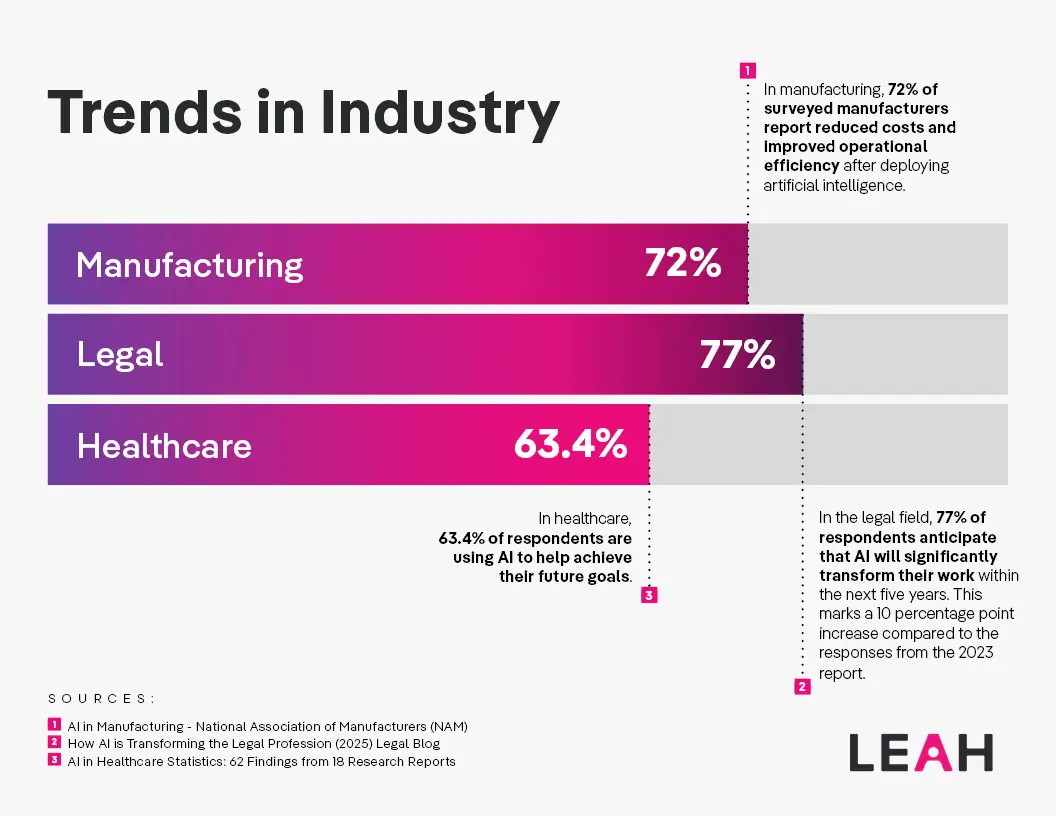
- AI use across professional services: Organization-wide AI use in professional services almost doubled to 40% in 2026, from 22% in 2025, in the Thomson Reuters Institute's survey of more than 1,500 respondents across 27 countries (Thomson Reuters Institute, February 2026).
- Agentic AI and ROI tracking: The same report found 15% of organizations had already adopted some type of agentic AI tool, while only 18% of respondents knew their organization was tracking the return on investment of AI tools (Thomson Reuters Institute, February 2026).
- In-house legal teams: Adoption of generative AI for legal work more than doubled to 52% among US respondents in the Association of Corporate Counsel (ACC) and Everlaw 2025 survey of 657 legal professionals worldwide (ACC and Everlaw, 2025).
- General counsel priorities: In a Gartner survey of 104 general counsel in July 2025, 36% were focused on adopting AI, while 37% reported relatively low confidence in using advanced contract analytics (Gartner, October 2025).
- AI in negotiation: 56% of negotiators now use AI, but only 30% of respondents use it to help create new contract language, according to the CCM Institute's Most Negotiated Terms 2026 research (CCM Institute press release, November 2026).
- Forecasts for legal AI: Gartner predicts legal technology budgets will double by 2028, and a Gartner analyst predicts that by 2029 about 50% of contract reviews will be delegated to self-service systems that escalate only one in 10 for human review (Gartner, May 2026).
- Accuracy is not a given: In a 2024 Stanford RegLab and Stanford HAI study of more than 200 legal queries, the legal research AI tools tested produced incorrect information more than 17% of the time, and one tool more than 34% of the time (Stanford HAI, May 2024).
What it means for your team: AI use is growing faster than measurement. Before you scale AI in contract review, agree on acceptance criteria, test on a fixed set of your own agreements, and keep a human approver on the decisions that carry risk. The Stanford study covered legal research tools rather than contract review, but the lesson about checking outputs applies to both.
Contract management trends to watch in 2026
These six themes carry over from our earlier CLM trends guide, updated for 2026. Use them as a checklist against your own agreements, controls, and operating model.
Generative and agentic AI in contract work
- AI-assisted review against your playbook, with a person approving the changes that matter
- Conversational search, so users can ask questions of a contract or a portfolio in plain language and see the clause each answer came from
- Extraction of parties, dates, obligations, and key clauses into structured data
- AI agents that run multi-step work such as intake, triage, and first-pass review, with clear rules for when to escalate to a lawyer
Sustainability and ESG terms in supplier contracts
- Supplier contracts are where sustainability commitments become enforceable: codes of conduct, reporting duties, audit rights, and remedies
- Track ESG commitments like any other obligation, with an owner, a due date, and evidence of performance
- Requirements differ by jurisdiction and continue to change, so confirm with counsel which rules apply to your supply chain
Proactive risk management
- Review that flags deviations from your standard positions before signature, not after a dispute
- Automated alerts for obligations, renewals, and notice periods
- Third-party terms (security, data protection, liability caps) monitored after signature, given how often breaches now involve a third party
Integration with enterprise systems
- CLM connected to CRM, ERP, and procurement systems so contract data flows both ways
- Less manual re-keying of prices, dates, and parties, which reduces errors
- Shared contract data for legal, procurement, finance, and sales, so each team works from the same record
Modular, self-service contracting
- Business users self-serve standard agreements from approved templates, while legal handles exceptions
- Rollouts that start with one contract type or workflow and expand once the results are measured
- Configurable components, so the platform fits your approval rules instead of the other way around
Data security and privacy
- Role-based access, encryption, and audit trails for sensitive contract data
- Compliance with data protection laws such as the GDPR and the CCPA, including the data processing terms you sign with vendors
- Identity verification and e-signature controls, so only authorized people can sign or view agreements
Start with a reliable baseline
Before setting a target, identify the stages that matter for the agreement type: intake, drafting, negotiation, approval, signature, handoff, renewal, and obligation management. Measure the median and range, not only a blended average. A sales agreement, a procurement agreement, and an employment agreement can have very different paths and risk thresholds.
- Time to agreement: Track elapsed time by agreement type, value band, business unit, and negotiation path. Separate time in a legal queue from time waiting for a requester, approver, or counterparty.
- First-pass quality: Record how often an intake is complete, an approved template is used, or a request is returned for missing information.
- Approval health: Show where work pauses, how often an exception is requested, and whether each handoff has a named decision-maker.
- Contract data quality: Test whether parties, effective dates, notice periods, key clauses, and obligations are complete and can be retrieved when required.
- Renewal readiness: Track upcoming notice periods, commercial owners, dependencies, and decisions before an agreement renews.
How to use external statistics
External research can provide context, but only when readers can see what the statistic measures. Record the publisher, source date, population, methodology, currency, and definition. Do not compare an analyst forecast, a vendor benchmark, and an internal baseline as though they describe the same outcome.
The market-research firm IMARC Group estimates the global CLM software market reached USD 2.6 billion in 2025 and forecasts USD 5.7 billion by 2034, with a 9.2% CAGR for 2026–2034. That is a market estimate and forecast, not evidence that a particular implementation will deliver a given time, cost, or risk result. Read the IMARC market report summary.
The market estimates above show why. IMARC Group and Grand View Research publish different values for the same year because they define and model the market differently. Both are estimates and forecasts, not evidence that a particular implementation will deliver a given time, cost, or risk result. The same caution applies to surveys produced with software vendors: they are useful signals, but the respondents and questions shape the answer.
Build a decision-ready scorecard
A useful scorecard connects operational measures to a decision. For example, a team considering automated intake can compare the completeness of requests before and after a pilot. A team improving renewal management can compare the percentage of agreements with a named owner and a decision recorded before the notice deadline. A team evaluating AI-assisted review can use representative agreements, a defined reviewer, and agreed acceptance criteria.
- Choose one outcome and state its owner.
- Document the population and time period before collecting data.
- Keep source links and calculation logic with every external statistic.
- Review results with legal, procurement, finance, security, and the business team affected.
- Retire a metric when its source or definition can no longer be checked.
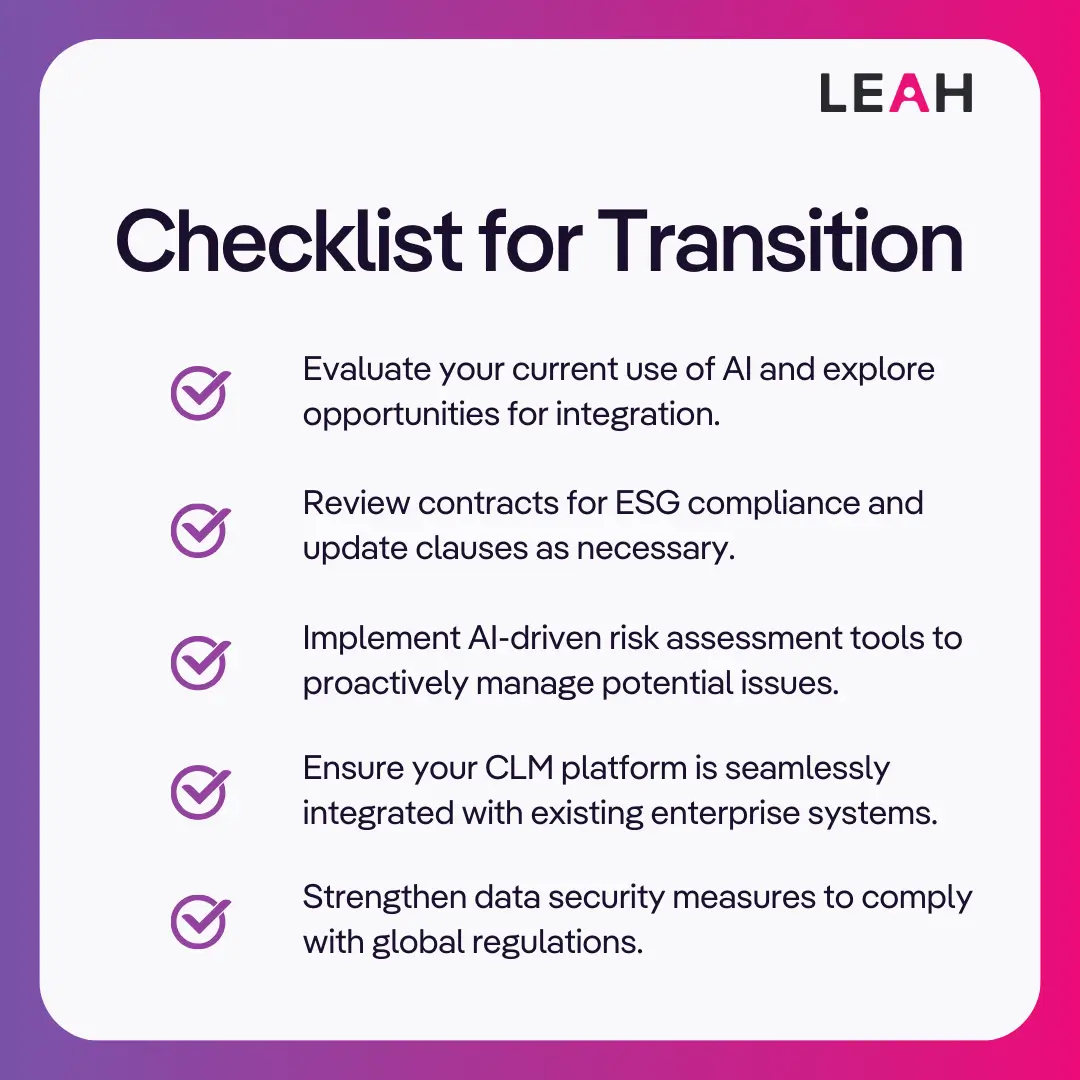
Start with an internal audit of your current contract process against the six trends above, then turn the gaps into a roadmap with named owners, data controls, review checkpoints, and measurable outcomes. To translate the results into a financial case, see our guide to contract management ROI.
Evaluate technology claims in context
Automation and AI can support extraction, triage, search, drafting, and review. Results depend on the agreement set, configuration, integrations, controls, human review, and adoption. Ask vendors to demonstrate priority workflows with representative agreements, explain the controls around outputs, and identify the implementation work required. That creates a better decision than relying on a headline percentage.
When a vendor makes an AI accuracy claim, ask for:
- Results on a test set of your own agreements, not only the vendor's demo documents
- How each answer or redline links back to the clause or source it came from
- Which outputs a person must approve, and how reviewer edits are logged
- How accuracy is monitored after go-live, and what happens when it drops
Our CLM RFP guide turns these questions into evaluation criteria.
Leah, formerly ContractPodAi, builds Leah Agentic CLM, a contract lifecycle management platform in which AI drafts, reviews, routes, and tracks contracts while your team approves the decisions that matter. Leah was named a Leader in The Forrester Wave™: Contract Lifecycle Management Platforms, Q4 2026. If you are comparing platforms, ask every vendor, including Leah, to run the before-and-after worksheet above on your own agreements.
FAQ
What is the future of contract management?
Contract management is moving from storing signed documents to running the whole lifecycle with AI-assisted drafting, review, and obligation tracking, while people approve the decisions that carry risk. A Gartner analyst predicts that by 2029 about 50% of contract reviews will be delegated to self-service systems that escalate only one in 10 for human review (Gartner, May 2026). The other shift is toward measurement: teams that baseline cycle time and value leakage can show what changed.
How big is the contract management software market?
Estimates for 2025 range from USD 1.8 billion (Grand View Research) to USD 2.6 billion (IMARC Group) for CLM software. Both publishers forecast the market to more than double, to USD 4.6 billion by 2033 (Grand View Research) and USD 5.7 billion by 2034 (IMARC Group). The figures differ because each publisher defines and models the market in its own way, so cite the publisher and year when you use one.
What are the latest trends in contract management solutions in 2026?
The main trends are AI-assisted and agentic contract work, CLM connected to CRM, ERP, and procurement systems, self-service for standard agreements, closer tracking of third-party and data protection terms, and a stronger focus on measuring results. Ownership is the gap to watch: 48% of respondents in the 2025 CCM Institute and WorldCC benchmark said there is no clarity over who is accountable for contracting performance (WorldCC Benchmark Report 2025).
What are the future trends in AI for contract management?
Expect AI to take on more first-pass review, extraction, and negotiation support, with more autonomy for routine work and human review for exceptions. 56% of contract negotiators already use AI, according to the CCM Institute's Most Negotiated Terms 2026 research (CCM Institute press release). Accuracy and measurement are the open questions, so ask vendors for results on your own agreements.
How do you compare contract metrics before and after implementing a CLM?
Freeze your metric definitions first, then measure the same contract types over comparable periods before and after go-live. Track median cycle time by stage, intake completeness, use of standard terms, renewal decisions made before the notice deadline, and data quality, as in the worksheet above. Separate delays caused by counterparties from delays inside your own process so you credit the right cause.
What evidence shows CLM shortens contract cycles?
Published evidence is mostly benchmark and survey data, so treat it as a signal rather than proof for your organization. WorldCC research finds the best performers run contract cycles almost 4 times faster than the worst (WorldCC, August 2025), and legal respondents in a 2026 Deloitte and DocuSign study self-reported average time savings of 37% across agreement management activities (Deloitte, September 2026). The strongest evidence is your own before-and-after comparison.