
Your most experienced lawyers can spot a problem clause in seconds. Yet much of their week still goes to moving contracts along and answering routine questions from the business. That's a costly use of scarce expertise, and it's why the next era of contracting starts with a different question: what if the process moved itself, and lawyers stepped in only where their judgment is needed?
That question is the starting point for agentic contracting, where AI agents handle each stage of a contract's life and bring people in only for the decisions that need them.
Key takeaways
- Traditional CLM organizes contracts, and the AI added to it speeds up individual tasks, but a human still moves each contract from step to step.
- Agentic contracting builds the system for AI agents to run each stage, with people stepping in only for decisions.
- Multiple AI models are widely available, so the real difference comes from the harness: the context and limits built around AI agents.
What customers now expect from contracting technology
Expectations are shifting. Organizations want AI to run more of the contracting process itself, within their own guardrails and only as far as they're comfortable. That might mean handling routine redlines, moving a contract from approval through to signature, or pulling obligations out of a signed agreement. The goal is to take on the manual work and bring the right people in only when there's a decision to make.
That raises a bigger question for the whole category. Can existing contract software meet this expectation by adding more AI on top, or does the software itself need to be built differently?
How contract management software evolved
Over the past few years, AI has found its way into nearly every business system companies rely on. CRM, ERP, HR, and CLM tools now come with built-in AI that can summarize documents, answer questions, and pull out key information. In contract lifecycle management, it can also review documents and suggest redlines. Most of this AI was designed to speed up a single task, and a person still runs the process around it. The way contract software evolved explains why.
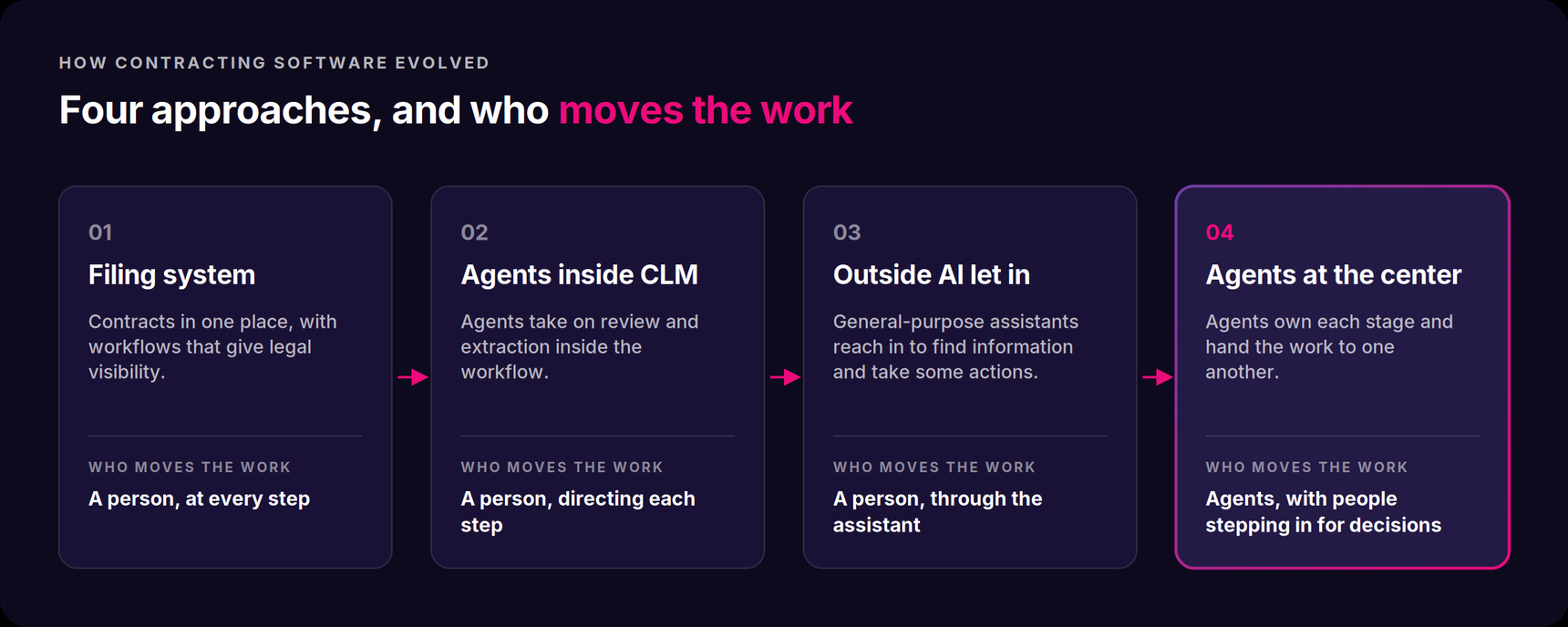
01 Contract software as a filing system. The first generation of contract lifecycle management software brought much-needed order. Contracts lived in one place, and workflows gave legal teams visibility. And people moved the contract from step to step: submitting the request, uploading the document, confirming the details the system extracted, and applying the relevant playbooks.
02 Agents inside CLM. The natural next step was to bring AI into existing CLM tools. Agentic CLM put agents to work on data extraction, contract review and redlining inside the workflow, and those agents have delivered real value to customers by speeding up the entire process. But a human was still needed to move the contract from one stage to the next within the lifecycle.
03 Letting outside AI in. Another approach has been to open these systems up, so outside AI assistants can come in to find information and take actions for a user. Contracts and data stay in one place, and people can work through whichever general-purpose AI tool they prefer. It's a useful step. But the software underneath is still built for people to click through, and the assistant still arrives without the context contracting depends on.
04 Rebuilding with agents at the center. All these approaches showed what agents could do. Once agents could work across several systems at once, the opportunity grew beyond individual tasks: agents that move the work forward themselves, instead of producing output for a person to act on. Which has led to the next era in contracting: rebuild contracting software around the agents themselves, so the system is designed from the start for agents to do the work. In that model, agents own each stage of the process and hand the work to one another.
How agentic contracting works
In agentic contracting, an agent takes responsibility for each stage of a contract's lifecycle, from the first request through negotiation, approval, signature, and the obligations that follow. When one agent completes its stage, it hands the work to the next. People come in only when a decision needs to be made.
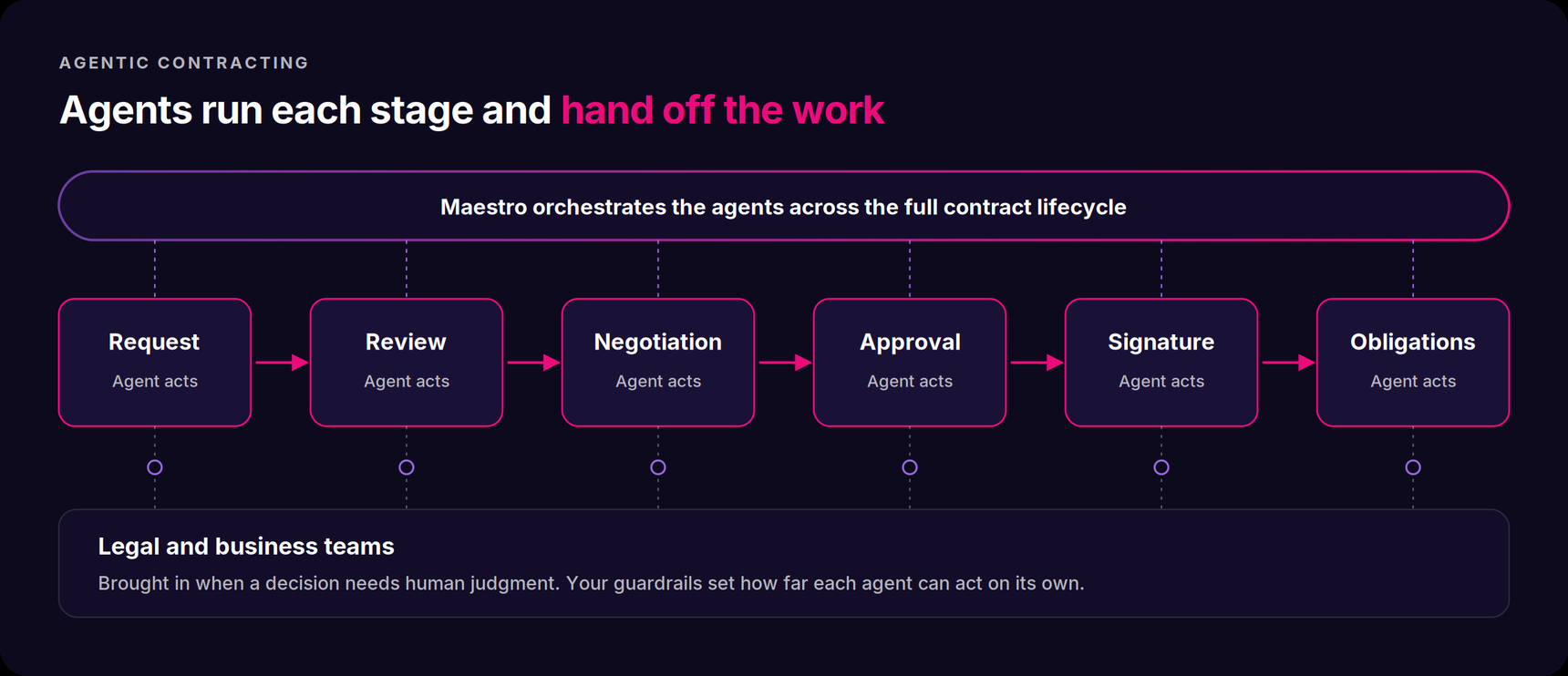
Each agent is built for its job, with the context, skills, and limits its stage requires. That context comes from two places:
- The contracting expertise built into the agents
- Your own business, from your playbooks to your approval rules
For your team, this changes where time goes. Lawyers spend their day on the tasks that need their expertise and judgment, agents carry the work between steps, and there are fewer surprises about what you've committed to.
Traditional CLM and agentic contracting, side by side
| Aspect | Traditional CLM | Agentic contracting |
|---|---|---|
| Who moves the work | A person moves each contract from step to step | Agents complete each stage and hand the work to the next |
| Starting a contract | Someone submits the request and uploads the document | Business teams send contracts through the chat and email tools they already use |
| First review | Someone confirms the extracted details and chooses the right playbook | The agent checks the contract against your playbook, makes the changes it's allowed to make, and explains each one |
| How AI helps | Speeds up single tasks, such as summarizing or suggesting redlines, once a person starts them | Runs each stage within the guardrails you set |
| Where lawyers spend time | Across every step of the process | Only on the questions that need legal judgment |
| After signature | Obligations are stored with the contract until someone acts on them | Obligations are extracted, assigned to owners, and checked against uploaded proof |
| Setup | Workflows and templates configured by hand, often through long implementations | Approval processes described in plain language, with far less manual template setup |
An agentic harness for enterprise contracting
AI models are widely available to everyone, but a harness designed specifically for contracting is where the difference lies. An agentic harness is the structure around an AI model that lets it do real work. It defines what the agent knows, what it can do, what it's allowed to change, and what happens next.
In contracting, a harness gives the agent:
- The contract and your playbooks; the guardrails within which the agents should function
- A record of what earlier agents have done on the deal, so each step builds on the previous ones
- Clear limits on approvals, so the agent knows what it can change on its own and where a person has to decide
A general-purpose assistant connected to your contracts can find a clause. An agent built for contracting knows which position your company takes on that clause and when to bring in a lawyer.
Example: turning a contract checklist into consistent reviews
Consider a scenario with an enterprise organization. One of its subsidiaries relied on a contracting checklist for supply agreements, kept as a Word document in a folder. The agreements ran to about 40 pages, and each manual review took hours. As a result, some checks happened and others did not. Sometimes legal found out only after signature, when an issue surfaced.
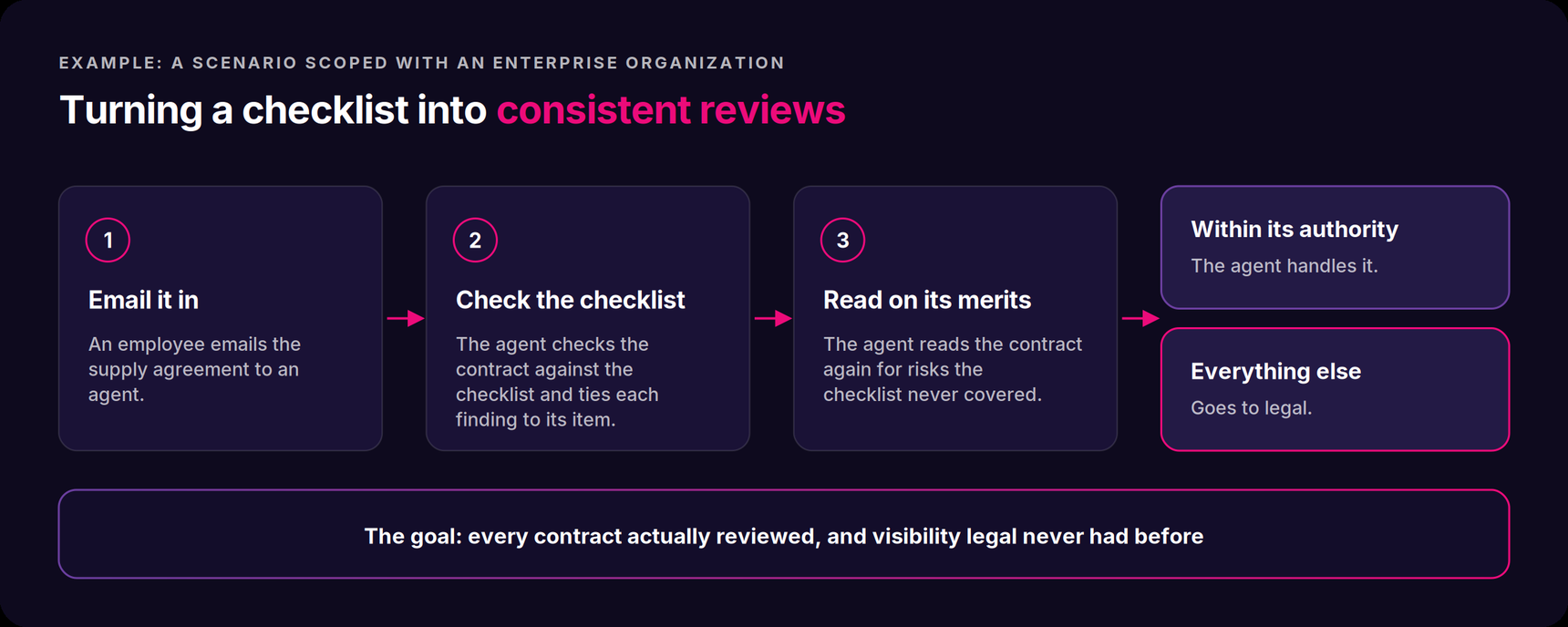
Agentic contracting keeps things simple for the business. Employees email the contract to an AI agent. The agent first checks the agreement against the checklist and ties each finding back to the item it came from. Then it reads the contract again on its own merits, looking for risks the checklist never covered. Anything within the agent's authority gets handled, and everything else goes to legal. Now every contract gets the same review, and legal gains visibility it never had.
The same handoff continues after signature, where much of a contract's value is won or lost, from meeting deadlines to managing renewals. In traditional CLM, obligations are stored with the contract until someone acts on them. In agentic contracting, agents keep managing them:
- The agent pulls each obligation out of the signed contract and assigns it to an owner.
- Recurring due dates are worked out from the contract's own terms.
- When someone uploads proof that an obligation has been met, the agent can review it.
How agentic contracting changes the work for your teams
For legal teams
In traditional CLM, a new contract arrives as a task for someone to pick up, route, and review. With agentic contracting, the legal team finds the first review already done. The agent has checked the contract against your playbook and made the changes it's allowed to make, with a note explaining each one. The questions that need a lawyer are waiting at the top. The agent can also point out issues your playbook doesn't cover, so nothing slips through because no one wrote a rule for it.
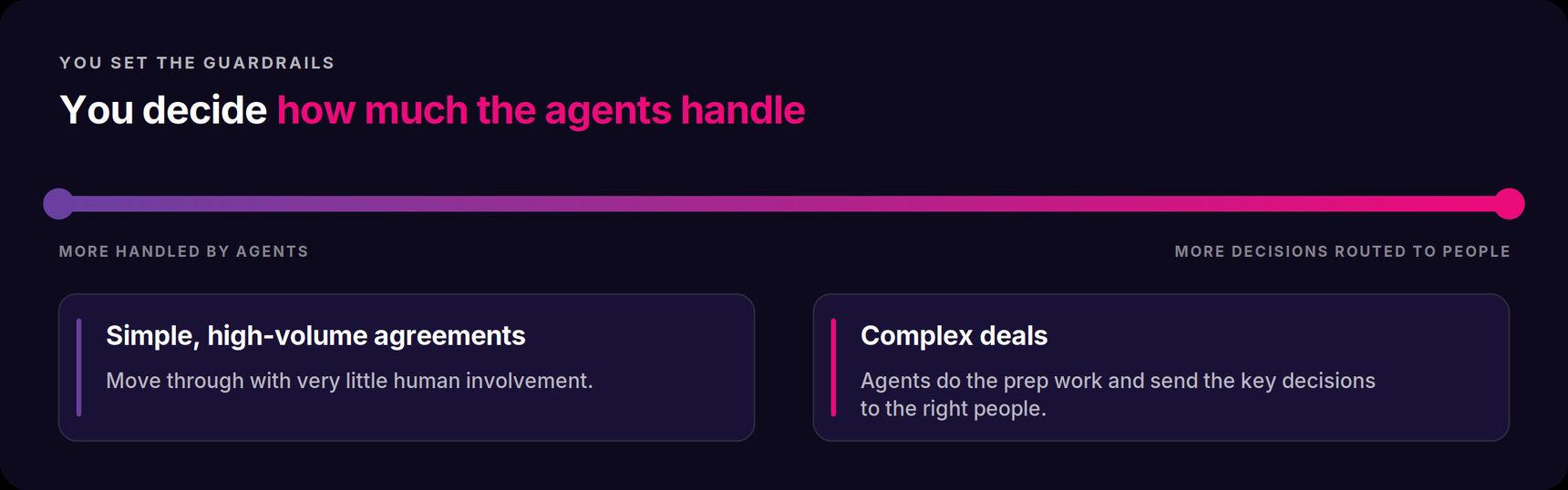
You decide how much the agents handle on their own. Simple, high-volume agreements can move through with very little human involvement. Complex deals still get the prep work done, with the key decisions sent to the right people. You set every guardrail.
For business teams
In traditional CLM, business teams log into a separate system to submit a request and upload the document, and a question about an existing agreement usually means waiting on legal. With agentic contracting, business teams get help where they already work. Someone in sales or procurement can send a contract through the chat and email tools they use every day, and ask questions about existing agreements in plain language.
For the teams setting it up
Setting the system up gets easier too. Traditional CLM rollouts depend on configuring workflows and templates by hand. With agentic contracting, teams can describe the approval process they want in plain language, and new templates take far less manual setup. That means less time and money spent on long implementations, which matters most for smaller legal teams without spare capacity.
Questions to ask before moving to agentic contracting
- Time spent: How much of your team's time goes into moving contracts from one step to the next?
- Human decisions: Which contracting decisions really need a person, and has anyone written them down?
- Handoffs: When the AI in your current tools finishes a task, who picks up the work?
- Context: What would an agent need to know to act on your behalf, and where does that information live today?
- Guardrails: Which contract types could move through with little or no human involvement today, and which should always reach a lawyer?
- Approval limits: Where does an agent's authority end? Is that written down as clear approval rules, or does it live in people's heads?
- Playbooks: Are your playbooks and checklists current, and are they applied to every contract or only when someone remembers?
- Business teams: How do people in sales or procurement start a contract or ask about an existing one today, and how often does that mean a question to legal?
- After signature: Who tracks obligations, deadlines, and renewals once a contract is signed, and how do you know they've been met?
- Transparency: When an agent makes a change, can your team see what it changed and why? Can they trace each finding back to the rule it came from?
- Gaps in your rules: What happens when a contract raises an issue your playbook doesn't cover?
- Setup: How long did your last CLM rollout or new template take? Could your team describe its approval process in plain language today?
What the new era of contracting means for your team
Earlier contracting technology was judged by what it stored and how much it sped up individual tasks. The new era will be judged by how much of the work actually gets done and how reliably each decision reaches the right person.
That's the thinking behind Leah Contracting, powered by Maestro. Agents act across the full life of a contract, and people stay in control of the decisions that shape risk and value.
See Leah Contracting in action
Frequently asked questions about agentic contracting
What is agentic contracting?
Agentic contracting is an approach where AI agents handle each stage of a contract's life, from intake and review through approvals, signature, and obligations. People join when a decision needs their judgment. The company sets how much the agents can do on their own.
How is agentic contracting different from traditional CLM?
Traditional CLM organizes contracts and workflows, and people move each contract from one step to the next. In agentic contracting, AI agents handle each stage and pass the work along. Lawyers are brought in for the questions that need them.
What's the difference between adding AI to CLM and agentic contracting?
Adding AI to existing CLM tools makes individual tasks faster, such as summarizing a contract or suggesting edits. A person still starts each task and decides what happens next. Agentic contracting builds the system around agents, so the work keeps moving until a decision needs a person.
Will AI agents replace lawyers in contract review?
No. Agents handle routine issues within limits the company sets and escalate everything else to legal. Lawyers spend more of their time on the questions that need legal judgment.
Can a general-purpose AI assistant manage contracts?
A general-purpose assistant can connect to a contract repository and find information. It lacks the context contracting depends on, such as which playbook applies and where its authority ends. An agent built for contracting has that context built in.
What do legal teams need before adopting agentic contracting?
Start by documenting your playbooks and deciding in advance which contracting decisions need a person.