
Published: November 12, 2019
Updated: November 17, 2026
Quick answer: Contract management is the process of requesting, drafting, negotiating, approving, signing, storing, and tracking contracts so that each side delivers what it promised and no renewal, deadline, or obligation slips by. The basics are one repository for signed contracts, approved templates, clear approval rules, a named owner for every contract, tracked key dates, and simple reporting.
Collaborative contract management means legal, procurement, sales, finance, and the business owner work from the same contract record and workflow instead of separate email threads and spreadsheets. Software can automate much of this, but the basics are the same whether you manage a handful of contracts or thousands.
What is Contract Management?
Contract management involves creating, executing, and monitoring contracts to ensure compliance, mitigate risk, and achieve business goals. Key steps include drafting terms, negotiating agreements, tracking obligations, and managing renewals. Effective contract management reduces legal disputes and improves operational efficiency.
It covers buy-side contracts (suppliers), sell-side contracts (customers), and everyday agreements such as NDAs. When software runs the whole process from request to renewal, it is usually called contract lifecycle management. If you are weighing tools, start with what contract lifecycle management (CLM) is. This guide covers the basics that apply with or without software.
Why Contract Management Matters
Every day, businesses lose millions of dollars because someone, somewhere, missed a contract renewal date, overlooked a critical clause, or couldn't find the right document when they needed it. If you've ever scrambled to locate a signed agreement before a crucial meeting or wondered why your organization keeps paying for services you no longer use, you already understand why contract management matters.
This guide covers contract management fundamentals, from a checklist of the basics and the contract lifecycle to the roles, practices, and systems that protect your business. Whether you're managing contracts manually or exploring digital solutions, you'll learn practical ways to reduce risk, protect revenue, and stay compliant across your organization.
As someone who's worked with organizations ranging from startups to Fortune 500 companies, I've seen firsthand how proper contract management transforms business operations. This guide draws on those experiences plus insights from legal professionals, procurement experts, and business leaders who've successfully implemented contract management systems.
Contract Management Basics: A One-Page Checklist
Use this checklist to see whether the basics are in place. Every row is something a team of any size can set up, with a shared drive and a spreadsheet or with software. If you can pass the quick test, that basic is working.
| Basic | What good looks like | Quick test |
|---|---|---|
| Request intake | One way to ask for a contract (a form, a shared inbox, or a ticket) that captures the counterparty, contract type, value, deadline, and business owner before drafting starts. | Can you list every contract request from last month and say where each one stands? |
| One repository | Every signed contract, amendment, and statement of work sits in one searchable place, with key fields filled in (parties, type, value, start and end dates, owner) and access set by role. | Pick five recent contracts at random. Can you find the signed copy and the latest amendment for each without asking anyone? |
| Templates | Approved templates for your most common agreements (for example NDA, MSA, statement of work, order form, and data processing agreement), each with an owner, a version date, and pre-approved fallback clauses. | Do new contracts start from the current template, or from an old signed contract someone found in a folder? |
| Approval rules | A written approval matrix that says who approves what by contract value, risk, contract type, and deviation from standard terms, with a named delegate for each approver. | Could a new hire tell, without asking, who must approve a high-value contract with uncapped liability? |
| Owners | Every contract has a named business owner who is accountable for performance and the renewal decision. Legal owns the terms, and one person owns the overall process. | For your 20 largest contracts, is the named owner still at the company and aware that they own it? |
| Key dates | Renewal dates, notice periods, termination rights, price review dates, and major obligations are recorded at signature, with reminders set ahead of the notice deadline rather than the renewal date. | Which contracts auto-renew in the next 90 days, and what is the last day to give notice on each? |
| Reporting | A short monthly or quarterly report: contracts in progress, cycle time, upcoming renewals, non-standard terms signed, and obligations at risk. | Can you answer "What do we have, what is coming up, and where are we exposed?" from the report alone? |
Start with the rows where you failed the test, and fix the one that carries the most risk first. For many teams that is key dates, because a missed notice deadline can lock you into another full term. For more depth, see how to build a smart contract repository, how to approach tracking contract obligations, and how to plan contract renewals. If requests still arrive by email and hallway conversation, read about the stages of an effective legal intake process.
Key Stages of Contract Management
- Contract request
- Drafting
- Negotiation
- Approval
- Execution
- Storage & tracking
- Renewal or termination
The Contract Lifecycle Explained
The contract lifecycle spans from initial request to final expiration or renewal. Understanding each phase helps you identify bottlenecks and opportunities for improvement. For a step-by-step guide to each phase, see the contract management process.
Think of contract management like maintaining a car. Just as you don't simply buy a vehicle and forget about it, contracts require ongoing attention through their entire lifecycle to perform optimally. The journey begins with request and initiation, where stakeholders identify the need for a new contract, gather initial requirements, and establish budgets and timelines.
During the authoring and drafting phase, legal teams create the initial contract draft, applying standard templates where possible while customizing terms for specific needs. This flows into negotiation and collaboration, involving multiple rounds of revisions between parties, internal stakeholder input collection, and finalization of key terms.
The review and approval stage ensures legal compliance, financial alignment, and executive buy-in. Once all parties agree, the execution phase involves preparing the final document, identifying appropriate signatories, and collecting signatures, whether electronic or traditional.
Post-execution, contracts enter the storage and repository management phase. Here, executed contracts are stored centrally with comprehensive metadata captured for easy retrieval and appropriate access permissions established. The compliance and performance monitoring phase tracks key dates, monitors obligations, and reviews performance metrics throughout the contract term.
Finally, contracts reach renewal or termination, where organizations assess renewal opportunities, follow termination procedures, and either begin a new cycle or end the relationship. Modern AI-powered contract lifecycle management tools automate many of these processes, but understanding the fundamentals remains essential whether you're working with paper files or sophisticated software.
Collaborative Contract Management: Who Does What
Contracts touch several teams, and most delays happen in the handoffs between them. Collaborative contract management means everyone works from the same contract record, sees the same status, and comments in one place, rather than passing versions back and forth by email. A typical split of responsibilities looks like this:
- Business owner (the requester): explains the commercial need, supplies the deal details, and manages the relationship and performance after signature.
- Legal: owns templates and playbooks, reviews non-standard terms, and negotiates legal risk.
- Procurement: runs supplier selection and negotiates price and service terms on buy-side contracts.
- Sales: negotiates customer contracts within the approved fallback positions.
- Finance: checks pricing, payment terms, and budget, and matches invoices to contracted rates.
- Signatory: signs within their delegated authority.
Collaboration works when three things are shared: one current version of the draft, one visible status for each contract, and one record of who approved what and why. Many teams start with a shared workspace and a status column; contract software adds tracked changes, automated workflows, and alerts on top.
Strategic Importance of Good Management
Contract management impacts every corner of your business. According to research by World Commerce and Contracting (formerly IACCM), poor contract management costs companies an average of 9.2% of annual revenue. In its August 2025 report on contract management, World Commerce & Contracting (WorldCC) found that poor contracting practices cost the average business value equivalent to almost 9% of annual revenue. The best performers lose about 3% of value, and the worst lose 15% or more. In practice, that leakage comes from missed renewal decisions, overpayments, penalties for non-compliance, and favorable terms that are agreed but never enforced.
Audits are another pressure point. If you cannot produce a signed contract or an approval record when an auditor or regulator asks for it, the contract may exist, but it does you no good. Proper contract management provides clear audit trails, regulatory compliance documentation, dispute resolution support, and liability protection.
When sales teams can use approved contract templates instead of waiting days for legal review, deals close sooner. Research indicates that organizations using contract management software report an 80% faster average cycle time from bid to signed agreement. That speed means faster time to revenue, less administrative work, better collaboration across departments, and better use of legal time.
Research shows that effective contract digitization boosts compliance by 55%, while contract management software can reduce administrative costs by 25-30%.
Mature contract management also pays off in negotiations: you know which terms you have accepted before, which suppliers perform well, and where you have room to push on price. The result is stronger vendor relationships, better pricing, and faster responses when the market changes.
Common Challenges in Contract Management
Understanding typical obstacles helps you anticipate and avoid them. Most organizations store contracts across multiple systems: some in email, others in shared drives, physical filing cabinets, or departmental databases. This fragmentation creates duplicate contracts with conflicting terms, inability to locate critical documents, version control nightmares, and incomplete contract visibility. According to research from industry sources, 71% of companies cannot find 10% or more of their contracts.
Traditional contract workflows involve sequential handoffs between departments. Without automated alerts, organizations routinely miss auto-renewal deadlines, price increase notifications, compliance certification requirements, and termination windows.
When every department creates their own templates and processes, legal exposure increases through unapproved language, training becomes impossible, metrics remain inconsistent, and best practices never develop. Leadership teams need contract intelligence for strategic decisions, but manual systems rarely provide real-time obligation tracking, comprehensive risk assessments, spend analysis by vendor, or performance metrics.
Low-Tech vs. Comprehensive CLM Solutions
The evolution from basic digital tools to sophisticated CLM platforms represents more than feature enhancement: it's a fundamental shift in how organizations approach contract lifecycle management. Low-tech solutions like shared drives and basic document management offer familiarity, lower initial costs, and minimal training requirements. You maintain simple workflows and can implement quickly with existing tools. However, the limitations quickly become apparent: fragmented processes across multiple systems, manual tracking and reporting, limited automation capabilities, basic search functionality, inconsistent approval workflows, and poor contract performance visibility.
Comprehensive CLM solutions address these limits through end-to-end workflow automation, contract analytics, AI-powered clause extraction, integrated approval processes, automated compliance monitoring, reporting dashboards, contract performance tracking, and integrations with the systems you already use.
Choosing a CLM System
Selecting the right Contract Lifecycle Management system requires careful evaluation of your organization's specific needs. Core features to evaluate include repository and search capabilities with OCR for scanned documents, advanced metadata tagging, full-text search, and bulk upload functionality. Workflow automation should offer customizable approval routing, parallel and sequential workflows, role-based permissions, and email notifications.
Reporting and analytics capabilities should include customizable dashboards, obligation tracking, spend analysis, and performance metrics. Integration capabilities must connect with your existing technology stack, including CRM systems like Salesforce or Microsoft Dynamics, ERP platforms like SAP or Oracle, e-signature tools like DocuSign or Adobe Sign, and communication platforms like Slack or Teams.
Create a vendor evaluation matrix considering total cost of ownership, implementation timeline, training requirements, customer support quality, security certifications, scalability options, and industry expertise. For a look at the market, see our roundup of leading CLM software solutions and our guide to choosing the best CLM software.
Leah (formerly ContractPodAi) is one option to include. In Leah Agentic CLM, AI drafts, reviews, routes, and tracks contracts while your team approves the decisions that matter, with conditional approval routing, renewal alerts, and integrations with tools such as Salesforce, SAP, Workday, DocuSign, and Microsoft Teams. Leah was named a Leader in The Forrester Wave™: Contract Lifecycle Management Platforms, Q4 2026.
Implementation Roadmap
Before implementation, assess where you stand today with a CLM maturity model. A maturity model scores your current contract management practices across areas such as functional processes, governance structures, policy frameworks, procedural guidelines, and service delivery, and shows what the next level looks like.
Understanding your maturity level helps determine the scope and complexity of your implementation journey, ensuring you build the right foundation for long-term success.
Successful CLM implementation requires a structured approach that turns good intentions into measurable business outcomes. The difference between success and an expensive failure often lies in following a proven method. A five-phase approach keeps progress systematic while maintaining organizational alignment and user adoption.
1. Kickoff
- Align stakeholders on vision and objectives
- Establish governance and ways of working together
- Formally kick off the project
2. Design
- Requirements validation workshops
- Map end-to-end business processes
- Integration design
- Document configuration requirements
- Sign-off on the Solution Design
3. Configure
- Configure platform per approved design
- Migrate legacy contracts
- Setup integrations
- Perform testing
- Develop training materials
4. Deploy
- User acceptance testing
- End-user training
- Production deployment
- Go-live readiness
5. Hypercare
- Monitor usage and adoption
- Provide post-go-live support
- Transition to continuous improvement
- Plan next phases
Treat go-live as a starting point, not the finish line. Once your CLM system is in place, the gains come from using it well: faster approvals, better compliance, and contract data you can act on. Keep reviewing adoption and process metrics so the system keeps pace with the business.
Best Practices for Contract Management
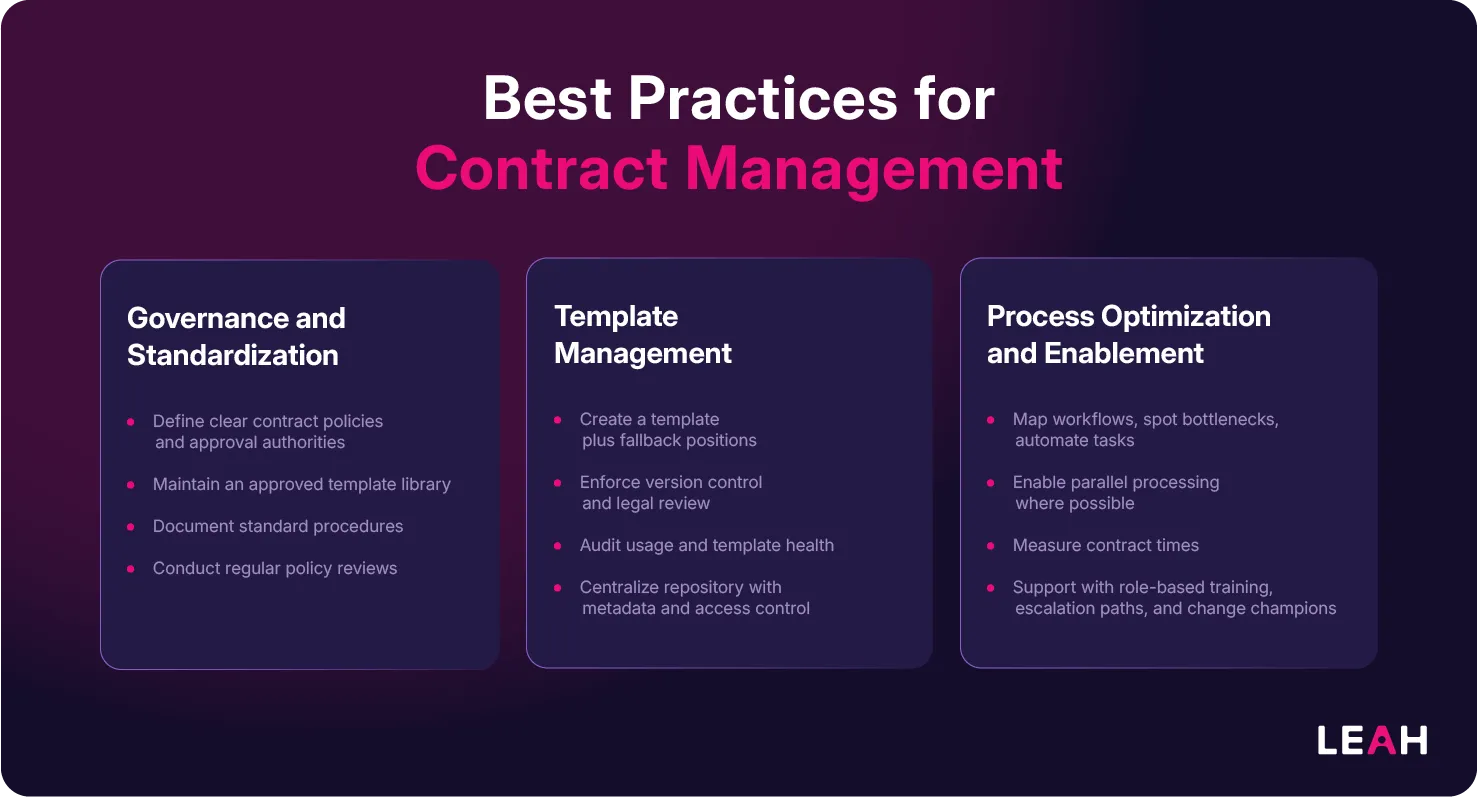
Whether using manual or digital systems, certain practices consistently improve outcomes. Establish clear contract policies, create an approved template library, define approval authorities, document standard procedures, and conduct regular policy reviews. This governance and standardization foundation enables consistent, compliant contract creation across your organization.
Template management requires developing templates for common scenarios, including approved fallback positions, maintaining version control, conducting regular legal reviews, and tracking template usage. Your centralized repository should serve as the single source of truth for all contracts, using consistent naming conventions, comprehensive metadata capture, regular repository audits, and proper access control management.
Process optimization involves mapping current workflows, identifying bottlenecks, implementing parallel processing where possible, automating repetitive tasks, and measuring cycle times. Support these technical improvements with role-specific training programs, regular refresher sessions, clear escalation paths, a change champion network, and a continuous improvement culture.
KPIs and Metrics
Measuring contract management performance drives continuous improvement across multiple dimensions. Efficiency metrics include contract cycle time from request to execution, average review time per stage, number of contracts processed monthly, percentage of contracts using templates, and first-time approval rates.
Compliance metrics track contracts with complete metadata, percentage with tracked obligations, audit readiness scores, regulatory compliance rates, and policy adherence percentages. Financial metrics encompass contract value under management, cost per contract processed, revenue at risk from expirations, savings from improved terms, and penalty avoidance value.
Risk metrics identify contracts without key dates tracked, high-risk clause frequency, vendor concentration analysis, contracts approaching expiration, and non-standard term usage. User adoption metrics monitor system login frequency, feature utilization rates, user satisfaction scores, support ticket volume, and training completion rates.
Compliance and Risk Management
Contract compliance extends beyond simple document storage. Different industries face unique regulatory requirements: healthcare organizations must ensure HIPAA compliance for patient data, financial institutions navigate SOX requirements for financial controls, organizations that handle personal data of people in the EU must meet GDPR requirements, and government contractors follow FAR/DFARS regulations.
Internal compliance encompasses procurement policies, spending authorities, conflict of interest rules, document retention requirements, and security protocols. Implement a risk assessment framework that identifies contract risks across financial, operational, and legal dimensions, assesses probability and impact, develops mitigation strategies, monitors risk indicators, and reports to leadership.
Maintain comprehensive audit trails by documenting all contract changes, tracking access history, maintaining approval records, storing communication logs, and preserving version history.
Contract Review and Auditing
Regular contract audits ensure ongoing compliance and optimization. Implement spot check methodology through random sampling of active contracts, focusing on high-value agreements, reviewing compliance with policies, verifying data accuracy, and assessing process adherence.
Automated monitoring provides obligation tracking alerts, expiration notifications, performance metric monitoring, budget variance reporting, and compliance deadline tracking. Annual contract audits should include comprehensive repository reviews, process effectiveness assessments, technology utilization analysis, training needs identification, and policy update recommendations.
Integration with Other Systems
Modern CLM systems don't operate in isolation. CRM integration with platforms like Salesforce or Microsoft Dynamics enables quote-to-contract workflows, customer data synchronization, opportunity tracking, and revenue forecasting alignment. ERP connections to SAP or Oracle provide financial data integration, purchase order matching, budget validation, and spend analysis.
E-signature tool integration with DocuSign or Adobe Sign offers direct signature routing, status tracking, completed document storage, and audit trail preservation. Collaboration platform connections to Microsoft Suite, Google Suite, or Slack deliver real-time notifications, approval requests, status updates, and team communication.
Future of Contract Management
Emerging technologies continue to reshape contract management. Artificial intelligence enables automated contract analysis, risk identification, clause extraction, obligation discovery, and predictive insights. Studies show that AI outperformed trained lawyers by 10% in accuracy and can complete a contract review in just 26 seconds compared to 92 minutes for humans. The newest step is agentic AI: software agents that carry out multi-step contract work, such as drafting, reviewing against a playbook, routing for approval, and tracking obligations, while people approve the decisions that matter.
Natural language processing provides plain language contract summaries, multi-language support, sentiment analysis, automated redlining, and intelligent search capabilities. Blockchain technology promises smart contract execution, immutable audit trails, decentralized validation, automated payments, and trust verification. Predictive analytics delivers renewal likelihood scoring, negotiation outcome prediction, risk forecasting, performance trending, and spend optimization.
FAQ
What is contract management?
Contract management is the process of handling contracts from request to renewal or termination: drafting, negotiating, approving, signing, storing, and tracking obligations and key dates. Its purpose is to make sure both parties deliver what they agreed, on the agreed terms, without missed deadlines. It applies to supplier contracts, customer contracts, and everyday agreements such as NDAs.
What are the basics of contract management?
The basics are a single way to request contracts, one repository for signed contracts, approved templates, written approval rules, a named owner for each contract, tracked key dates and obligations, and regular reporting. You can set all of these up with a shared drive and a spreadsheet, then add software as volume grows. The checklist near the top of this guide shows what good looks like for each.
What is collaborative contract management?
Collaborative contract management is a way of working in which legal, procurement, sales, finance, and business owners work on the same contract record, version, and workflow instead of trading attachments by email. Everyone can see the status, comments, and approvals in one place. It cuts the delays that build up in handoffs and leaves a clear record of who agreed to what.
What information should a contract management system track for executed contracts?
At a minimum, track the parties, contract type, value, start and end dates, renewal terms and notice period, termination rights, payment terms, key obligations and their owners, the business owner, and links to any amendments. Add the risk fields that matter to you, such as liability caps, data protection terms, and governing law. These fields drive your renewal alerts, obligation reminders, and reports.
What is contract management technology?
Contract management technology is software that supports the contract process: templates and drafting, review and redlining, approval workflows, e-signature, a searchable repository, and alerts for renewals and obligations. Contract lifecycle management (CLM) platforms combine these in one system, and newer platforms add AI that extracts clause data, reviews drafts against a playbook, and routes work. Spreadsheets and shared drives are the low-tech starting point.
Can you manage contracts without software?
Yes. A small team with a modest number of contracts can manage them with a shared folder, a contract register spreadsheet, standard templates, and calendar reminders for notice dates. The weak points are manual data entry, reminders that disappear when people leave, and limited reporting. Most teams move to software when volume, risk, or the number of people involved makes the spreadsheet hard to keep accurate.
Final Thoughts: Getting Started
Your contract management journey depends on organizational maturity and specific needs.
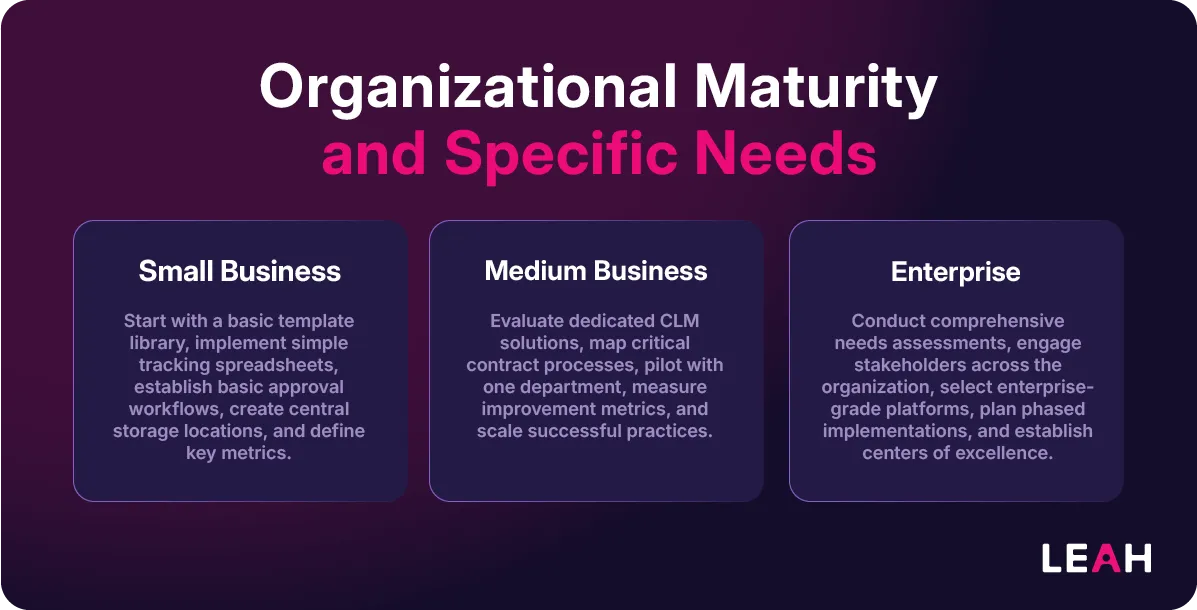
Small businesses should start with a basic template library, implement simple tracking spreadsheets, establish basic approval workflows, create central storage locations, and define key metrics.
Mid-size companies need to evaluate dedicated CLM solutions, map critical contract processes, pilot with one department, measure improvement metrics, and scale successful practices.
Enterprises must conduct comprehensive needs assessments, engage stakeholders across the organization, select enterprise-grade platforms, plan phased implementations, and establish centers of excellence.
Remember: perfect is the enemy of good. Start where you are, use what you have, and improve incrementally. Every step toward better contract management reduces risk and increases value.
Contract management fundamentally shapes how organizations operate, compete, and grow. While technology accelerates these processes, success ultimately depends on understanding core principles, implementing sound practices, and maintaining continuous improvement. Whether you're managing ten contracts or ten thousand, the principles remain consistent: know what you have, track what matters, and optimize continuously. Your future self, and your organization, will thank you for starting this journey today.
Looking to improve your contract management process? Explore our CLM software comparison guide or talk to a legal tech expert.