
A CTO's Perspective | Anurag Malik, CTO & President, Leah | March 2026
The core insight: The most effective enterprise AI strategies follow a simple pattern: start with high-value use cases that prove business impact, then scale them into an ecosystem that connects intelligence across the enterprise.
The false choice between use cases and ecosystems
A common framing position "use case-driven" and "ecosystem-focused" strategies as mutually exclusive. It is a false and costly choice. Use cases provide specificity, measurable ROI, and the organizational momentum required to sustain AI investment. Ecosystems provide the connective tissue that allows intelligence to compound across business functions. Strip one away and you are left with either a fragmented collection of automations or an ambitious platform strategy with no traction.
The most successful AI transformations start with use cases chosen deliberately, for their functional depth, data richness, and ability to expand into adjacent processes, then build ecosystem infrastructure that turns early wins into enterprise-wide intelligence.
Why use cases still matter, enormously
Use cases do several things that ecosystem strategies alone cannot. They generate real data, revealing how AI performs under actual business conditions. They build organizational trust; a procurement team that sees AI reduce contract cycle time by 30% becomes an advocate for the next phase of deployment. They expose integration requirements, because connecting an invoice processing AI to procurement data teaches you more about your data architecture than any theoretical mapping exercise. And they create accountability, since use-case-level ROI is measurable, keeping AI investments grounded in business outcomes.
Bain research confirms that most enterprise work happens across multiple systems, which is precisely why use cases must be selected with an eye toward their cross-functional connections. The right question is not "use cases or ecosystem?" It is "which use cases, in which sequence, will build the ecosystem we need?"
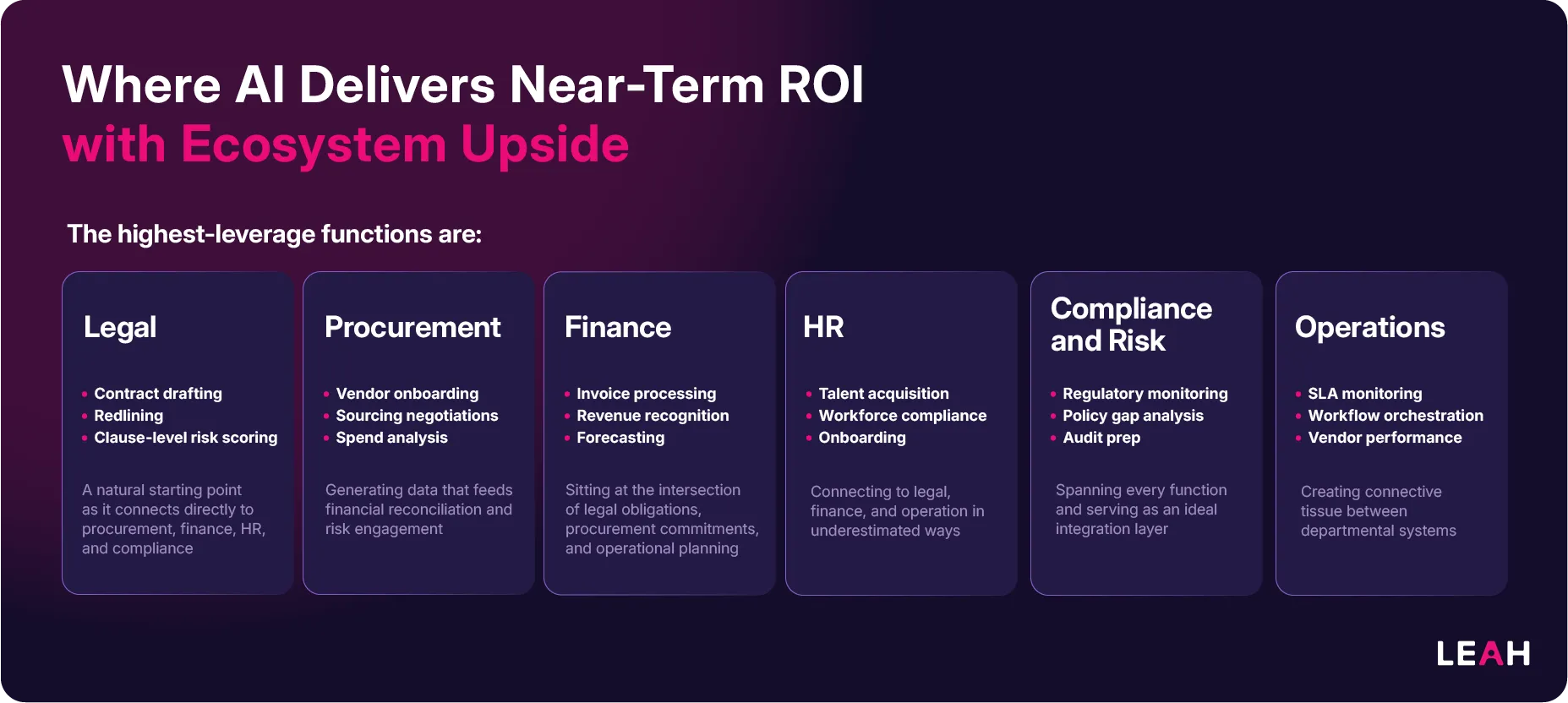
Where AI delivers near-term ROI with ecosystem upside
The highest-leverage functions are:
- Legal (contract drafting, redlining, clause-level risk scoring, a natural starting point as it connects directly to procurement, finance, HR, and compliance)
- Procurement (vendor onboarding, sourcing negotiations, spend analysis, generating data that feeds financial reconciliation and risk management)
- Finance (invoice processing, revenue recognition, forecasting, sitting at the intersection of legal obligations, procurement commitments, and operational planning)
- HR (talent acquisition, workforce compliance, onboarding, connecting to legal, finance, and operations in underestimated ways)
- Compliance and Risk (regulatory monitoring, policy gap analysis, audit prep, spanning every function and serving as an ideal integration layer)
- Operations (SLA monitoring, workflow orchestration, vendor performance, creating connective tissue between departmental systems)
What changes at the ecosystem level
When intelligence flows across functions rather than within them, three things shift materially. Patterns become visible that no single function can detect; a contract renewal risk, layered with payment history from finance and alternative supplier data from procurement, becomes a strategic recommendation rather than a simple flag. Automation spans boundaries instead of stopping at them; a procurement AI flagging a non-standard clause can trigger a legal review, update a risk register, and notify a finance controller without human handoffs at each step. And the platform learns from enterprise-wide context, developing a model of how your organization actually operates, including informal processes and cross-functional dependencies.
Bain's analysis of the AI stack identifies three essential layers: systems of record, agent operating systems, and outcome interfaces. Use cases populate the first; ecosystem architecture builds the second and third.
Why Domain expertise is the moat
Every enterprise now has access to similar large language models, cloud infrastructure, and development frameworks. What they cannot easily replicate is accumulated knowledge of how specific industries and business functions actually work, including the edge cases, compliance nuances, and patterns of negotiation friction. Companies that build AI without this foundation create impressive demonstrations that fail in production. As EY notes, successful AI companies are becoming true partners to their customers, and that partnership is only possible with deep domain understanding, not just access to a capable foundation model.
The sequenced roadmap:
- Months 1-3: Inventory existing AI experiments; identify use cases with measurable impact, data richness, and connections to adjacent functions
- Months 3-12: Deploy 2-3 high-value use cases spanning at least two business functions, with the explicit goal of building integration infrastructure, not just automating tasks
- Months 12-36: Expand through adjacencies, leveraging existing data pipelines, governance frameworks, and partner relationships rather than rebuilding from scratch
Full ecosystem transformation typically requires 18-36 months, but sequencing matters more than timeline. Organizations that start with the right use cases and build integration infrastructure early see measurable results within the first quarter and compound returns as the ecosystem expands.
What will 2027 look like?
The current proliferation of specialized AI tools will consolidate into comprehensive platforms. Gartner forecasts that 15% of day-to-day work decisions will be made autonomously by agentic AI by 2028, up from near zero in 2024, and that 33% of enterprise software applications will include agentic capabilities, compared to less than 1% today. Pricing will shift from seat-based to outcome-based models. The organizations that navigate this successfully will be those that started with the right use cases, built ecosystem infrastructure intentionally, and formed partner relationships based on complementary strength rather than revenue opportunity alone.
Anurag Malik is CTO and President at Leah, where he leads AI technology strategy and product innovation across legal, procurement, finance, and compliance functions.