
Quick answer: Contract compliance reporting is a regular report that shows whether each party is meeting its contract obligations, what evidence proves it, and which gaps need action. To track and report on contract compliance, list every key obligation in one register, give each one an owner, a source of evidence, and a check frequency, compare it with invoices, delivery records, or service reports, and escalate anything that crosses a threshold you set in advance.
Contract compliance itself means making sure your organization and the other party do what a signed contract requires, from prices and service levels to payment terms, insurance, and regulatory clauses. Contract compliance services, whether an audit firm, a managed service, or contract management software, help you do the same work across many contracts: finding obligations, monitoring them, and producing the report.
Introduction
Contracts govern most of your important business relationships, but signing one is only the start. Contract compliance, the ongoing work of making sure every party meets its contractual obligations, affects what you pay, what you receive, and how much risk you carry.
This guide explains what contract compliance involves, gives you a report template and a tracking process you can put to work right away, and covers the people, processes, technology, and governance that keep a compliance program running. It applies to supplier agreements, customer contracts, and contracts that carry regulatory requirements.
What is Contract Compliance?
Contract compliance refers to the systematic monitoring and management of contractual obligations to ensure all parties meet their commitments as specified in the agreement. It covers both internal compliance (your organization meeting its obligations) and external compliance (making sure other parties fulfill theirs).
At its core, contract compliance involves:
- Tracking and enforcing contractual obligations throughout the agreement lifecycle
- Monitoring performance against agreed metrics and standards
- Verifying pricing, discount structures, and billing accuracy
- Identifying and managing contractual risks early
- Ensuring adherence to both contractual terms and applicable regulations
Contract compliance is not a single checkpoint. It is an ongoing discipline that runs from execution through renewal or termination.
Contract Compliance Reporting Template and Tracking Process
Most compliance problems are not hidden. They sit in invoices, service reports, and calendars that nobody compares with the contract. A simple report fixes that: it tells each owner what to check, where the evidence lives, how often to look, and when a problem must be escalated.
Contract compliance report template
Use one row per obligation type. The rows below are starting points: replace the sources, owners, frequencies, and thresholds with ones that fit your contracts and your tolerance for risk.
| What to track | Source of evidence | Owner | Frequency | Escalate when |
|---|---|---|---|---|
| Pricing and discounts | Invoice lines from accounts payable or the ERP, checked against the contract price schedule | Procurement or accounts payable | Each invoice run or monthly | Any line is billed above the contract rate, or an agreed discount is missing |
| Volumes and rebates | Purchase or sales volumes from the ERP, compared with the contract's tiers and minimums | Category or account manager | Quarterly | The forecast shows a minimum commitment will be missed or a rebate tier will go unclaimed |
| Service levels | Supplier SLA reports, ticketing data, or monitoring tools | Service owner in the business | Monthly | The same service level is missed in two consecutive periods, or a miss entitles you to service credits |
| Milestones | Project plan, delivery notes, and acceptance records | Contract or project owner | At each milestone | A milestone is late past any cure period, or acceptance has not been signed off |
| Your payments | Accounts payable aging and payment run data | Finance | Monthly | An approved invoice will miss its due date, putting late-payment interest or an early-payment discount at risk |
| Insurance and certificates | Certificates of insurance, licenses, and security certifications | Vendor management | Ahead of each expiry date | A document has expired, or its renewal has not arrived by the date you set (for example, 30 days before expiry) |
| Data protection | Data processing agreement, security questionnaires, audit reports, and incident notices | Privacy or information security | Annually and after any incident | Any security incident, an unannounced subprocessor change, or an audit finding still open after its agreed fix date |
| Regulatory clauses | Supplier attestations and sanctions or anti-bribery screening results | Compliance | Annually or when the supplier changes | An attestation is missing or a screening check returns a match |
| Renewals and notice | Renewal dates and notice periods in the contract repository | Contract owner | Monthly look-ahead | A notice deadline is approaching with no decision to renew, renegotiate, or terminate |
| Contract policy | Approval and signature records in your contract system | Legal operations | Quarterly | A contract was signed outside the approval matrix, or on non-standard terms without legal review |
Each reporting period, present the results in four parts:
- Summary: contracts in scope, and obligations due, met, missed, and at risk.
- Exceptions: each missed or at-risk obligation with its contract, counterparty, owner, agreed action, and due date.
- Financial impact: overcharges found, service credits claimed, and amounts recovered.
- Coming up: renewals, notice deadlines, and certificate expiries in the next quarter. Our guide to managing contract renewals covers how to act on them.
To choose the few numbers leadership should see every quarter, see these contract management KPIs.
A six-step contract compliance tracking process
- Choose the contracts in scope. Start with the agreements that carry the most value or risk, such as top suppliers, regulated services, and large customer contracts. Add the rest in waves.
- Build an obligation register. Record one row per obligation: contract, clause reference, responsible party, what must happen, due date or frequency, required evidence, and owner. Automated contract data extraction can speed this up for a large backlog, but have someone check the output.
- Link each obligation to its evidence. Decide which system proves compliance: invoice data, SLA reports, certificates, or approval logs. If no evidence exists, you cannot track the obligation, so fix that first.
- Check on schedule and record a status. Mark each obligation as met, missed, at risk, or not yet due, and attach the evidence. Use reminders so checks do not depend on anyone's memory.
- Escalate and act. When a threshold is crossed, the owner raises it with the counterparty, claims the credit or refund, or issues a formal notice, and records the outcome.
- Report and review. Share the report monthly with contract owners and quarterly with leadership. Update the register whenever a contract is amended, renewed, or terminated.
For more detail on running the register day to day, see our guide to tracking contract obligations.
Why Contract Compliance Matters: The Business Impact
The significance of contract compliance extends far beyond legal protection. When nobody checks performance against the contract, value leaks away through missed discounts, unclaimed service credits, and invoices that do not match agreed prices, while risks such as expired insurance or unapproved subcontractors go unnoticed. Recent research shows that organizations lose approximately 9.2% of revenue annually due to poor contract management, with compliance issues representing a substantial portion of these losses. This statistic has remained consistent in World Commerce & Contracting's 2024 effectiveness report, highlighting an ongoing challenge for businesses worldwide.
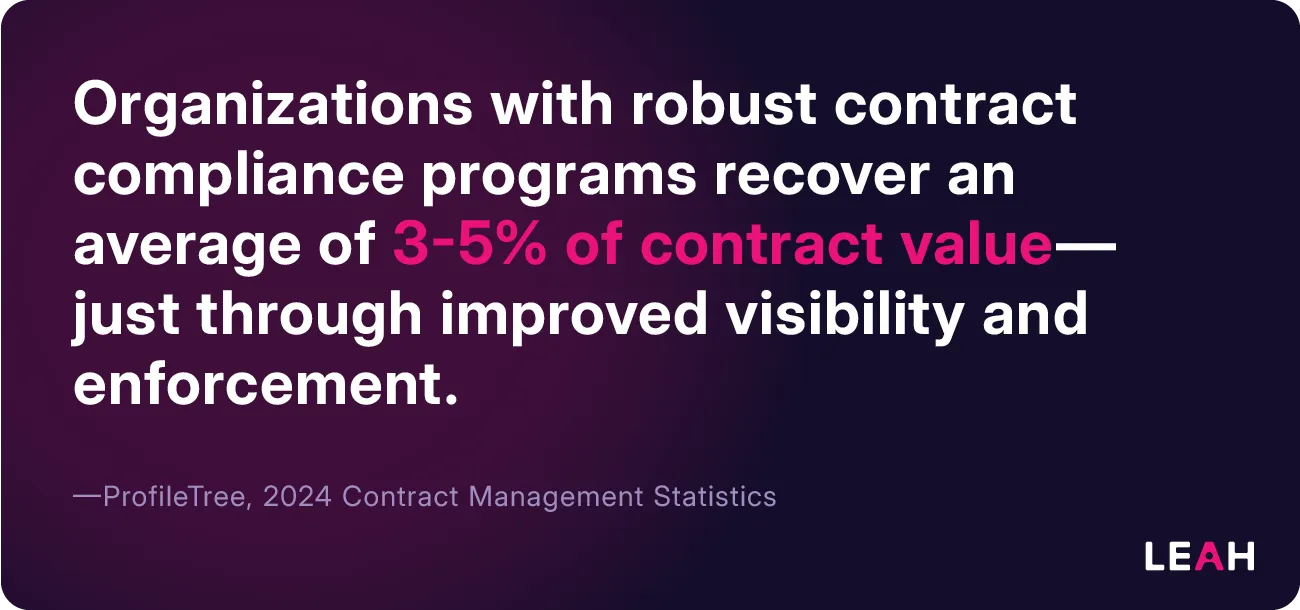
Furthermore, a 2024 study from Profile Tree's contract management statistics analysis reveals that organizations with robust contract compliance programs recover an average of 3-5% of contract value through improved visibility and enforcement.
The Cost of Non-Compliance
Organizations with inadequate contract compliance mechanisms face numerous risks:
Financial Leakage: Unrealized discounts, pricing errors, missed volume incentives, and undetected billing discrepancies directly reduce profitability.
Legal Vulnerability: Non-compliance can trigger breach of contract claims, resulting in litigation, penalties, and damaged business relationships.
Operational Disruption: Service level failures, missed deliveries, and quality issues can disrupt business continuity.
Reputational Damage: Repeated compliance failures erode trust and can permanently damage relationships with partners and customers.
Regulatory Penalties: In regulated industries, contract compliance failures can trigger fines and sanctions from oversight bodies.
Recent research published in Procurement Tactics' 2025 Contract Management Statistics indicates that "between 55% and 70% of organizations lack efficient contract management systems," leaving them particularly vulnerable to these risks.
The Four Pillars of Effective Contract Compliance
A contract compliance program works when four elements support each other:
1. People: Establishing Clear Accountability
Contract compliance begins with clear ownership and accountability. Define who is responsible for monitoring each aspect of contract performance. Train the people involved in contract review, obligation management, and compliance monitoring. Set up ways for legal, procurement, finance, and operations teams to work together, and secure executive support so leadership understands and champions the importance of contract compliance.
2. Process: Implementing Systematic Compliance Workflows
Effective contract compliance requires a structured process to identify and categorize every contractual commitment. Establish consistent monitoring protocols for tracking performance, along with clear escalation paths for addressing issues. Regular compliance reviews assess contract performance over time, and the lessons learned feed back into the process.
3. Technology: Using Digital Tools
Contract compliance benefits from purpose-built technology, starting with a centralized contract repository as a single source of truth for all contracts. Look for automated alerts for approaching deadlines and obligations, compliance dashboards, and reporting that shows compliance trends. Integration with ERP, procurement, and financial systems lets contract data reach the teams that need it without manual re-entry.
The Forrester Wave Q2 2023 CLM report indicates that organizations implementing dedicated contract management technology achieve up to 55% faster contract cycles and reduce compliance-related costs by approximately 25%.
4. Governance: Establishing Oversight Mechanisms
Governance keeps compliance activities aligned with business objectives. Documented compliance policies and standards set clear expectations, regular audits check adherence, and performance metrics track key compliance indicators. Continuous training keeps teams current on requirements, and a risk assessment framework helps you prioritize compliance work based on potential impact.
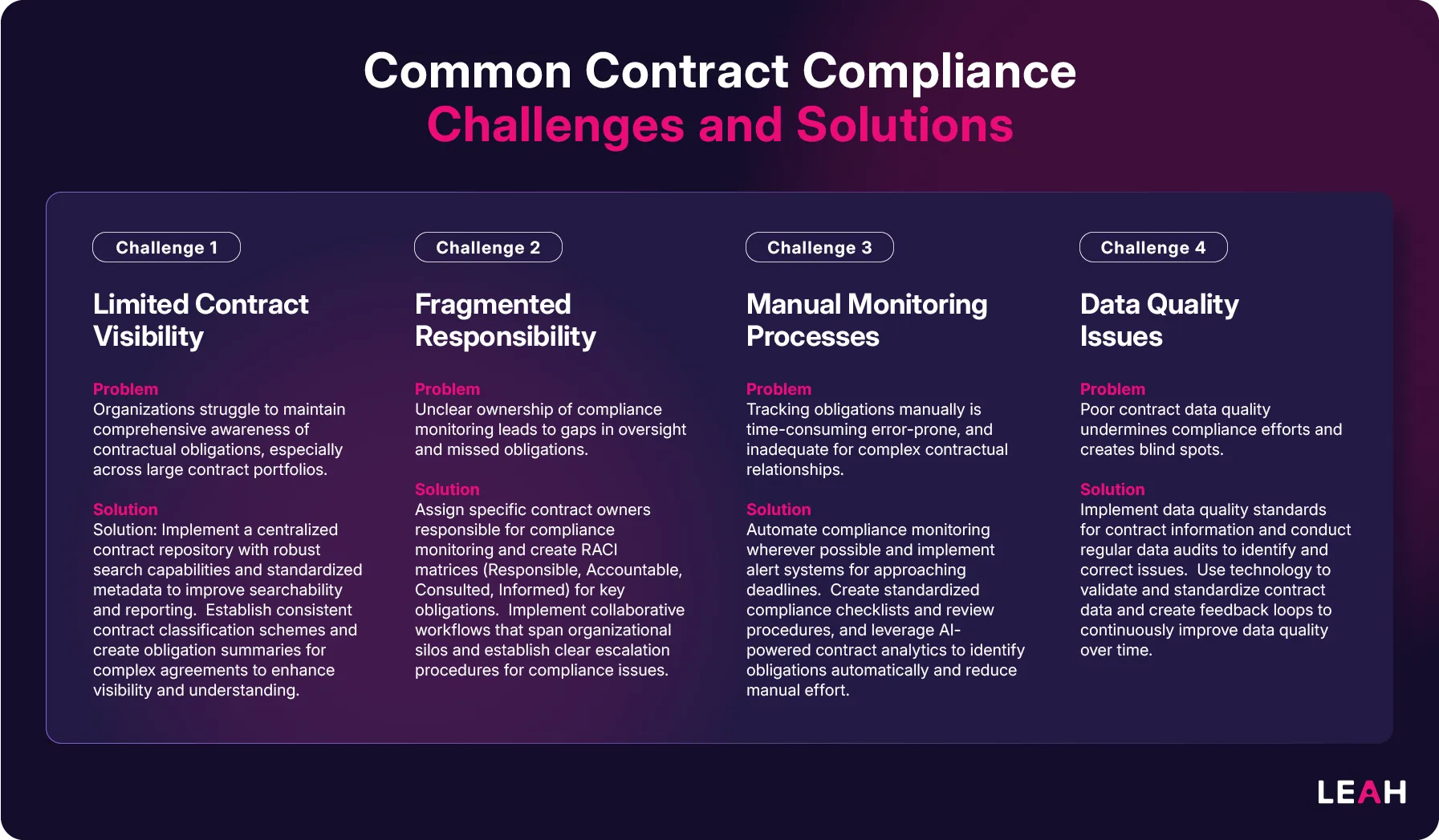
Contract Compliance Best Practices
1. Adopt a Risk-Based Approach
Not all contracts need the same level of compliance monitoring. Develop a contract risk assessment framework that categorizes agreements by value, complexity, and strategic importance. This lets you put more compliance effort into higher-risk agreements and match monitoring intensity to risk exposure.
2. Implement Proactive Compliance Monitoring
Proactive monitoring helps you detect issues before they escalate and stop revenue leakage early. It also supports stronger relationships with counterparties and shows regulators and partners that you take your commitments seriously.
3. Measure and Report on Compliance Performance
Compliance metrics drive accountability. Track obligation fulfillment rates, the financial impact of compliance work, and compliance-related costs and disputes, and report compliance status to key stakeholders on a regular schedule. The report template above is a practical place to start.
4. Use Technology Appropriately
Adopt technology strategically: match capabilities to your specific compliance needs, and plan for user adoption and change management. Integrate compliance tools with existing business systems, and balance automation with human oversight.
The Future of Contract Compliance: Emerging Trends
Artificial Intelligence and Machine Learning
AI and machine learning support contract compliance through automated obligation identification and extraction, natural language processing for contract analysis, predictive analytics to flag likely compliance issues, and automated monitoring and alerts.
Blockchain and Smart Contracts
Distributed ledger technology offers possible applications for compliance through self-executing contract terms that automate verification and enforcement. These technologies can create tamper-resistant audit trails of contractual activity, enable transparent performance tracking across parties, and automate verification of compliance conditions, reducing the need for manual oversight.
Integrated Compliance Ecosystems
Connected systems can provide end-to-end visibility across contract portfolios and real-time compliance dashboards for executives. Cross-contract analytics help identify broader trends, and supplier network integration extends monitoring across the value chain.
Implementing a Contract Compliance Program: A Step-by-Step Guide
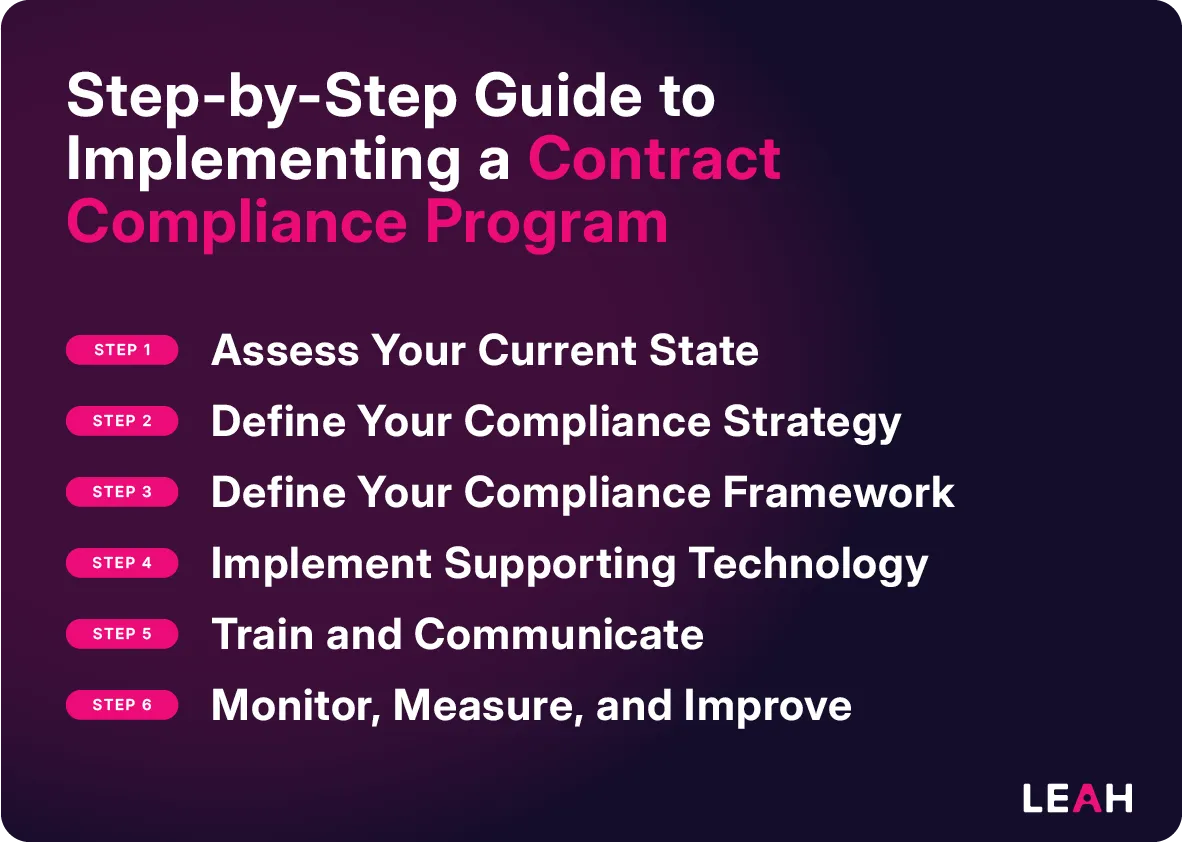
Step 1: Assess Your Current State
Before adding new compliance measures, evaluate your existing contract management processes and identify compliance gaps and recurring issues. Review past compliance incidents and compare your current practices with industry standards to set a clear baseline for improvement.
Step 2: Define Your Compliance Strategy
Align your compliance approach with business objectives: set clear compliance goals, define the scope of the program, estimate the resources needed, and secure an executive sponsor.
Step 3: Develop Your Compliance Framework
Document compliance policies and procedures, define roles and responsibilities across the organization, and set up governance. Agree on the compliance metrics and reporting that will give you ongoing visibility into program performance.
Step 4: Implement Supporting Technology
Select technology that meets your specific compliance needs. Choose contract management software with strong compliance capabilities, configure obligation tracking and alerts, set up reporting, and integrate with existing business systems.
Deloitte's 2023 third-party risk management survey found that over 51% of organizations have become more focused on integrating business strategy and risk management into their contract management approach, indicating a growing awareness of the strategic importance of contract compliance.
Step 5: Train and Communicate
Make sure every stakeholder understands their compliance responsibilities through role-specific training and clear compliance guidelines. Set up a channel for compliance questions and explain why compliance matters, so it becomes part of how teams work.
Step 6: Monitor, Measure, and Improve
Run regular compliance audits, track and analyze compliance metrics, and adjust processes based on what the data shows.
How Leah Helps with Contract Compliance
Leah Agentic CLM is a contract lifecycle management platform in which AI drafts, reviews, routes, and tracks contracts while your team approves the decisions that matter. For compliance work, One-Drop classifies a counterparty document and extracts its key clauses, obligations, and parties; obligation tracking and renewal alerts remind owners of renewal dates, notice periods, and milestones; and conditional approval routing sends contracts to the right approvers by value, risk flags, jurisdiction, or contract type. Request a demo to see it with your own contracts.
FAQ
What is contract compliance?
Contract compliance means every party to a contract, including your own organization, does what the contract requires. It covers obligations such as prices, deliveries, service levels, payment terms, confidentiality, and regulatory clauses, from signature through renewal or termination. "Contractual compliance" and "agreement compliance" mean the same thing.
How do you ensure contract compliance?
Put each important obligation in one register with an owner, a source of evidence, and a check frequency, then check it on schedule and escalate exceptions. Start with your highest-value and highest-risk contracts, use reminders for key dates, and update the register whenever a contract changes. The same method works for a handful of ongoing contracts or thousands; only the level of automation changes.
What should a contract compliance report include?
A useful report shows obligations due, met, missed, and at risk; an exceptions list with owners and actions; the financial impact, such as overcharges found and credits claimed; and upcoming renewals and notice deadlines. Keep it short, send it monthly to contract owners and quarterly to leadership, and use the same thresholds each period so trends are visible.
What are contract compliance services?
Contract compliance services help organizations check that contracts are being followed. They include contract and supplier audits, pricing and invoice reviews, obligation tracking, and reporting, delivered by audit firms, managed service providers, or contract management software. In the public sector, "contract compliance" can also mean checking that government contractors meet requirements such as wage or equal opportunity rules, so confirm which kind of service you need.
How does AI help with contract compliance?
AI can read contracts at scale, extract obligations, dates, and key clauses, and turn them into tasks and reminders. It can also flag terms that differ from your standard positions and answer questions about what a contract says. People still need to confirm the extracted data, decide on exceptions, and handle disputes with the counterparty.
How are compliance requirements built into contract templates?
Write required terms, such as audit rights, insurance, anti-bribery, and data protection clauses (for example, a data processing agreement where personal data is involved), into approved templates and a clause library, and define which fallback positions negotiators may use. Guided intake can select the right template by contract type or jurisdiction, and approval rules send any deviation to legal before signature. This helps new contracts meet your policies and legal standards from the start, which makes later tracking easier.
Conclusion
Contract compliance is not only a back-office legal function. It directly affects financial performance, risk, and operations. With clear processes, engaged owners, and the right technology, you can turn compliance from a reactive risk activity into a reliable source of value.
Whether your goal is to prevent revenue leakage, strengthen supplier relationships, or manage contractual risk, start with the report template above: a short register of high-value obligations, checked on schedule, quickly shows you where the gaps are.