
Quick answer: A DPA, or data processing agreement (also called a data protection agreement or data processing addendum), is a contract between an organization that controls personal data and a service provider that processes that data on its behalf, setting out what the provider may do with the data and how it must protect it. Under the EU and UK GDPR (Article 28), a binding written contract with specific terms is required whenever a controller uses a processor, and several US state privacy laws have similar requirements.
DPA can also mean a data protection authority, the regulator that enforces data protection law (such as the ICO in the UK), or the UK's Data Protection Act 2018. This guide covers the agreement and includes a clause-by-clause review checklist. It is general information, not legal advice.
For many organizations, collecting the personal data of people who visit their websites, use their products, and subscribe to their services is standard practice.
They use that data across many functions, from targeting ads to improving the customer experience. For many consumers, keeping that data private has become a real concern, and many countries and US states have passed data protection laws that control how and where personal data can be used. The organizations that collect and process the data are responsible for following those rules.
But what happens when a company hires an outside organization to process data it has collected? How does it make sure data protection rules are still followed, and avoid fines or a loss of customer trust? A data processing agreement (DPA), also known as a data protection agreement or data processing addendum, fills that gap by making clear each party's obligations and the rules they must follow. Any organization that collects personal data from its users or customers should consider a DPA before engaging a third party to process that data.
What Is a DPA?
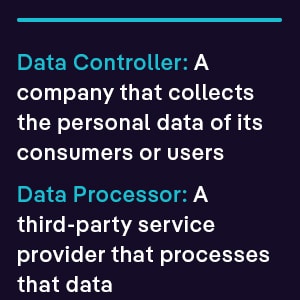
A data processing agreement is a legally binding contract between two parties:
- A data controller: the organization that decides why and how personal data is processed, typically the company that collects it from its consumers or users
- A data processor: a third-party service provider that processes that personal data on the controller's behalf
These terms vary by jurisdiction (California's law, for example, speaks of businesses, service providers, and contractors), and a DPA or similar contract is typically also required between a processor and any sub-processors it uses. A DPA sets out how the personal data shared between the parties may be used and makes the obligations of each side clear. It is sometimes called a data privacy agreement, and it is often signed as an addendum to a main services contract, such as a master service agreement.
A DPA is different from a data sharing agreement, which is a contract between two controllers that each decide how they use the data, and from a privacy policy, which tells individuals how an organization processes their personal data. It is also different from a non-disclosure agreement, which protects confidential business information rather than setting rules for processing personal data.
A DPA must comply with the laws that apply to the processing, such as the General Data Protection Regulation (GDPR) and the California Consumer Privacy Act (CCPA). Which laws apply depends on where the controller and processor are located, where the data subjects (the people the data is about) are, and whom the organization is targeting.
DPA Review Checklist: Clauses to Check Under GDPR Article 28
Whether you are a controller reviewing a vendor's standard DPA or a processor responding to a customer's draft, these are the clauses to read first. The first nine rows follow the contract requirements in Article 28 of the GDPR, with the related security and breach rules in Articles 32 and 33. The last two rows cover other points that are commonly negotiated. Use the checklist as a first-pass review aid alongside advice from your own counsel.
| Clause | What to look for | Red flags |
|---|---|---|
| Scope of processing | The subject matter, duration, nature, and purpose of the processing, the types of personal data, and the categories of data subjects, usually set out in an annex. | A blank or generic annex (for example, "data as needed to provide the services"), or sensitive data that will be processed but is not listed. |
| Documented instructions | The processor processes personal data only on your documented instructions, including for transfers outside the EU, and tells you if it believes an instruction breaks data protection law. | The processor may use your data for its own purposes, such as product improvement or training AI models, without your instruction, or may change how it processes the data without telling you. |
| Confidentiality | Everyone the processor authorizes to process the data has committed to confidentiality or is under a statutory duty of confidentiality. | No confidentiality commitment, or one that covers employees but not contractors who also handle the data. |
| Security measures | The technical and organizational measures required by Article 32, described in an annex: for example, encryption, access controls, backups, and regular testing. | Only a reference to "industry-standard security" with no detail, or a right for the processor to reduce its security measures without notice. |
| Sub-processors | No sub-processor is engaged without your prior specific or general written authorization. Look for a current list, advance notice of changes with a real opportunity to object, the same data protection obligations passed down by contract, and the processor remaining fully liable for its sub-processors. | No list, changes posted to a web page with no notice to you, no right to object, or a disclaimer of liability for sub-processors. |
| Data subject rights | The processor helps you, through appropriate technical and organizational measures, respond to requests from individuals to access, correct, or delete their data or exercise their other rights, and passes any requests it receives to you. | The processor answers individuals directly without your instruction, or offers help only "where commercially reasonable" or for fees that are not defined. |
| Breach notification | The processor notifies you of a personal data breach without undue delay after becoming aware of it, gives you the details you need, and helps you meet your own obligations on security, breach notification, and data protection impact assessments. | Notice only after the processor finishes its own investigation, or a fixed notice period too long for you to meet your own deadline to notify the regulator (72 hours under the GDPR, where notification is required). |
| Deletion or return | When the services end, the processor deletes or returns all personal data, at your choice, and deletes existing copies unless the law requires it to keep them. | Data kept indefinitely or "as long as needed for business purposes," no timeframe, or no mention of backups. |
| Audits and information | The processor makes available all the information needed to show it meets these obligations and allows for, and contributes to, audits and inspections by you or an auditor you appoint. Many processors offer independent audit reports or certifications as a first step. | Audit rights excluded entirely, or limited to a certificate summary with no right to ask further questions or to audit if concerns remain. |
| International transfers | Where the data is stored and accessed from, and the legal mechanism for any transfer outside the EU or UK, such as an adequacy decision or standard contractual clauses. | No list of processing locations, or transfers with no stated legal mechanism. |
| Liability and precedence | How liability for data protection failures is allocated and capped, and which document prevails if the DPA and the main agreement conflict. Article 28 does not set these commercial terms. | Data protection liability capped far below the harm a breach could cause, or a clause that makes the main agreement prevail over the DPA on data protection matters. |
Once the DPA is signed, the processor's commitments (breach notice, sub-processor notices, deletion at the end) become obligations that someone needs to monitor. Our guide to tracking contract obligations explains how to keep them from slipping.
Why Do You Need a Data Processing Agreement?
Data processing agreements are now standard practice as controllers and processors look to protect their interests under a growing number of privacy laws and to assure consumers that their data stays confidential. They are a requirement under the General Data Protection Regulation in the European Union and under the UK GDPR. Several US state privacy laws, including California's CCPA, Virginia's VCDPA, Colorado's CPA, and Connecticut's CTDPA, also require contracts between organizations and the service providers or processors that handle personal data for them. A DPA helps all parties comply with these laws.
Even where no law requires one, a DPA is generally good practice. It protects data privacy, keeps personal data confidential, and reduces the risk of unauthorized access to user data. It also creates accountability for how data is used and defines each party's role. For processors, a DPA sets out obligations on cross-border data transfers, data use, security, and sub-processors, and gives written instructions on what to do when an individual asks for their data to be deleted or corrected.
The Risks of Not Having a DPA
Without a data processing agreement in place, a controller risks regulatory fines. Under the GDPR, infringements of the controller and processor obligations, which include Article 28, can lead to fines of up to €10 million or 2% of total worldwide annual turnover for the preceding financial year, whichever is higher (Article 83(4)). Fines are not the only concern. If a third-party processor misuses personal data, the controller that collected it can also face liability, and misuse can damage a company's reputation and erode customer trust.
Key Elements of a DPA
Every DPA should reflect the needs, locations, and applicable laws of the parties signing it, but there are some key elements to consider, including the following:
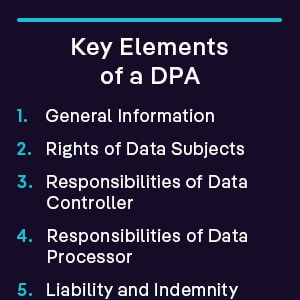
General Information
A data processing agreement should include standard general information: who the data controller and data processor are, how the personal data will be used, the types of data being processed, and the duration of the agreement. It should also include termination terms and details of where the data will be stored.
Rights of Data Subjects
Data subjects are the individual users or customers the personal data is about. The DPA should set out how the processor will help the controller respond when individuals exercise their rights to access, delete, or correct their data, and the steps that will be followed if that data is lost or accessed unlawfully.
Responsibilities of the Data Controller
The data controller's responsibilities should be clearly set out in the DPA and meet the relevant data protection laws. Under the GDPR, for instance, the controller decides why and how personal data is processed, is responsible for complying with the data protection principles and responding to data subjects, and must give the processor documented instructions.
Responsibilities of the Data Processor
Data processors have their own responsibilities, which should also be set out in the DPA. Under the GDPR, for instance, processors must keep personal data secure, notify the controller of personal data breaches without undue delay, allow audits, and delete or return data when the services end. Processors must also cooperate with supervisory authorities when asked and keep records of their processing activities.
Liability and Indemnity
Finally, a DPA sets out the liability and indemnity of the data processor, the data controller, and any other parties involved.
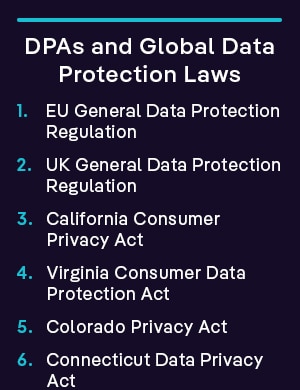
DPAs and Global Data Protection Laws
Data processing agreements play a large role in making sure companies, and the third parties they work with, follow applicable data protection laws. A DPA gives the controller contractual commitments that the processor will handle personal data as those laws require, which helps reduce liability and the risk of fines. Laws that a DPA may need to address include:
EU GDPR
The EU General Data Protection Regulation (GDPR) is the European Union's data privacy and security law. It applies to organizations established in the EU and to organizations outside the EU that offer goods or services to, or monitor the behavior of, people in the EU. Article 28 requires processing by a processor to be governed by a contract (or other legal act) that includes specific terms, which are the basis of the checklist above. Organizations that do not comply risk significant fines and other penalties.
UK GDPR
The United Kingdom has its own GDPR, which sits alongside the Data Protection Act 2018. The UK GDPR is the version of the EU GDPR kept in UK law after Brexit. It closely mirrors the EU GDPR, although UK law has since been amended in places. Like the EU GDPR, the UK GDPR requires a written contract between controllers and processors that sets out each party's responsibilities, and a contract between processors and sub-processors.
CCPA/CPRA
The California Consumer Privacy Act (CCPA) gives California consumers a range of privacy rights. These include the right to know what personal information a business collects about them and how it uses and shares it, the right to delete personal information collected about them, and the right to opt out of the sale or sharing of their personal information. The California Privacy Rights Act (CPRA), approved by California voters in 2020, amended the CCPA to add the right to correct inaccurate personal information and the right to limit the use and disclosure of sensitive personal information. The CCPA requires a contract when a business sells or shares personal information with a third party or discloses it to a service provider or contractor for a business purpose. That contract can be a standalone data processing agreement, an addendum, or terms in the underlying agreement.
VCDPA
The Virginia Consumer Data Protection Act (VCDPA) went into effect on January 1, 2023. It gives consumers the right to access their personal data and to have it corrected or deleted, among other rights. The VCDPA requires a binding contract between a controller and a processor that sets out the processing instructions, the nature and purpose of the processing, the type of data, the duration of the processing, and the rights and obligations of both parties. Separately, controllers must carry out data protection assessments for higher-risk processing, such as targeted advertising, the sale of personal data, certain profiling, and the processing of sensitive data.
CPA
The Colorado Privacy Act (CPA) is another state law. It lets consumers opt out of the processing of their personal data for targeted advertising, sale, or certain profiling. It also gives them the right to confirm whether a controller is processing their personal data, to access, correct, or delete it, and to obtain a copy. Like the VCDPA, the CPA requires a binding contract between controller and processor, with some additional requirements. For instance, a processor must give the controller an opportunity to object before engaging a subcontractor. Controllers and processors must also implement appropriate technical and organizational measures, such as data security measures, to protect personal data.
CTDPA
The Connecticut Data Privacy Act (CTDPA) took effect on July 1, 2023. It gives consumers the right to access their personal data, correct inaccuracies, delete personal data, obtain a portable copy, and opt out of certain processing. It generally gives controllers 45 days to respond to consumer requests. Like Virginia's law, the CTDPA requires a binding contract between controller and processor, and it separately requires controllers to conduct data protection assessments for processing that presents a heightened risk of harm, such as targeted advertising, the sale of personal data, the processing of sensitive data, and certain profiling. Connecticut has amended the law since it took effect, so check the current text.
Other Global Data Protection Laws
In the US, several other states have passed comprehensive privacy laws with similar controller-processor contract requirements. Elsewhere, applicable data protection laws include Brazil's general data protection law, Lei Geral de Proteção de Dados (LGPD); the United Arab Emirates' Personal Data Protection Law (PDPL); Thailand's Personal Data Protection Act (PDPA); and South Africa's Protection of Personal Information Act (POPIA).
Real-World Examples of DPAs
Before preparing a data processing agreement, it helps to see how other businesses approach theirs. Here are three published examples that show what a DPA looks like in practice.
HubSpot
Like many software-as-a-service (SaaS) businesses, HubSpot collects user data when people interact with its website and use its products and services. It uses that data to market its own products, and it also acts as a data processor for customers of its subscription service. HubSpot uses a standard data processing agreement for that role. Its DPA sets out the responsibilities of HubSpot's customers (the data controllers), HubSpot's own obligations, and how data subject requests are handled. It also covers sub-processors, data transfers, and additional provisions. Have a look at HubSpot's DPA here.
Adobe
Adobe sets out its data policies in its online privacy center and privacy policy and has published a sample of its EU data processing agreement. The sample DPA describes where data will be processed, the security measures that will be in place, and what happens if a personal data breach occurs. It also covers the controller's responsibilities, audit protocols, and expectations around sub-processors and international transfers. View Adobe's sample EU DPA here.
LinkedIn uses personal data to personalize content, for research, and to help recruiters. Its data processing agreement sets out both LinkedIn's and its customers' obligations for personal data and personal data breaches, along with protocols for audits, data transfers, and data return and deletion. It also includes sections on controller-to-controller scenarios and third-party data processors. See LinkedIn's DPA here.
How to Create a DPA
Templates can give you a starting point. Examples include the template on GDPR.eu (an information site, not an official EU source) and the standard contractual clauses for controller-processor contracts that the European Commission adopted in 2021 (Implementing Decision (EU) 2021/915). Both data controllers and data processors still need to make sure their needs are met when drafting and negotiating a data processing agreement. Standard DPA language is a useful starting point, but each relationship may need its own terms depending on where the parties are, what type of data is processed, how the data will be used, and so on. With that in mind, here are the steps to create and manage an effective DPA:
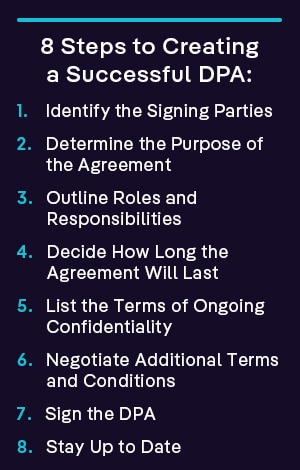
Step 1: Identify the Signing Parties
Who is the data controller, and who is the data processor in this agreement?
Step 2: Determine the Purpose of the Agreement
What types of personal data will be processed, about whom, and for what purpose?
Step 3: Outline Roles and Responsibilities
What is each party responsible for? Set out the obligations and legal responsibilities of both the data controller and the data processor in full.
Step 4: Decide How Long the Agreement Will Last
What is the term of the data processing agreement, and what will happen to the data when it ends? Align this with the termination provisions of the main agreement; our guide to contract termination covers how those provisions work.
Step 5: List the Terms of Ongoing Confidentiality
How will each party protect the data during the agreement, and who must be bound by confidentiality?
Step 6: Negotiate Additional Terms and Conditions
What other terms do you need to meet applicable regulations or to fully define the relationship? The review checklist above is a quick way to confirm nothing required is missing.
Step 7: Sign the DPA
Once the data processing agreement is final, both the data controller and the data processor sign it, or formally accept it as part of the main agreement, so that it is binding.
Step 8: Stay Up to Date
Data processing agreements may need to be updated as data protection laws change, as new laws take effect, or as the scope of the relationship between the data processor and data controller changes. Scheduling these reviews is part of good contract compliance.
FAQ
What is a DPA?
A DPA, or data processing agreement, is a contract between an organization that controls personal data and a service provider that processes that data on its behalf. It sets out the scope and purpose of the processing, the processor's obligations on security, confidentiality, and sub-processors, and what happens to the data at the end. Under the GDPR, a contract with these terms is required whenever a controller uses a processor.
What does DPA stand for?
In contracts and privacy work, DPA usually stands for data processing agreement, and you will also see data protection agreement and data processing addendum used for the same document. In regulatory contexts, DPA can mean a data protection authority, the public body that enforces data protection law. In the UK, it can also refer to the Data Protection Act 2018.
Is a data protection agreement the same as a data processing agreement?
In most cases, yes: both terms describe the contract that governs how a processor handles personal data for a controller. "Data processing agreement" is the term most closely tied to GDPR Article 28, while "data protection agreement" and "data processing addendum" are common alternatives. What matters is the content, not the title, so check that the required clauses are there.
When is a data processing agreement required?
Under the EU and UK GDPR, a DPA is required whenever a controller uses a processor to process personal data on its behalf, and processors need equivalent contracts with their sub-processors. Several US state privacy laws, including those in Virginia, Colorado, and Connecticut, also require contracts between controllers and processors, and the CCPA requires contracts with service providers and contractors. If you are unsure whether a law applies to you, ask qualified counsel.
What is the difference between a DPA and a privacy policy?
A DPA is a contract between two organizations about how one processes personal data for the other. A privacy policy is a notice from an organization to individuals explaining what personal data it collects, why, and what rights they have. A data sharing agreement (sometimes called a data disclosure agreement) is different again: it usually governs data passed between organizations that each decide independently how to use it.
What is a data protection authority?
A data protection authority is an independent public body that monitors and enforces data protection law, handles complaints, and can investigate and fine organizations. Under the GDPR, each EU member state has at least one, called a supervisory authority, such as the CNIL in France or the Data Protection Commission in Ireland, and the UK's equivalent is the Information Commissioner's Office (ICO). These authorities can require organizations to provide information, including their contracts with processors.
Conclusion
For organizations that collect personal information from consumers or users, and for the third parties that process that data, data processing agreements are a critical tool. They provide a framework for respecting personal data and upholding data protection laws, which helps protect businesses from fines and reputational damage and gives users and customers confidence that their privacy is taken seriously. An effective DPA requires understanding which laws apply, holding all parties accountable for following them, and respecting people's right to know how their data will be handled. With the right measures in place, people are more comfortable sharing their data, which makes it easier for organizations to do business while keeping customer trust.
Understanding DPAs is only the start. If your team reviews DPAs and other agreements at volume, Leah Agentic CLM can review them against your playbook, extract key clauses, obligations, and parties, and track obligations and renewal dates after signature, while your team approves the decisions that matter. Request a demo to see it with your own agreements.