
Quick answer: An NDA lasts as long as its own terms say: business NDAs usually protect information for a fixed period the parties choose (one to five years is common), while trade secrets are often protected for as long as they stay secret. An NDA works by having the receiving party promise to keep the disclosing party's information confidential, use it only for an agreed purpose, and share it only with people who need it and are bound by the same duty.
NDA stands for non-disclosure agreement, also called a confidentiality agreement. Good NDA management means business teams send routine NDAs on an approved template without waiting for legal, changes to key terms go to counsel, and every signed NDA is stored with its dates tracked. This guide is general information, not legal advice.
What is a Non-Disclosure Agreement (NDA)?
A Non-Disclosure Agreement (NDA) is a legally binding contract establishing a confidential relationship between parties. The Legal Information Institute at Cornell Law School defines NDAs as "agreements in contract law where parties agree that certain information will remain confidential." Well-crafted NDAs ensure that information shared between parties remains private and is only shared with explicit consent. They are used by individuals and businesses to protect sensitive information, including:
- Trade secrets
- Proprietary data
- Business strategies
- Employment terms
- Financial details
- Other confidential information
NDAs may be unilateral (one-way), where only one party is required to keep the information private, or mutual, which requires that both parties protect each other's confidential information. A multilateral NDA involves three or more parties agreeing to protect each other's confidential information and is typically used when collaborating and sharing sensitive information.
The use of NDAs is common in various enterprises, including:
- Tech companies utilize NDAs when sharing proprietary technology or collaborating on new inventions or trade secrets
- Independent contractors may be asked to sign NDAs to protect sensitive details about upcoming projects, prevent leaks, and protect intellectual property
- Many in the healthcare sector are required to sign NDAs to protect sensitive health data or comply with regulations like HIPAA
- NDAs act as a safeguard to prevent the premature disclosure of proprietary information and research findings in R&D
- Startups use NDAs when pitching to investors or collaborating with partners to protect their innovative ideas and plans
An NDA commonly accompanies employment agreements. For example, a company may want executives to keep their individually negotiated pay and benefits confidential, so that each new hire negotiates on their own terms. Be careful here: many jurisdictions protect employees' right to discuss their own pay, so confidentiality terms about compensation need legal review.
How does an NDA work?
- Agree the purpose and sign first. The parties name the reason for sharing (for example, evaluating a partnership or a supply deal) and sign before anything sensitive changes hands.
- Share under the definition. The NDA's definition of confidential information decides what is protected, such as anything marked confidential or anything a reasonable person would understand to be confidential.
- Use and protect it only as agreed. The receiving party may use the information only for the stated purpose, must protect it with reasonable care, and may share it only with employees, advisers, or other representatives who need to know and are bound by similar duties.
- Apply the standard exclusions. Information that is already public, already known to the recipient, independently developed, or received lawfully from someone else is usually not covered. If a court or regulator compels disclosure, the recipient typically gives notice where allowed and discloses only what is required.
- Return or destroy at the end. When the discussions end or on request, the recipient returns or destroys the information, and the duty of confidentiality continues for the period the NDA states.
- Enforce if needed. If the recipient breaches the NDA, the disclosing party can ask a court to stop further disclosure (an injunction) and claim damages for its losses.
How long do NDAs last?
An NDA lasts as long as it says; there is no single default length. Two periods matter, and many NDAs set them separately:
- The term, or disclosure period: the window during which shared information is covered, for example one or two years from signing.
- The confidentiality period: how long the recipient must keep the information secret, which often runs past the term, for example several years after each disclosure or after the term ends.
Trade secrets are often protected for as long as they remain trade secrets, because a fixed end date could let the recipient use them freely once it passes. As the Cornell definition notes, an NDA "can continue indefinitely or can include a duration clause," but an indefinite period for ordinary business information can be harder to enforce. If an NDA is silent on duration, the answer depends on the governing law, so ask counsel.
NDA Self-Service Checklist: Which NDAs Business Teams Can Send Without Legal
Most NDAs are routine. A clear rule for which ones business teams can send on their own, and which go to counsel, keeps deals moving without adding risk. Use the table below as a starting point and agree the final version with your legal team. For the full workflow (intake, templates, approvals, and signature), see our guide to sales self-service contracts.
| Request or change | Who handles it | Why | Who signs |
|---|---|---|---|
| Mutual NDA on the current approved template, with only the blanks filled in (party names, addresses, purpose, effective date) | Business team, self-service | Legal has already approved every clause | Authorized business signer |
| One-way NDA on the approved template where only your company shares information | Business team, self-service | Your company takes on no confidentiality duties | Authorized business signer |
| Correcting the counterparty's legal name or address, or adding its affiliates as parties | Business team if your playbook allows; otherwise legal operations | Administrative change, but the legal entity must be right for the NDA to bind it | Authorized business signer |
| Counterparty insists on using its own NDA | Legal, reviewed against the NDA playbook | Every clause is unknown until reviewed | Authorized signer, after legal approves |
| Any change to the term or confidentiality period | Counsel | Sets how long information is protected; trade secrets may need open-ended protection | Authorized signer, after counsel approves |
| Any change to the definition of confidential information or the exclusions | Counsel | Decides what is protected at all; a narrow definition can leave key information unprotected | Authorized signer, after counsel approves |
| Non-solicit or no-hire clause added | Counsel | Restricts hiring, and enforceability varies by jurisdiction | Authorized signer, after counsel approves |
| Governing law, venue, or dispute resolution changed | Counsel | Decides which courts and rules apply if you need to enforce the NDA | Authorized signer, after counsel approves |
| Residuals clause added | Counsel | Can let the recipient use information its people retain in memory, which weakens protection | Authorized signer, after counsel approves |
| Non-compete, exclusivity, standstill, or no-contact terms (common in M&A) | Counsel | Goes beyond confidentiality and can restrict how your business operates | Senior signer named in your signature policy |
| Personal data, health data, source code, or export-controlled technical data will be shared | Counsel, plus privacy or security | An NDA alone may not meet your legal duties; you may need a data processing agreement or security terms | Authorized signer, after counsel approves |
| NDA or confidentiality agreement with an individual employee, contractor, or consultant | HR and counsel | Employment confidentiality terms have extra rules, such as the US whistleblower immunity notice under 18 U.S.C. § 1833(b) | HR or the signer named in your policy |
Who signs. Only someone with authority to bind your company under your signature authority policy. One workable setup: a named business role (for example, a sales or procurement director) may sign NDAs on the unchanged template, and anything else needs legal approval first. Before you file the NDA, check that the counterparty's signer has authority too, that both sides signed the same version, and that you hold the fully executed copy (signed by every party).
Why are NDAs Important?
Non-disclosure agreements are a frontline tool allowing entities to safeguard private data. They provide a legal shield and promote trust between parties engaged in collaboration or negotiations. When parties arrive at the table, they can openly exchange ideas and knowledge, knowing that their private information will be protected.
NDAs outline what information is considered confidential and the respective obligations of the involved parties. It is important to sign an NDA early in the relationship because, without one, there is little expectation of privacy. Too often, parties enter preliminary discussions before signing an NDA. Although an NDA can be drafted to be retroactive, it may not be able to cover and control information that was disclosed to others before the NDA was signed. Having an NDA in place from the beginning can help prevent misunderstandings and ensure everyone is on the same page.
NDAs can offer crucial financial protection against the consequences of leaked sensitive information. The following example from mergers and acquisitions shows why NDAs are essential.
ABC Company enters negotiations for a potential merger, requiring them to share sensitive financial data, strategies, and proprietary technology. If the merger fails in negotiations without NDAs in play, the other party could use the information it has acquired to damage ABC Company. They could also provide that information to direct competitors, causing substantial financial loss to ABC Company.
Key Elements of a Non-Disclosure Agreement (NDA)
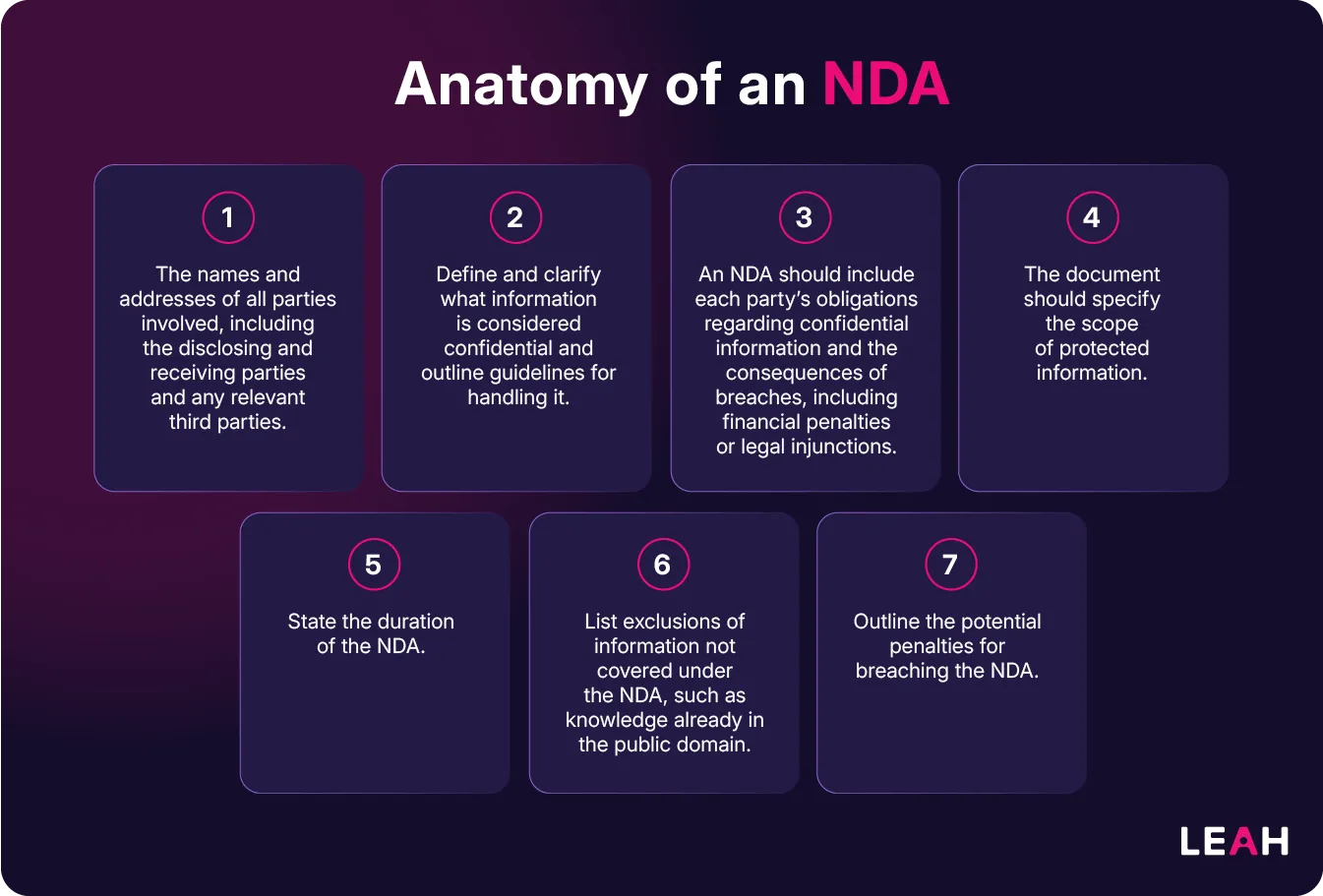
There are essential elements that should be included in an NDA to ensure they are effective, powerful, enforceable risk mitigation tools. These elements include:
- The names and addresses of all parties involved, including the disclosing and receiving parties and any relevant third parties
- Define and clarify what information is considered confidential and outline guidelines for handling it
- An NDA should include each party's obligations regarding confidential information and the consequences of breaches, including financial penalties or legal injunctions
- The document should specify the scope of protected information
- State the duration of the NDA
- List exclusions of information not covered under the NDA, such as knowledge already in the public domain
- Outline the potential penalties for breaching the NDA
One of the most common mistakes when crafting an NDA is using vague language, such as "proprietary information." Instead, the NDA should clearly define what is considered confidential information. Clear and specific language helps every party understand the terms of the agreement.
If an NDA comes before a longer relationship, the confidentiality clause in your later contract may replace it. Our master service agreement guide explains how the two fit together.
What Happens if You Break an NDA
Breaching an NDA can have serious repercussions, including lengthy and expensive lawsuits that impose emotional and financial burdens on both parties. Consider a dispute that followed a failed acquisition: Garda USA, Inc. v. Sun Capital Partners, Inc., 2023 NY Slip Op 32460(U) (N.Y. Sup. Ct., N.Y. County, July 7, 2023).
Garda, a security services company, was negotiating to acquire SOS, another security services company, from Sun Capital Partners, which held a controlling interest in SOS. Garda claimed that Sun disclosed negotiation details to other bidders in violation of their NDA, which enabled a competitor to outbid it. The court dismissed Garda's claims. Among its reasons, it found that Garda had itself breached the NDA by sharing confidential information with potential financing sources that the NDA did not cover. Sun knew Garda was sharing the information to raise financing and did not object, but it never formally waived the NDA's confidentiality terms.
The case shows why an NDA should state exactly who may receive the information and in what circumstances (for example, lenders and other financing sources), and why any waiver should be in writing.
Enforcing an NDA can present challenges. Language that is too broad or information that becomes public presents problems, as does the lack of clear and specific terms. NDAs are most effective when the information being protected is clearly defined. Jurisdictional awareness is also crucial, as failure to understand the laws governing NDAs across different jurisdictions can render them unenforceable.
Consequences for breaking an NDA
Legal Action: The party whose information was disclosed can file a lawsuit for breach of contract. This can lead to costly legal battles and the need for legal representation.
Monetary Damages: If found in breach of the NDA, the individual or organization may be required to pay monetary damages to the injured party, including compensation for losses incurred. Punitive damages are generally not available for a simple breach of contract, but trade secret laws can allow extra damages for willful and malicious misappropriation.
Employment Consequences: If an employee breaks an NDA, their employer may take disciplinary action, which could include termination. Breaching an NDA can harm your reputation, making finding employment in the same industry difficult.
Damage to Your Reputation: Breaching an NDA can severely damage relationships, leading to a loss of trust with business partners, clients, and employers. This can impact future job opportunities and collaborations.
Criminal Charges: In extreme cases, especially if the disclosed information involves trade secrets or sensitive data, there could be potential criminal charges associated with the breach.
What to do if someone breaks your NDA
If a party to an NDA breaches the contract, act quickly to protect your interests. Document and collect evidence of the breach and check the remedies the NDA provides. Communication may solve the problem, so raise the issue with the party involved. If that doesn't resolve it, seek legal advice about pursuing remedies, such as an injunction to stop further disclosure.
How to Use an NDA Effectively
Learning how to use an NDA effectively can improve enforceability, increase protection, and protect confidential information responsibly.
Best NDA practices for businesses and individuals
- Specify the scope of the NDA by using clear and specific language defining confidential information.
- Limit the duration of the NDA by setting a reasonable timeline for how long the confidentiality obligations last. While indefinite NDAs exist, they can be hard to enforce.
- Identify the parties bound by the NDA, including the names of the individuals or entities involved.
- Define the circumstances under which the information may be disclosed, such as legal requirements or financial institutions needing access to the information, as in the example above.
- Utilize simple, straightforward language without legal jargon. The goal is for all parties to understand the terms of the agreement.
Training employees and stakeholders about the importance of confidentiality can help avoid accidental disclosures.
Scenarios where NDAs may not be enforceable
Numerous scenarios can result in an NDA being unenforceable. Examples include:
- Public interest disclosures: NDAs are often unenforceable if the disclosed information involves illegal activities or poses a risk to public safety. In the US, for example, the Defend Trade Secrets Act gives individuals immunity for disclosing a trade secret in confidence to a government official or an attorney solely to report or investigate a suspected violation of law (18 U.S.C. § 1833(b))
- Sexual harassment and assault disputes: under the US Speak Out Act of 2022, nondisclosure and nondisparagement clauses agreed before a dispute arises cannot be enforced in court in sexual assault or sexual harassment disputes (42 U.S.C. § 19403)
- If the information becomes publicly accessible, the NDA loses its effectiveness
- NDAs that use vague or ambiguous language can be challenged and may be deemed unenforceable
- NDAs must identify confidential information. General terms that lack specificity may not hold up in court
- An unreasonably long or indefinite confidentiality period for ordinary business information (as opposed to trade secrets) may be challenged in some jurisdictions
- New agreements made after the NDA is signed that contradict or nullify the information in the NDA could render it unenforceable
Standard NDA templates: oneNDA and Bonterms
Standard, publicly available NDA templates can speed up signing, because both sides may already know the terms. Two examples:
- oneNDA describes itself as a crowd-sourced, open-source NDA created by the legal community, and it is free to use.
- Bonterms publishes standard agreements, including mutual and one-way NDAs. Deal-specific terms such as the NDA term, confidentiality period, and governing law go on a cover page.
As with any template, check that its defaults (duration, definition of confidential information, governing law) match your own policy before you adopt it, and add it to your self-service rules only once legal has approved it.
Legal Tech Solutions for NDA Management
Good NDA management is mostly about the process around the document. Whatever tools you use, aim for these basics:
- One approved template set (mutual and one-way), version-controlled, so everyone sends the same language. This is also the simplest way to keep confidentiality language consistent across NDAs and the confidentiality clauses in your other contracts.
- A simple intake route, such as a request form or a button in your CRM, that captures the counterparty, the purpose, and what will be shared.
- A playbook for counterparty paper, with preferred positions and fallbacks for the clauses in the checklist above, so contract redlining is consistent from one reviewer to the next.
- E-signature and one home for signed NDAs. Save every fully executed copy to a central contract repository with the counterparty, type, effective date, term, confidentiality period, governing law, and signer recorded.
- Tracking of dates and post-term duties, such as returning or destroying information when discussions end. Our guide to tracking contract obligations covers how to assign and monitor them.
- Simple reporting: how many NDAs you sign, how long they take, and how many stay on the template.
Platforms that help collect and manage signed NDAs fall into three broad groups: e-signature tools (signing and storage), standard-template services like those above, and contract lifecycle management (CLM) platforms that cover the whole process from request to expiry.
Leah, formerly ContractPodAi, offers one such CLM platform. In Leah Agentic CLM, your teams can start an NDA through guided intake or from email with the Outlook Add-in, generate it from approved templates, and send it for signature through DocuSign or Adobe Sign. When a counterparty sends its own NDA, One-Drop classifies it and extracts key clauses, and playbook-driven review returns redlines as tracked changes in Microsoft Word. Signed NDAs go into a searchable repository with alerts for key dates. Request a demo to see it with your own templates.
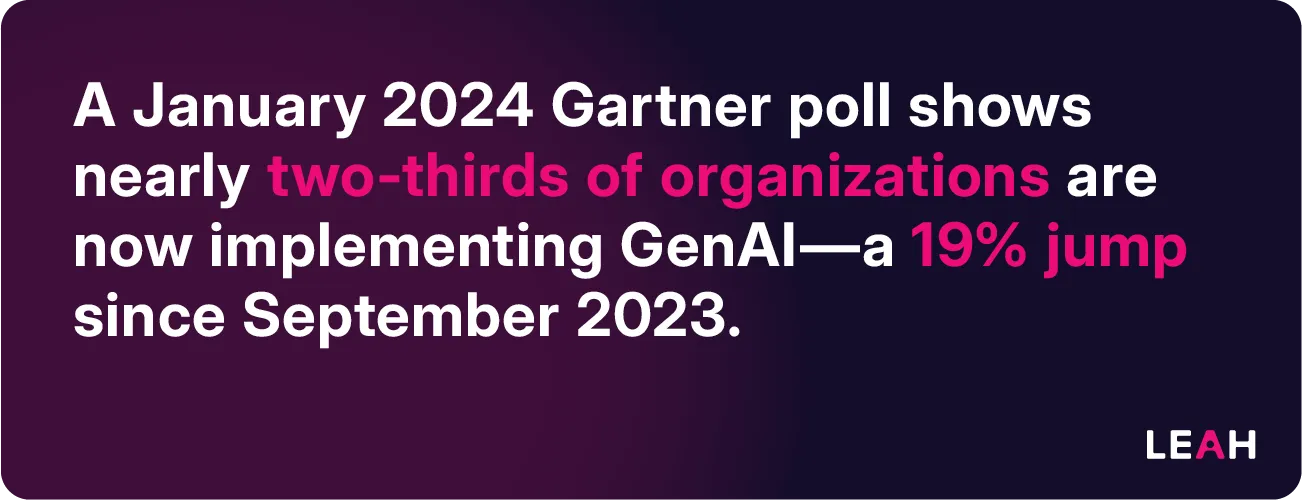
A January 2024 poll by Gartner reveals that interest in GenAI is still high, with nearly two-thirds of organizations implementing it across various business units. This marks a significant increase of 19 percentage points since September 2023.
Final Thoughts: NDAs for Better Protection
An NDA is a crucial tool for protecting sensitive information and preventing unauthorized sharing, which can safeguard intellectual property, trade secrets, and financial information. The terms, duration, and scope of NDAs are critical aspects that determine compliance and enforceability.
Most of the risk sits in a handful of clauses: the definition of confidential information, the term and confidentiality period, permitted recipients, governing law, and any extras such as non-solicit or residuals terms. Put clear self-service rules around the routine NDAs, send the rest to counsel, and track every signed NDA to its end date. This guide is general information, not legal advice; for a specific NDA, talk to your legal counsel.
FAQ
How long does an NDA last?
As long as its terms say. NDAs have variable timeframes but most commonly remain in effect for one to five years. The term may be indefinite in limited instances, such as protecting highly sensitive trade information. Check both the NDA's term and its confidentiality period, because the duty to keep information secret often continues after the agreement itself ends.
What does NDA stand for?
NDA stands for non-disclosure agreement. It is also called a confidentiality agreement or a confidential disclosure agreement (CDA). A mutual NDA, sometimes written MNDA, protects information shared in both directions.
Can an NDA be retroactive?
Yes, if it says so. An NDA can cover information shared before signing, for example by defining confidential information to include information disclosed before the effective date. It cannot undo disclosures already made to third parties before signing, so sign before sharing whenever you can.
Can you refuse to sign an NDA?
Yes. You can refuse to sign an NDA if you're uncomfortable with its terms, or negotiate terms such as duration, scope, or the definition of confidential information. If the other side makes the NDA a condition of a job, a deal, or a meeting, refusing may mean it does not go ahead. Consider seeking legal advice if you're unsure of the agreement's implications.
What does good NDA management look like?
Business teams send routine NDAs on an approved template without waiting for legal, and anything off-template goes to counsel under clear rules. Every fully executed NDA sits in one repository with its term, confidentiality period, and counterparty recorded, and someone is alerted before key dates. The self-service checklist and the NDA management section above show how to set this up.
Which documents do companies have employees sign to protect trade secrets?
Most commonly a confidentiality agreement (NDA), often combined with an invention assignment agreement, and in some cases a non-compete or non-solicitation agreement, whose enforceability varies widely by state and country. In the US, a confidentiality agreement with an employee, contractor, or consultant entered into or updated after May 11, 2016 should include the whistleblower immunity notice described in 18 U.S.C. § 1833(b). Without it, the employer cannot recover exemplary damages or attorney fees under the Defend Trade Secrets Act against an employee who did not receive the notice.