
Quick answer: Contract termination, or termination of a contract, means ending a contract so the parties no longer have to perform their future obligations under it, either early under a right in the contract (for cause or for convenience), by mutual agreement, or on a ground the law allows. A contract that simply reaches its end date usually expires rather than terminates, although both are often called the end of the contract.
Termination does not erase everything. Rights that have already accrued, such as unpaid fees or claims for an earlier breach, usually remain, and survival clauses keep obligations such as confidentiality, indemnities, and audit rights in force. To terminate validly, rely on a ground the contract or the law gives you, respect any cure period, and serve notice exactly as the notice clause requires.
Contract Termination at a Glance
| Termination type | What it means | What to check |
|---|---|---|
| Expiration | The contract ends when the stated term runs out. | Renewal language, notice deadlines, and surviving obligations. |
| Mutual agreement | Both parties agree to end the contract. | Release language, final payments, transition duties, and written approvals. |
| Termination for breach | One party ends the contract because the other party failed to perform. | Cure periods, materiality thresholds, evidence, and remedies. |
| Termination for convenience | A party may end the contract without proving breach if the contract allows it. | Required notice, fees, wind-down obligations, and any limits on when the right can be used. |
| Event-based termination | A specified event creates a right to terminate. | Change of control, insolvency, regulatory change, force majeure, or failed milestones. |
Before You Terminate a Contract
Review the contract language, confirm the factual basis, follow the notice procedure exactly, preserve evidence, and check whether any obligations survive. The checklist below walks through each step. This article is general information and is not legal advice, so legal counsel should review high-risk or disputed terminations.
Termination and Notice Checklist
Use this checklist before you send a termination notice or let a contract run out. The contract wording and the governing law decide what is required in each case, so treat it as a guide to what to look for, not as a substitute for reading the clause.
| Step | What to check | Why it matters |
|---|---|---|
| Expiry or termination | Is the contract ending because its term runs out, or is a party ending it early? Check the term, the renewal clause, and any notice needed to stop an automatic renewal. | Letting a contract expire needs no breach and no termination right, but an auto-renewing contract may continue unless notice is given before a deadline. Ending early needs a contractual right, an agreement, or a legal ground. |
| Governing documents | The signed agreement, every amendment, order forms, SOWs, and incorporated terms. Check which document controls termination and whether ending one order or SOW also ends the master agreement. | Termination rights can differ between a master agreement and its orders, and a later amendment may have changed the notice terms. |
| Cause or convenience | For cause: the breach or event the clause lists, such as material breach or insolvency, and your evidence. For convenience: whether the right exists, which party has it, and any fee, minimum term, or wind-down cost. | Relying on a ground you do not have, or a breach you cannot show, can make the termination itself a breach and expose you to a damages claim. |
| Cure period | Whether you must first give written notice of the breach and a set time to fix it, when that period starts, and whether the breach can be cured at all. | Terminating before a required cure period ends can make the termination invalid. |
| Notice period | How much notice is required, whether it is counted in calendar or business days, and the date termination takes effect. | A short or miscounted notice period can delay the end date or make the notice ineffective. |
| Notice method | The delivery method the notice clause requires (for example, courier, registered mail, or email only if the clause allows it), the address and named recipient, any copy-to party, and who at your company has authority to sign. | Notice sent the wrong way, to the wrong address, or signed by the wrong person may not count as valid notice. |
| Survival clauses | Which obligations continue after termination, such as confidentiality, payment of amounts due, indemnities, limitation of liability, audit rights, and dispute resolution. | These obligations remain enforceable after the relationship ends, so someone still has to track and meet them. |
| Final obligations | Final invoices, refunds of prepaid fees, termination fees, return or deletion of data and confidential information, return of property, transition assistance, and access removal. | Wind-down terms decide who pays what and when, and data or transition duties often have their own deadlines. |
| Record and confirm | Keep a copy of the notice and proof of delivery, ask for written acknowledgment, and update the contract record with the new status, end date, and surviving obligations. | Proof of notice matters if the termination is disputed, and an updated record stops renewals, invoices, or system access from continuing by mistake. |
Two rows need an owner after the notice goes out. Surviving obligations, such as confidentiality and audit rights, still need tracking after the contract ends. Data return and deletion terms often sit in a data processing agreement (DPA) rather than the main contract, so check both. If you only want to stop an automatic renewal, see how to manage contract renewals.
Understanding Contract Termination
Terminating a contract brings the agreement to an end. That can happen early, before the parties have finished performing their obligations, or at the natural end of the relationship. Strictly, a contract that ends because its term runs out expires, while termination usually means a party ends it before then, although many contracts and many people use "termination" for both.
When a contract is terminated, the parties' future obligations under it typically end, except those the contract says will "survive" termination. Termination also does not normally wipe out rights that have already accrued. So even after a contract is over, the parties may still have post-termination obligations, and a party may still be able to claim damages for an earlier breach under the contract or applicable law.
The reasons for termination vary, and they depend on each party's situation and on the type of contract. When and how the contract is terminated can decide whether the termination is valid and whether either party is liable for breach.
Why Does a Contract Get Terminated?
Contracts end for several common reasons:
- Expiration of the term: The contract ends on its stated end date or when its duration runs out, unless the parties renew it or it renews automatically under its own terms.
- Example: A one-year equipment lease ends on the last day of its term unless the parties agree to renew it.
- Termination for convenience (T for C clause): If the contract includes this right, a party can end the contract without showing any breach by the other party, usually by giving a set period of notice and sometimes by paying a fee.
- Example: A customer's needs change and it no longer requires a consultant's services, so it gives the notice the contract requires.
- Termination for cause: A party ends the contract because the other party committed a breach, or because an event the contract lists, such as insolvency, has occurred. Many clauses require notice and a cure period first.
- Force majeure and impossibility: A force majeure clause may suspend performance, or allow termination, when an event outside the parties' control prevents performance. Separately, legal doctrines such as impossibility, impracticability, or frustration may discharge a contract in some circumstances.
- Example: Natural disasters, war, and changes in law are often listed in force majeure clauses. Whether a particular event qualifies depends on the clause wording and applicable law.
Six Types of Contract Breaches
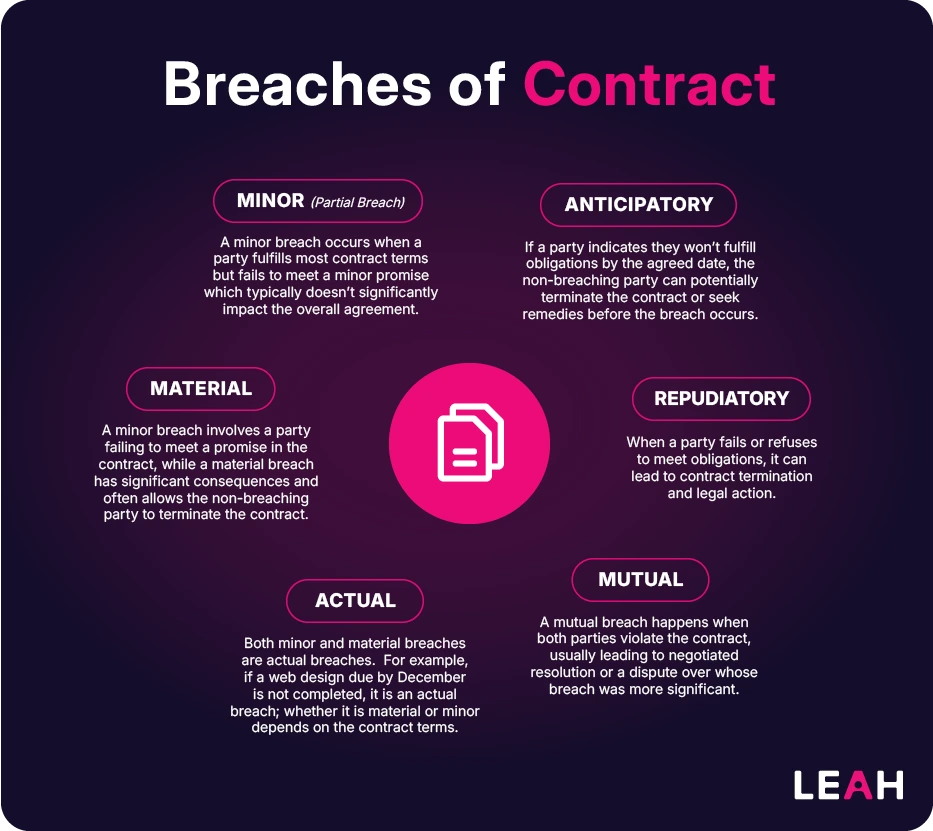
Another reason for contract termination is a breach of the agreement. Breaches are commonly described in the six ways below. The categories overlap, and their legal effect depends on the contract and the applicable law.
1. Minor Breach (Partial Breach):
A party fulfills most of the terms of the contract but fails to meet a minor promise. Because the unmet promise does not significantly affect the rest of the contract, a minor breach usually supports a claim for damages rather than a right to terminate.
2. Material Breach:
As with a minor breach, one party fails to meet a promise in the contract. A material breach, however, goes to the heart of the agreement and often gives the non-breaching party the right to terminate, as well as to claim damages.
3. Actual Breach:
Both minor and material breaches are kinds of actual breach: a failure to perform when performance is due. For example, if you contract for a web design service due by December 1, and the designer does not finish by that date, that is an actual breach. Whether it is material or minor depends on the other terms of the contract and the circumstances.
4. Anticipatory Breach:
A party indicates, before performance is due, that it will not perform, for example by saying it will not deliver by the agreed date. Depending on applicable law, the other party may be able to treat the contract as ended and seek remedies without waiting for the due date. This is also called anticipatory repudiation, and it is closely related to the repudiatory breach described below.
5. Repudiatory Breach:
This term is used mainly in English law and related legal systems. It describes a breach serious enough, or a refusal to perform clear enough, that the other party may choose either to accept it and end the contract or to affirm the contract and keep it going. In both cases, the other party may also be able to claim damages.
6. Mutual Breach:
A mutual breach may occur when both parties have breached the contract or are in the process of doing so. These situations are harder to resolve, because the parties, or a court or arbitrator, have to work out whose failure came first and how much each one mattered.
What Are The Conditions for Terminating a Contract?
Whether a contract can be ended, and how, depends on its terms and the applicable law. Common grounds include:
Fraud or a mistake: A contract induced by fraud or misrepresentation, or affected by certain kinds of mistake, may be voidable. The affected party may then be able to rescind it, which unwinds the contract rather than ending it from that point on.
Illegality: If a change in law makes performance illegal, performance may have to stop. Depending on the contract and the law, the contract may be discharged, or a change-in-law clause may set out what happens next.
Breach of the contract: All parties are responsible for performing their obligations under the contract. If a party fails to perform, prevents the other party from performing, or otherwise violates the contract, it is in breach. Not every breach allows termination, though: that usually requires a material or repudiatory breach, or a breach the termination clause specifically lists.
Prior agreements: The parties can agree in the contract that it may be ended in specific circumstances, such as insolvency, a change of control, or a missed milestone, or for convenience. A termination on one of these grounds must follow the clause exactly; otherwise the termination may itself be a breach.
How Does a Party Terminate a Contract?
Start with the contract. Termination clauses set out who can terminate, on what grounds, with how much notice, and by what method. Read them together with any amendments and related documents, such as a master service agreement and its statements of work, before you act. Then work through the checklist above, and involve legal counsel if the termination is high-value or likely to be disputed.
Contract Termination Notice
Contract termination often starts with a termination notice or letter, and the agreement usually sets out how that notice must be given. The notice is a formal communication from one party to the other that states its intention to terminate. It typically identifies the contract, the termination right being used, and the date termination takes effect. A notice of termination for cause usually also describes the breach or event and the clauses that justify the action. If the notice does not meet the contract's requirements, it may be ineffective or lead to a dispute.
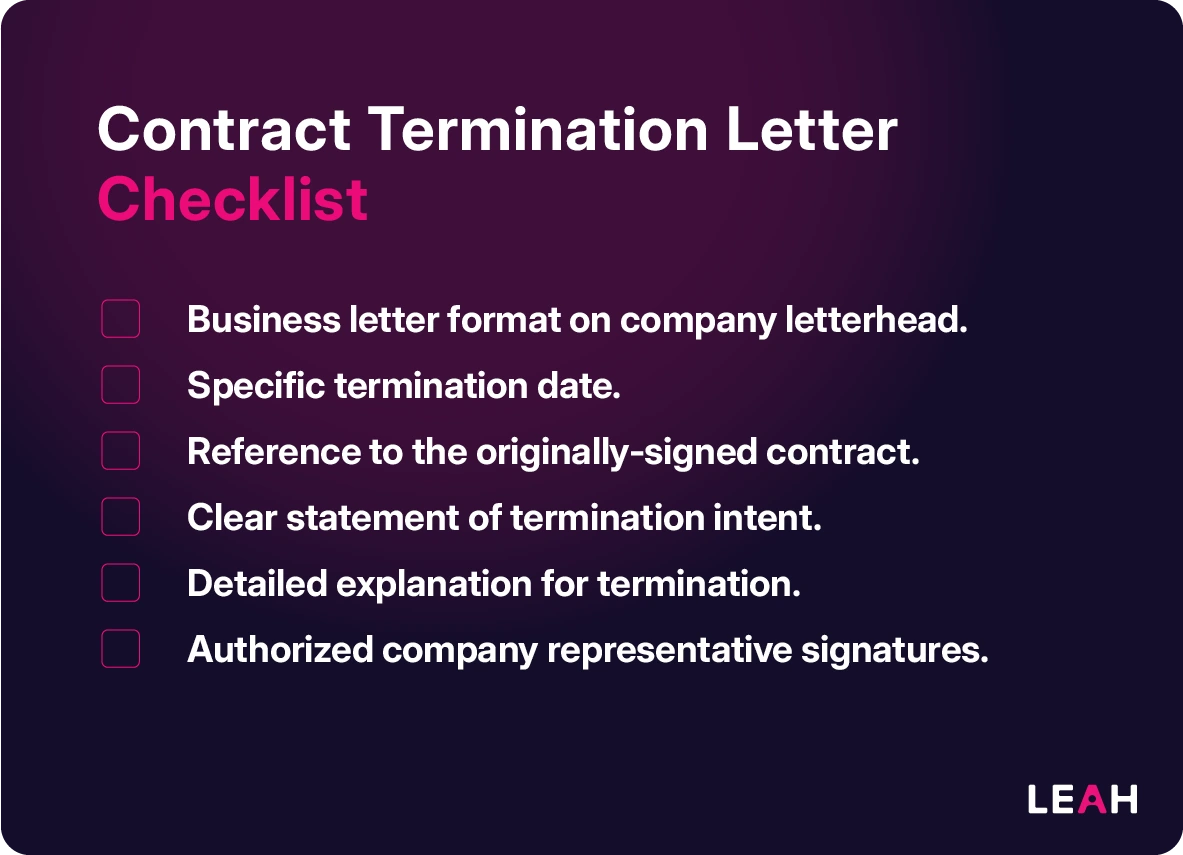
Contract Termination Letter Checklist:
- Business letter format on company letterhead
- Clear statement of termination intent
- Reference to the originally signed contract and any relevant amendments
- The ground for termination and the clause relied on (a notice of termination for convenience may not need a reason)
- Specific termination date
- Signature of an authorized company representative
- Delivery by the method, and to the address, the notice clause requires
Dispute Resolution
If a dispute arises during termination, for example over whether the termination was valid or what compensation is due, there are a few common ways to address it formally: negotiation, mediation, arbitration, or litigation. The contract may require a particular method or sequence.
Negotiations: When parties want to resolve a dispute amicably, they often try negotiation first. The parties communicate openly and look for compromises that avoid lengthy legal proceedings.
Mediation: A neutral third party helps the parties discuss the dispute and reach a mutually acceptable resolution. The mediator does not impose a decision, and the parties can explore their concerns in a structured setting.
Arbitration: Some contracts specify arbitration as the method for resolving disputes. It is more formal: an arbitrator or a panel of arbitrators, acting as neutral decision-makers, hears both sides and issues a decision. Arbitration awards are generally binding, and the grounds for challenging them in court are usually narrow. Whether the process is confidential depends on the arbitration rules, the agreement, and applicable law.
Litigation: Litigation is often the least preferred method because it can be costly and time-consuming. When other efforts fail, a party may bring a claim in court, and both sides present their case to a judge or jury. Court proceedings and judgments are generally public. The parties can still settle at any stage, including before trial.
What are Contract Termination Remedies?
Contract termination remedies are the options available to a party to address a breach, including:
Compensatory (Monetary) Damages: Financial compensation intended to cover the losses that result from the breach, based on a reasonable estimate of the actual harm suffered.
Specific Performance: A court orders the breaching party to perform its contractual obligations. Courts usually grant this only when money damages would not be an adequate remedy.
Liquidated Damages: The contract sets a predetermined amount the breaching party must pay. In many jurisdictions, courts will not enforce an amount that operates as a penalty rather than a reasonable estimate of the likely loss.
Rescission (Restitution): The contract is canceled and the parties are restored, as far as possible, to their pre-contract positions.
How Does Contract Termination Fit within the CLM Process?
A standard agreement should go through the entire contract lifecycle: initiation, authoring, editing and review, approval, tracking and auditing, reporting, and finally renewal or termination. When contracts are managed manually, notice deadlines, termination rights, and renewal dates are easy to miss, and an unwanted contract can renew simply because no one sent notice in time. An agentic CLM platform with automated workflows and notifications helps prevent that.
To learn more, read the contract management process, where renewal, expiry, and termination are the final step, or what is contract lifecycle management?
Leah keeps contracts in a searchable repository and tracks obligations, with renewal dates, notice periods, and milestones triggering reminders. Its contract helpdesk answers questions about any contract, with each answer linked to the clause or document it came from. To find out how Leah can help you adopt and implement a CLM system of your own, contact us today to book a demo.
FAQ
What does termination mean in a contract?
In a contract, termination means ending the agreement so the parties no longer have to perform their future obligations under it. It can happen by agreement, under a termination right in the contract, or on a ground the law allows. Outside contracts, "termination" simply means bringing something to an end; in employment, for example, it usually means an employer ending a person's job.
What does "contract terminated" mean?
It means the contract has been brought to an end, usually before its scheduled end date, by one or both parties. Future obligations stop, but accrued rights, such as unpaid invoices, and any obligations covered by a survival clause, such as confidentiality, continue. The termination is only effective if it followed the contract's terms or a legal ground.
What does end of contract mean?
"End of contract" usually means the contract has reached the end of its term and expired, rather than being terminated early. Unless the contract renews or the parties agree to extend it, performance stops on that date, while surviving obligations continue. If the contract renews automatically, you may need to give notice before a deadline to make sure it actually ends.
How do you terminate a contract?
Find the termination clause and confirm you have a valid ground, such as a material breach, a listed event, or a termination-for-convenience right. Give any required cure period, then serve written notice by the method, to the address, and with the notice period the contract specifies. Keep proof of delivery, and manage final payments, data return, and surviving obligations.
What does pre-termination mean?
Pre-termination, or early termination, means ending a contract, lease, loan, or deposit before its scheduled end date. Whether you can do it, and at what cost, depends on the agreement. Some contracts allow early termination on notice, some charge an early termination fee, and some do not allow it except for cause.