
Enterprise contract management (ECM) is a comprehensive approach to managing an organization's contracts throughout their entire lifecycle, from creation to renewal or termination. But for enterprises operating at scale, ECM represents something far more transformative: the evolution from treating legal departments as cost centers to positioning them as strategic profit drivers.
While traditional definitions focus on technology and processes to streamline contract workflows, improve efficiency, and reduce risks, the reality for large organizations is that enterprise contract management has become the foundation for competitive advantage in an increasingly contract-driven business environment.
Understanding Enterprise Contract Management: Beyond the Basics
ECM solutions help organizations manage large volumes of contracts while ensuring compliance, optimizing performance, and maximizing value from contractual agreements. However, for enterprises managing 20,000 to 50,000+ active contracts across multiple jurisdictions, business units, and regulatory frameworks, the challenge extends far beyond basic contract lifecycle management.
What Makes Enterprise Contract Management Different
Scale and Complexity: Enterprise contract management isn't simply "contract management, but bigger." It requires architectural sophistication that can handle multi-tier contract hierarchies, global deployment capabilities, and cross-departmental dependencies that span continents and business units.
Strategic Intelligence: Modern ECM transforms contracts from static legal documents into dynamic business assets that continuously generate actionable insights for competitive positioning, risk mitigation, and revenue optimization.
Regulatory Sophistication: According to Navex Global's 2023 research, only 50% of risk and compliance professionals describe their programs as mature, making advanced compliance automation a critical differentiator for enterprise-grade solutions.
Key Aspects of Enterprise Contract Management: The Advanced Framework
Comprehensive Enterprise Contract Management with AI Intelligence
While ECM covers all contract stages including drafting, negotiation, approval, execution, performance monitoring, and renewal or termination, enterprise-grade solutions leverage agentic AI to make these processes predictive rather than reactive.
Traditional Approach: "If renewal date approaches, then send reminder."
Enterprise AI Approach: "Based on vendor performance patterns and market conditions, initiate renegotiation 90 days early to secure better terms."
Recent industry studies show contract cycle times reduced by up to 40% through intelligent automation.
Centralized Repository with Global Architecture
ECM provides a central location for storing and managing all contracts, but enterprise solutions require sophisticated multi-tenancy, data segregation capabilities, and API-first architecture that integrates seamlessly with complex ERP, CRM, and procurement ecosystems.
Enterprise Reality Check: A global manufacturing company discovered they were losing $2.3 million annually from missed software license optimizations because their contract repository couldn't surface optimization opportunities across their distributed operations.
Automation and Streamlining for Complex Workflows
ECM solutions automate repetitive tasks like contract creation, approvals, and reminders. However, enterprise environments require conditional logic that can handle matrix management structures, regional variations, and complex delegation requirements across global operations.
Advanced Workflow Orchestration: Modern enterprise systems manage approval chains involving stakeholders across five continents and three business units automatically, with conditional logic adapting to different scenarios in real-time.
Enhanced Visibility and Control Through Predictive Analytics
ECM offers visibility into contract terms, obligations, and performance, but enterprise-grade solutions provide predictive analytics that identify potential issues before they become problems.
Strategic Value Creation: A pharmaceutical company increased annual revenue by $12 million by improving renewal management processes. They weren't negotiating better deals; they were ensuring they captured the value they'd already negotiated.
Advanced Compliance Beyond Basic Requirements
ECM helps organizations comply with legal and regulatory requirements, but enterprise solutions must automatically apply relevant compliance frameworks based on contract type, jurisdiction, and industry requirements across multiple regulatory environments simultaneously.
Compliance Intelligence: Advanced systems don't just track compliance. They predict regulatory changes, automatically update contract templates, and provide jurisdiction-specific reporting for global operations.
Risk Mitigation Through Contract Intelligence
While ECM provides tools for risk assessment and obligation tracking, enterprise solutions leverage contract intelligence to benchmark competitive positioning, identify market opportunities, and optimize entire supplier ecosystems rather than managing vendors as isolated relationships.
Benefits of Enterprise Contract Management: The Business Impact
Transforming Enterprise Operations Through AI-Enhanced Contract Management
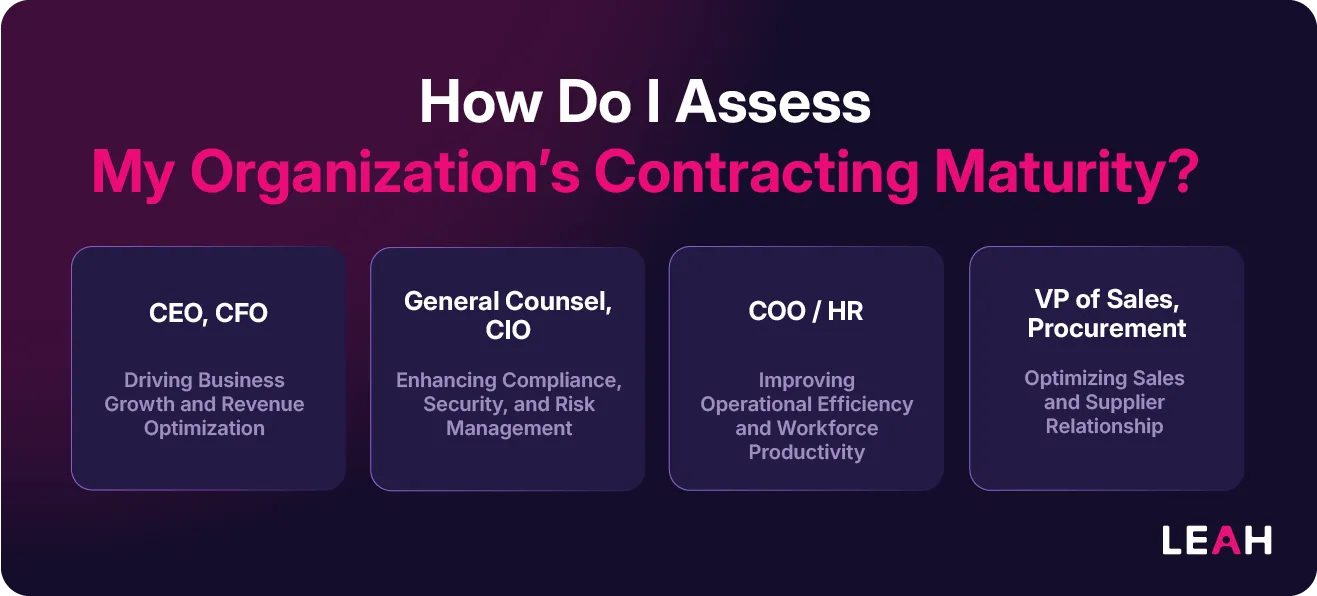
Modern AI-integrated ECM creates value far beyond the legal department, revolutionizing how organizations operate at every level. Let's explore how this technology empowers various stakeholders to achieve their strategic objectives:
Accelerating Financial Performance and Strategic Decision-Making (Executive Leadership)
C-suite executives seeking competitive advantage find AI-powered ECM essential for financial optimization and strategic agility:
- Revenue Acceleration Through Speed: Automated contract generation and streamlined approvals compress negotiation timelines, converting opportunities into revenue faster
- Financial Intelligence and Control: Advanced analytics prevent revenue leakage by catching missed renewals and identifying pricing inconsistencies, directly improving bottom-line results
- Growth Without Growing Headcount: Intelligent automation enables rapid scaling while maintaining lean legal operations, preserving margins during expansion
Strengthening Organizational Resilience Through Risk Intelligence (Legal and IT Leadership)
For those responsible for organizational protection, AI-powered ECM provides unprecedented visibility and control:
- Proactive Compliance Management: Intelligent monitoring systems track obligations and deadlines automatically, transforming compliance from reactive to predictive
- Transparent Governance Framework: Automated documentation creates complete audit histories, simplifying regulatory reporting and internal controls
- Modern Security Architecture: Next-generation ECM platforms replace legacy systems with secure, integrated solutions that align with contemporary IT standards
Maximizing Human Capital and Operational Excellence (Operations and HR Leadership)
AI-powered ECM liberates teams from administrative burden while enhancing collaboration:
- Streamlined Talent Operations: Automated employment documentation accelerates onboarding and reduces administrative friction in HR processes
- Cross-Functional Integration: Intelligent workflows connect previously isolated departments, creating seamless handoffs between legal, sales, procurement, and HR
- Strategic Resource Allocation: By automating routine tasks, AI enables teams to redirect their expertise toward high-value strategic work
Driving Commercial Excellence and Partnership Value (Sales and Procurement Leadership)
Commercial teams leverage AI-powered ECM to strengthen both customer relationships and supplier partnerships:
- Competitive Sales Velocity: Rapid contract turnaround times remove friction from the sales process, improving win rates and customer experience
- Strategic Vendor Management: Continuous monitoring of supplier agreements ensures performance standards are met and value is delivered
- Data-Driven Negotiations: Historical contract intelligence reveals pricing patterns and performance benchmarks, strengthening negotiating positions
With a clear understanding of how AI-powered ECM delivers value across the organization, leaders can now focus on identifying the specific capabilities that will drive maximum impact.
Industry-Specific Enterprise Contract Management Considerations
Highly Regulated Industries
Healthcare: HIPAA compliance, FDA requirements, and complex billing arrangements
Financial Services: SOX compliance, regulatory reporting, and sophisticated risk management
Energy: Environmental compliance, safety regulations, and complex joint ventures
Global Enterprises
Multi-jurisdictional Compliance: Automatic application of relevant regulatory frameworks
Currency and Language Management: Understanding how terms translate across legal systems
Regional Customization: Adapting workflows while maintaining central oversight
Technology Companies
Intellectual Property Management: Sophisticated licensing and joint development contracts
Fast-Paced Deal Cycles: Speed optimization without sacrificing compliance
Complex Partnerships: Managing ecosystem partnerships with appropriate governance
Measuring Enterprise Contract Management ROI
Financial Metrics That Matter
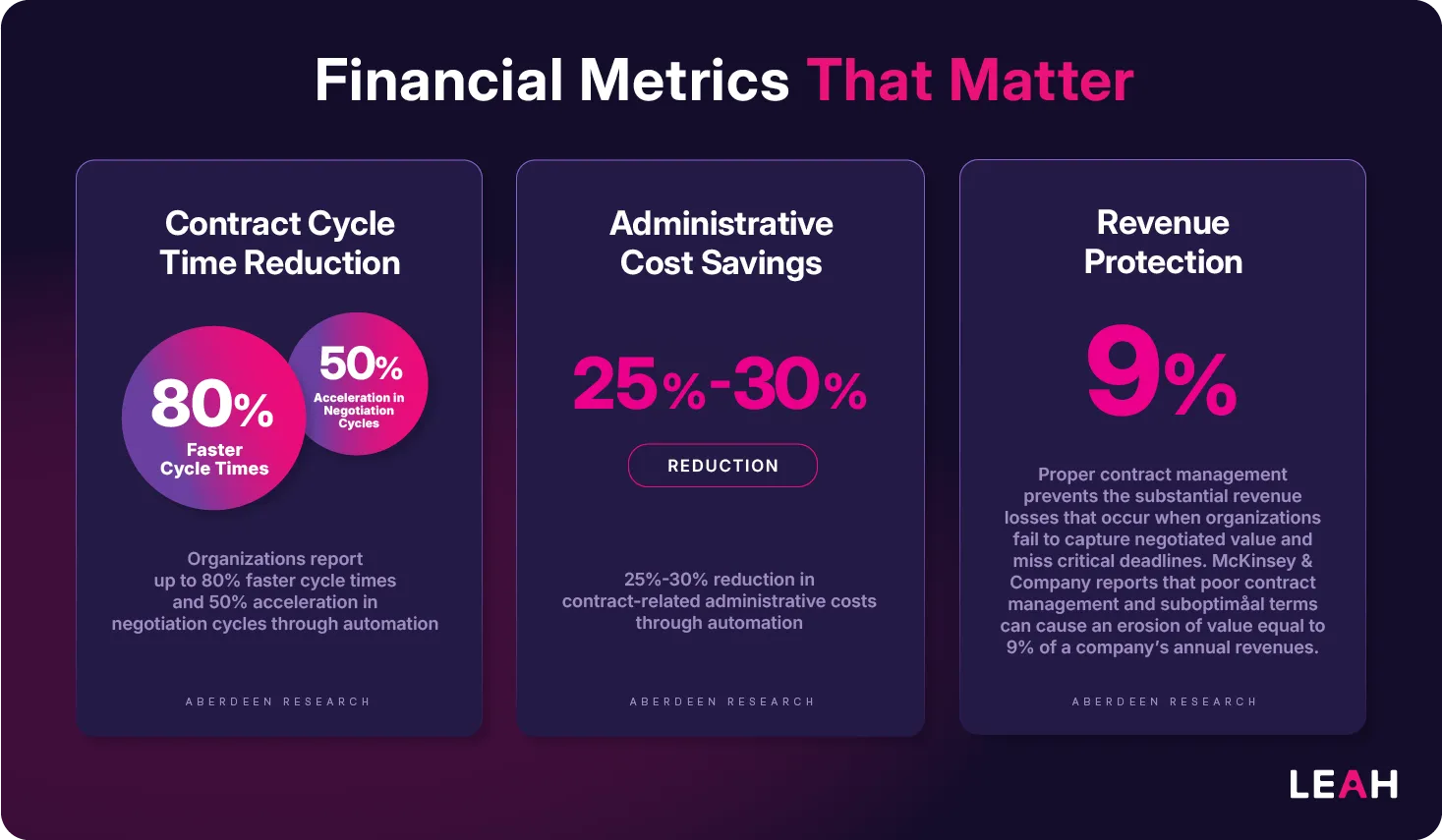
- Contract Cycle Time Reduction: Organizations report up to 80% faster cycle times and 50% acceleration in negotiation cycles through automation
- Administrative Cost Savings: 25%-30% reduction in contract-related administrative costs through automation (Aberdeen Research)
- Revenue Protection: Proper contract management prevents the substantial revenue losses that occur when organizations fail to capture negotiated value and miss critical deadlines. McKinsey & Company reports that poor contract management and suboptimal terms can cause an erosion of value equal to 9% of a company's annual revenues.
Strategic Value Creation
- Enhanced Negotiation Positioning: Data-driven insights for every negotiation
- Supplier Portfolio Optimization: Portfolio-level insights rather than isolated vendor management
- Risk Prediction: Identifying issues before they become problems
ROI Timeline
Most enterprises achieve initial returns within 6-12 months, full ROI within 18-24 months. The global contract management software market is projected to reach $10.5 billion by 2035, reflecting the substantial value organizations are finding in these solutions.
The Future of Enterprise Contract Management
Agentic AI Evolution
Moving beyond automation toward autonomous contract management with systems that can negotiate routine amendments, identify optimization opportunities, and predict disputes before they escalate.
Integrated Business Ecosystems
Contract management is becoming the central nervous system for enterprise operations, enabling dynamic pricing optimization, automated supplier performance management, and predictive business planning.
Sustainability and ESG Integration
Advanced systems tracking ESG compliance across supplier networks, automating sustainability clause enforcement, and providing supply chain transparency for stakeholder reporting.
Your Enterprise Contract Management Maturity Assessment
Your Enterprise Contract Management Maturity Assessment
Although choosing an ECM platform typically focuses on capabilities and features, truly successful implementations begin well before vendor evaluation. Building a solid foundation requires thoroughly understanding existing challenges—not just within legal departments but throughout all business units—as each function faces unique contract-related obstacles. Essential preparatory work includes ranking current pain points by impact, evaluating gaps in existing workflows, and mapping improvement opportunities. Technology will address some issues, while straightforward process refinements can resolve others.
The Contract Management Maturity Model (CMMM) provides a structured approach to evaluate your organization's current contract management sophistication and pinpoint advancement opportunities.
Automation serves as the catalyst for ascending the maturity ladder. Organizations operating at higher maturity levels through automated workflows experience significantly reduced legal response times and enhanced risk mitigation capabilities.
Throughout this assessment phase, developing a compelling business case becomes paramount for securing stakeholder commitment. Illustrating benefits that extend beyond legal department efficiency—showcasing enterprise-wide value creation—strengthens investment justification and connects ECM initiatives to overarching business strategies. Our comprehensive guide on constructing the business case for Enterprise Contract Management delivers detailed frameworks for articulating your vision, calculating tangible returns, and presenting ECM as a transformative business initiative.
CLM Readiness: Defining Your Target Operating Model
Before diving into feature comparisons and vendor demonstrations, organizations must establish a clear target operating model that defines how contract management will function post-implementation. This critical step prevents the common pitfall of selecting technology based on impressive capabilities that don't align with your organization's actual needs or operational reality.
Your target operating model should address fundamental questions: How will contracts flow through your organization? Which stakeholders will participate in each stage of the contract lifecycle? What approval hierarchies and governance structures will guide decision-making? How will contract data integrate with existing business systems? Without these foundational decisions, even the most sophisticated CLM platform can become an expensive solution searching for clearly defined problems.
This readiness assessment extends beyond process mapping to include change management considerations, resource allocation planning, and success metrics definition. Organizations that invest time upfront in articulating their desired future state—rather than immediately gravitating toward feature-rich solutions—consistently achieve faster implementations, higher user adoption rates, and more measurable business outcomes. The target operating model becomes your north star, guiding not only technology selection but also training programs, rollout strategies, and long-term optimization efforts.
Essential Features of Enterprise Contract Management
Choosing an enterprise contract management platform represents a pivotal business decision that extends far beyond feature comparisons—it requires deep alignment between the technology solution and your organization's strategic objectives, current ECM sophistication level, and future growth trajectory.
We've developed essential evaluation criteria to accelerate your vendor assessment process. These assessment points guide you through fundamental dimensions including technical infrastructure, operational capabilities, partnership support, and investment models. Remember that these criteria serve as a foundation rather than a rigid framework—your optimal solution will reflect your organization's distinct requirements and strategic priorities.
Looking deeper, we examine comprehensive capabilities that distinguish leading-edge contract management platforms from basic solutions. Through early, targeted inquiry into these differentiators, you'll identify platforms that not only complement your existing processes but also introduce the intelligence, automation, and operational excellence necessary to transform contract management into a competitive advantage.
Essential Feature Evaluation Criteria
Technology Infrastructure Assessment
- Security Certification Requirements: Verify the platform maintains industry-standard security certifications (SOC 2, ISO 27001, etc.)
- Data Protection Standards: Confirm encryption protocols for data at rest and in transit meet enterprise requirements
- Service Reliability Metrics: Evaluate uptime guarantees and historical performance data
Functional Capabilities Analysis
- Workflow Flexibility: Assess the depth of workflow customization options available
- AI Integration Depth: Understand the scope and sophistication of included AI capabilities
- Template Management Process: Review how templates are maintained, updated, and version-controlled
Support Structure Evaluation
- Implementation Partnership Model: Understand the level of hands-on support during deployment
- Enhancement Request Process: Learn how customer feedback drives product development
- Response Time Commitments: Review support ticket resolution timeframes and escalation procedures
Financial Model Understanding
- Core Platform Components: Identify what functionality comes standard versus add-on modules
- Integration Cost Structure: Clarify any additional fees for connecting third-party systems
- Scalability Pricing Model: Understand how costs evolve with increased usage and users
Comprehensive Feature Assessment Guide
Contract Workflow Architecture:
- Support for diverse contract types and use cases
- Agreement creation wizard capabilities and user experience
- In-platform editing functionality and collaboration features
- Custom approval routing configuration by contract category
- Direct signature request initiation from within the platform
Electronic Signature Integration:
- Compatibility with leading e-signature platforms
- Final document storage location and accessibility
- Alternative acceptance methods including click-to-accept functionality
- Counterparty interaction experience and ease of use
- Cloud storage system integration options
Document Management Infrastructure:
- Centralized repository capabilities for all contract types
- Obligation tracking and visualization features
- Bulk upload capacity and volume limitations
- AI/ML document analysis and extraction capabilities
- Legacy contract migration support and assistance
Negotiation Management Tools:
- Side-by-side version comparison functionality
- Complete audit trail maintenance and accessibility
- Approval/denial commentary and documentation features
- Renewal management and notification systems
- Email-based approval collection options
Collaboration Framework:
- External party access and viewing permissions
- Email distribution capabilities with contract attachments
- Automated reminder configuration for critical dates
- Knowledge management and best practice sharing features
- Cross-functional team collaboration tools
Analytics and Reporting Suite:
- Contract categorization and filtering capabilities
- Pre-built report availability and customization options
- Scheduled report distribution functionality
- End-to-end contract lifecycle visibility
- Visual dashboard and data visualization tools
System Integration Capabilities:
- API availability and documentation quality
- CRM platform compatibility and pre-built connectors
- ERP system integration options
- Business intelligence tool connectivity
- General availability of integration features
User Experience and Administration:
- Role-based access control and permission management
- Non-technical workflow configuration capabilities
- Mobile device accessibility and functionality
- Bulk contract reassignment for organizational changes
- Training resources and sandbox environment availability
Artificial Intelligence Specifications:
- AI implementation approach and methodology
- Proprietary versus third-party AI technology
- Document classification and clause extraction capabilities
- Multi-language OCR support beyond English
- AI risk management and governance protocols
Product Evolution and Updates:
- Release frequency and update schedule
- Pricing model for new features and enhancements
Implementation and Ongoing Partnership:
- Implementation partner involvement and typical deployment timelines
- Professional services fee structure for implementation and customization
- Average support response times and SLA commitments
- Integration setup and configuration support
- Training program structure and sandbox access
- Data migration assistance and methodology
Selecting Your Enterprise Contract Management Solution
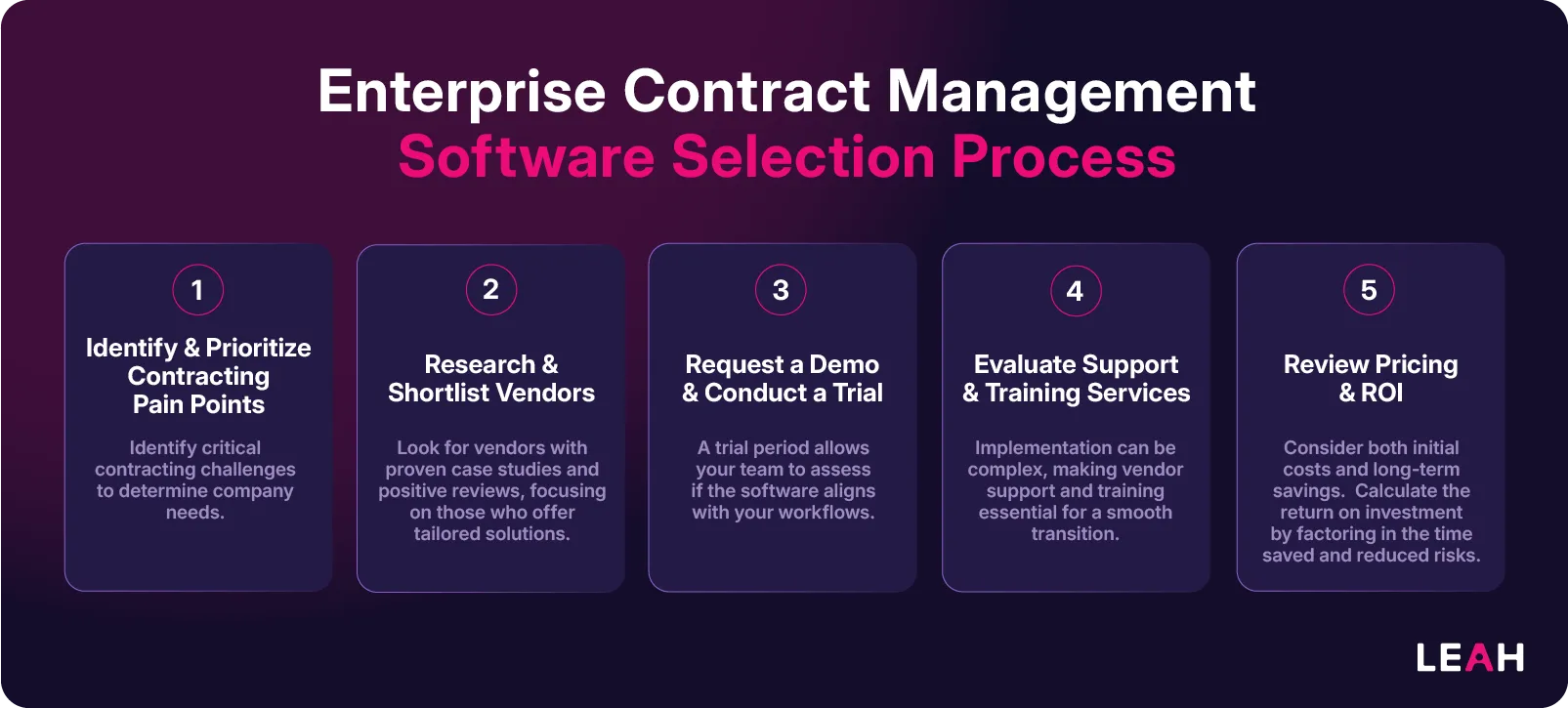
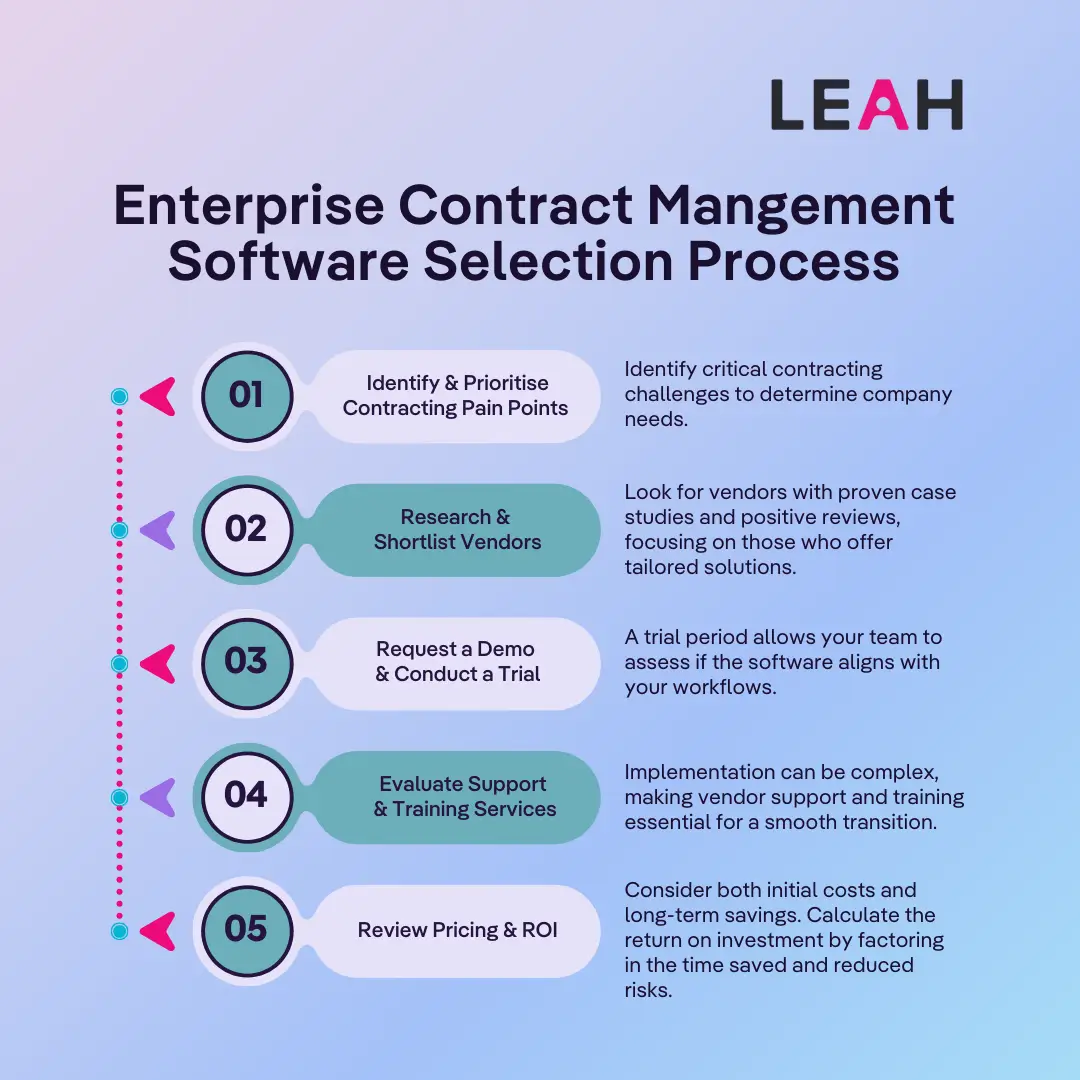
Once you've completed your feature assessment, you're ready to move into the decision phase. The following section guides you through the critical stages of choosing a platform that addresses your immediate enterprise contract management requirements while delivering sustained strategic value for your organization.
Leah's Implementation Methodology: A Proven 5-Stage Approach
After the selection process the Implementation can finally begin. Leah delivers advanced Enterprise Contract Management through our battle-tested implementation methodology. Our "Crawl, Walk, Run" philosophy prioritizes quick wins and iterative value delivery over risky "big bang" deployments, combining deep legal industry expertise with proven project management practices.
The Five-Stage Implementation Framework
Stage 1: Kick Off
- Align key stakeholders on vision and objectives
- Establish project governance and success criteria
- Create detailed project plans and reporting frameworks
Stage 2: Design
- Conduct validation workshops and requirements gathering
- Execute end-to-end business process mapping
- Develop solution design documentation and obtain formal sign-off
- Establish training and change management frameworks
Stage 3: Configure
- Execute platform configuration and legacy contract migration
- Conduct system integration and performance testing
- Develop training materials and user acceptance testing scripts
Stage 4: Deploy
- Execute user acceptance testing and production migration
- Deliver end-user training and UAT programs
- Implement production integration and provide change execution support
Stage 5: Hypercare
- Provide post-go-live support and Business-as-Usual transition
- Monitor system usage and performance optimization
- Maintain continuous improvement processes and plan subsequent phases
In Summary: Enterprise Contract Management as Strategic Imperative
Enterprise contract management has evolved from a basic requirement for managing legal documents to a strategic imperative that determines competitive advantage. Organizations that delay this transformation risk falling behind competitors who are already leveraging contract intelligence for business optimization.
The companies implementing advanced ECM solutions first are establishing the vendor relationships, process maturity, and data insights that will be essential for competing in an increasingly contract-driven business environment.
Your contracts are already generating data, creating obligations, and driving business outcomes. The question is whether you're capturing their full strategic value or leaving millions on the table through poor contract execution.
With the right enterprise contract management approach, your legal department transforms from a necessary cost center into a strategic profit driver that accelerates deals, optimizes vendor relationships, and provides competitive intelligence for better business decisions.
The transformation starts with understanding that enterprise contract management isn't just about managing agreements. It's about transforming those agreements into competitive advantages that drive measurable business value across your entire organization.
Ready to transform your contract management from basic lifecycle management to strategic business intelligence? Contact Leah to discover how our agentic AI architecture can unlock the hidden value in your contract portfolio.