
TL;DR: The Bottom Line for Legal Teams
ChatGPT creates serious risks for legal work. agentic AI for legal teams delivers specialized capabilities, enterprise security, and attorney-client privilege protection that general AI tools simply do not match. Legal teams need purpose-built solutions, not consumer chatbots.
The ChatGPT Legal Risk Reality
Why General AI Tools Fail Legal Standards
ChatGPT was never designed for legal work. Period. As someone who spent years as a General Counsel before joining the legal technology space, I've seen what happens when legal teams try to force-fit general tools into specialized workflows.
The fundamental problem: ChatGPT is a predictive text engine that generates plausible-sounding responses. "Plausible" is not the same as "accurate" in legal contexts.
Key risk factors:
- Hallucination problem: ChatGPT confidently provides incorrect legal information
- No privilege protection: Individual ChatGPT conversations receive zero attorney-client privilege protection
- Training data limitations: Only current through 2023, lacks legal-specific context
- No regulatory compliance: Designed for general use, not legal industry standards
Attorney-Client Privilege: The Critical Distinction
Why ChatGPT Conversations Aren't Protected
Sam Altman's recent comments about ChatGPT have created confusion in our industry. Here's what every legal professional must understand:
When individuals use ChatGPT for legal questions, conversations receive no attorney-client privilege protection.
This applies regardless of platform security or how legal the AI responses sound. The privilege does not exist because:
- No attorney participates in the communication
- No lawyer directs or supervises the usage
- No attorney-client relationship exists
Writing in a private diary creates no privilege because no lawyer receives the information. Inputting data into AI chatbots lacks the attorney-client relationship required for privilege.
Bottom line: I would never have a ChatGPT conversation I wouldn't want discovered in litigation.
Enterprise Legal AI: A Different Analysis
When lawyers use specialized AI tools while representing clients, the analysis changes completely.
This includes:
- In-house counsel using enterprise legal AI platforms
- Employees using lawyer-created models in enterprise systems
- Legal teams asking AI questions about contracts under proper supervision
Using third-party technology that accesses confidential client information does not waive attorney-client privilege when lawyers take reasonable precautions to prevent unauthorized disclosure.
Courts have established this principle for email, legal research tools, and cloud storage. Privilege remains intact with proper safeguards.
Enterprise Legal AI: Purpose-Built for Legal Excellence
Agentic AI Architecture vs. Basic Automation
Unlike ChatGPT or basic automation tools, enterprise legal AI platforms operate with sophisticated agentic architectures.
These platforms don't respond to prompts. They:
- Autonomously manage complex legal workflows
- Understand context and make informed decisions
- Adapt to organizational policies and playbooks
- Combine specialized language models with legal-specific intelligence
- Continuously evolve for precise execution and long-term efficiency gains
This isn't a chatbot with legal training. These are intelligent platforms designed for how legal work gets done.
Specialized Risk Management Capabilities
Enterprise legal AI platforms provide comprehensive risk visibility through specialized legal models.
Key capabilities across the industry:
- Automated compliance checks across multiple languages
- Learning from organizational risk profiles
- Increasingly precise insights over time
- Comprehensive protection and sustained regulatory alignment
This level of specialized risk management is impossible with general-purpose AI tools.
Intelligent Workflow Orchestration
Enterprise legal AI platforms excel at workflow orchestration that extends beyond legal departments:
- Automate complex processes across departments
- Provide AI-guided assistance for attorneys, junior staff, and business stakeholders
- Integrate seamlessly with existing enterprise systems
- Drive productivity and operational excellence organization-wide
Enterprise Data Security vs. Consumer AI
The Real Difference: Enterprise Agreements vs. Public Interfaces
Enterprise legal AI platforms don't use public ChatGPT interfaces for client information. They maintain direct, enterprise-level data agreements with major AI providers like Microsoft, Anthropic, and OpenAI.
Enterprise data handling standards:
- No data retention on external systems
- Immediate deletion of information after processing
- Customer data stored only on secure enterprise servers
- Enterprise-grade security with SOC 2, GDPR compliance
The nature of enterprise legal work is fundamentally different from ChatGPT conversations.
Preserving Privilege with Enterprise AI
To preserve confidentiality while using enterprise AI assistance:
- Don't use public systems (especially free ones)
- Ensure AI tools operate under legal team auspices
- Communicate to teams that questions without legal supervision may not be protected
Lawyers waive privilege if they share AI-generated information inappropriately, use public sharing features, or fail to implement reasonable security measures. The same waiver rules that apply to any legal work still apply.
The Business Case: Total Cost of Ownership
Why "Free" ChatGPT Becomes Expensive
ChatGPT may appear cost-effective initially. Total cost of ownership becomes problematic when factoring in:
- Customization needs for legal accuracy
- Additional security measures
- Accuracy verification processes
- Professional liability risks from non-specialized tools
- Lost productivity from inadequate capabilities
Enterprise Platform Architecture Benefits
Enterprise legal AI platforms typically offer:
- Both targeted use cases and comprehensive platform deployment
- Start small, expand seamlessly approaches
- Maintained accuracy, performance, and cost control at scale
- Flexible implementation without massive upfront commitments
Consultative Implementation vs. Technology Vendor
Leading enterprise legal AI providers offer hands-on, consultative support backed by ecosystems of legal consultancies focused on customer success.
Enterprise AI platforms adapt to organizational needs with focus on delivering positive outcomes, not features.
Having been a General Counsel myself, I understand the difference between tools that work in demos versus tools that work in practice.
2025 Legal AI Landscape: What's Changed
Regulatory Environment Evolution
The legal AI regulatory environment has evolved significantly in 2025:
- Enhanced data privacy requirements
- Stricter professional responsibility guidelines for AI use
- Industry-specific compliance standards for legal AI platforms
- Clear distinctions between consumer and enterprise AI tools
Market Maturation
The legal AI market has matured beyond basic automation:
- 41 of the Am Law 100 firms actively use AI tools for document analysis, contract drafting, and due diligence as of early 2024
- 2.5x growth in enterprise AI budgets from $7 million in 2023 to $18 million in 2024
- Integration requirements with existing legal tech stacks
- Demand for measurable ROI and business outcomes
- Recognition that specialized platforms outperform general tools
Implementation Best Practices: Getting AI Right
Strategic Approach to Legal AI
Successful enterprise legal AI implementation requires:
- Change management strategies for legal team adoption
- Training programs that build confidence and competency
- Integration planning with existing technology stack
- Supervision protocols that maintain professional responsibility standards
Measuring Success
Key performance indicators for legal AI:
- Contract processing time reduction: 50-90% improvement reported across implementations
- Risk identification accuracy improvements
- Compliance monitoring effectiveness
- Overall legal team productivity gains
- Cost per legal transaction reductions
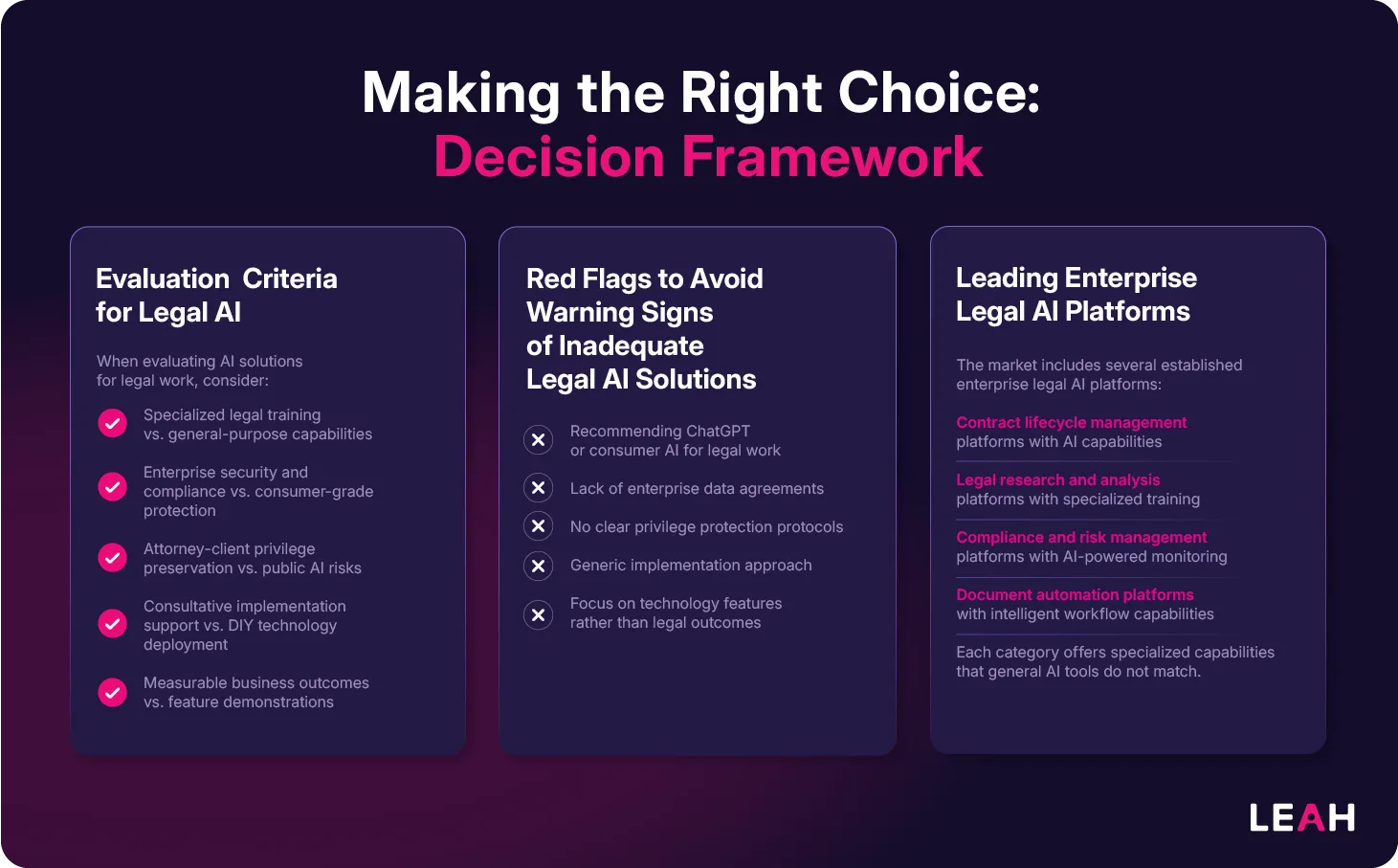
The Clear Choice for Legal Excellence
ChatGPT, while impressive for general applications, simply isn't designed for serious legal work. The specialized nature, security considerations, compliance requirements, and tailored functionality of enterprise legal AI platforms make them indispensable for professional legal practice.
The stakes are too high for both client service and professional liability to rely on general-purpose tools for specialized legal work.
As someone who's experienced this transformation from both the client and vendor perspective, the difference between purpose-built legal AI and adapted general tools is dramatic and decisive.
The question isn't whether AI will transform legal practice (AI already has). The question is whether you'll choose tools designed for legal excellence or risk your practice on consumer-grade alternatives.
About the Author
Jerry Levine serves as Chief Legal Officer at Leah and brings over 20 years of legal experience, including extensive tenure as General Counsel. He specializes in legal technology implementation, AI governance, and enterprise legal operations transformation.
Jerry's unique perspective comes from experiencing the evolution from frustrated legal technology user to advocate for purpose-built legal AI solutions.
Connect: LinkedIn
Take Action: Evaluate Enterprise Legal AI
Ready to explore how enterprise legal AI transforms your legal operations?
Key next steps:
- Assess your current AI usage and identify security gaps
- Evaluate enterprise legal AI platforms that meet your specific needs
- Develop implementation strategy with proper supervision protocols
- Establish success metrics for measuring AI impact on legal operations
Choose purpose-built platforms over general AI tools for serious legal work.