
From risk and compliance requirements to governance concerns, today’s organizations face a multitude of challenges and a myriad of issues tied to their everyday agreements. So much, it has increased the demand for legal technology solutions, particularly in the form of enterprise contact management systems.With such automated software, you can centralize your contracts and related documents in one hub — creating single source of truth — and make all of your legal documents easily accessible and searchable for your organization. You can customize and automate your workflows, improve your collaborations with legal and other departments, and expedite the contract review and negotiation processes. And you can flag contract renewals and deadlines with automated alerts and never miss another milestone. With that, here are some helpful tips for the most effective enterprise contract management.
What is Enterprise Contract Management?
Imagine one legal platform that unifies and streamlines your contract lifecycle management (CLM) from beginning to end. That is instead of a system that forces you to carry out legal tasks little by little, and in silos, creating a lack of communication, delayed workflows — and, ultimately, contract inefficiencies, risks, and liabilities. Well, an enterprise contract management is perfect for organizations that need a more robust and reliable solution for their agreements — and beyond. And with enterprise contract management systems like Leah Cloud, you can do the following:
- Standardize contracts with templates and clause libraries, while automating the contract authoring, approval, and execution processes
- Store all agreements and related documents in a cloud-based repository, keeping everything updated and every user on the same page
- Leverage all contractual data, improving the financial performance of agreements
- Identify clauses needed to comply with a regulation, thereby reducing contract risk
Tips for Effective Enterprise Contract Management
Whatever enterprise contract management platform you select, though, you would do well to do your homework to make sure your digital tools meets certain criteria.
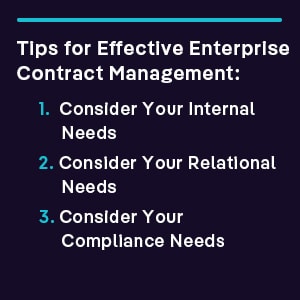
Consider Your Internal Needs
Ease of Use
First and foremost, your legal team and organization need to be able to use the contract management system (CMS) without any difficulty or delay. After all, legal and business users will rely on this software for quick, reliable contract access. And confusing interfaces and complex contract management processes will only dissuade users from employing the contracting system, and lower adoption rates will translate to poor returns on investment.
Configurability
Given legal and business users are rather different, you should be able to configure the contract management software to fit everyone’s needs. For example, your platform should be flexible enough to help you track agreements before and after approvals, and give you enough insight into your contract database, as well as manage a number of legal risks.
Metrics for Evaluation
To manage your contracts more effectively, it is also important to have data on key metrics, like the following:
- How long does it take you to access agreements in the central repository?
- How many parties are involved in the creation of contracts typically?
- How long do you and your team spend negotiating agreements?
- What is the average cycle time of your contracts?
- How do you go about evaluating risks in contractual language?
Keep in mind that as the number of parties involved in creating and negotiating an agreement contract increases, so does the likelihood of human errors.
Consider Your Relational Needs
Collaboration
To receive all of the benefits of enterprise contract management software, you need to be able to share agreements not only with colleagues, but also external stakeholders like vendors. And you need to be able to collaborate with contract parties — both internally and externally — adjusting and changing agreements as needed.
Contract Tracking & Visibility
You do not want to create silos between legal, sales, and procurement teams. So a holistic view of the contract lifecycle is crucial whenever anyone needs to track down a legal document or receive contract status updates, among other tasks. The good news is that automated enterprise contract management provides various departments with the visibility and communication needed to stay on top of agreements. It also provides a digital audit trail, making parties accountable for their contracting roles and reducing contract risk. And it helps to identify any workflow complications, speeding up contracting or at least managing client expectations.
Consider Your Compliance Needs
Compliance
Your contract management arguably matters most from a compliance perspective. Your organization may be subject to state or federal laws and regulations. It may have to follow strict rules and guidelines if your company is in a highly regulated industry, like finance or health care. So to avoid fines and other financial penalties — and litigation and other legal liabilities — you need to keep your agreements as compliant as possible. This is made easier with proactive risk strategies and effective enterprise contract management.
Data Security
Similarly, you need to be able to send agreements securely during contract signage. After all, the data they hold is critically sensitive. This data security means ensuring that laws, rules, and guidelines around sensitive legal documents are adhered to and data breaches, ransomware attacks, and other exposures are prevented. And the right contracting tool can pay dividends here, too.
Risk Management
Lastly, but not least of all, you should seek out enterprise contract management system that offers robust functionality around contract risk reduction, as mentioned above. This means software that offers features, such as automated alerts and notifications, which go a long way in reducing the risk associated with your agreements.
Transform Your Enterprise Contract Management
The bottom line is your organization needs a single source of truth for its contracts — one that is accessible, searchable, customizable, and fully automated. And switching over to an enterprise contract management solution helps you achieve this, while helping you stay on top of your day-to-day contracting for the foreseeable future.So, do you want to make your everyday contracting more efficient and effective? Do you need a solution that supports end-to-end enterprise contract management, delivers contract data and deep contractual insights, and helps you manage overall risk? Download a free copy of our white paper, How to Choose a Contract Management Solution.And to find out how to start your digital transformation journey, contact us today and request a demo.