
Published: January 26, 2023
Updated: April 3, 2025
“Contracts are the foundation of modern commerce” - Forrester
Legal technology has evolved from a convenience to a cornerstone of effective enterprise contracting operations. Contract Management Software plays a crucial role in streamlining workflows, mitigating risks, and improving compliance. With increasing volumes of contracts, increased levels of regulatory compliance, geo-political global tensions and uncertainties, and tighter deadlines, organizations are turning to automated solutions to maintain a competitive edge.
The Contract Management Software market is expected to grow at an average annual rate of 12.1% throughout the forecast period from 2024 to 2034. The growth is driven by increasing adoption of AI and machine learning, automation of manual processes, and the need for enhanced compliance and integration with broader tech ecosystems.
With so much growth, there are thousands of Contract Management Software products on the market. However, the right Contract Management Software doesn’t just serve legal needs; it integrates seamlessly into a company’s tech stack, enhancing collaboration across departments and contributing to broader business goals.
Building a Solid Foundation for CLM
While selecting the right CLM solution often revolves around features and functionality, the most successful transformations begin long before the selection process. A strong foundation starts with a clear understanding of current pain points—both within legal and across other business functions—since different teams will have distinct challenges. Prioritizing these pain points, assessing weaknesses in the current operating model, and identifying opportunities for improvement are critical steps. Some improvements will require technology, while others may be addressed through simple process enhancements.
The Contract Management Maturity Model (CMMM) on page 8 of our The True Impact of CLM: 4 Ways Advanced Contract Management Provides Enterprise-wide Value white paper offers a framework for understanding how advanced your organization’s contract processes are, and where there are opportunities for improvement.
Automation plays a key role in moving up this maturity scale. For instance, companies with more mature, automated processes see faster response times to legal requests and better risk management.
As a part of this process, it’s essential to build a strong business case to secure buy-in from key stakeholders. Demonstrating the enterprise-wide impact—beyond just legal efficiencies—will help justify the investment and align it with broader business objectives. Our white paper on building the business case for CLM provides a comprehensive guide to structuring your approach, quantifying benefits, and positioning CLM as a strategic initiative.
Why Choosing the Right Contract Management Software Matters
Once you have reached the selection stage, its crucial to take a wholistic view of how CLM solutions will impact long-term efficiency, cost savings, and legal accuracy across the business. While it is true that with automation, legal departments can save time (addressing legal requests faster and significantly reducing contract delays), focusing solely on the operational efficiencies for legal would be a missed opportunity. In fact, many prospective buyers struggle to secure budget when taking a legal-led approach to their business case. Treating the contract management software as a cross-functional strategic initiative with enterprise-wide quantifiable benefits stands a much greater chance of securing budget.
A robust Contract Management Software ensures smoother workflows and decreases the time legal teams spend on manual, repetitive tasks. Moreover, it integrates with other key tools like CRM, ERP, P2P systems and e-signature platforms, making it an indispensable core pillar of the enterprise technology stack.
The most impactful cost saving and revenue generation opportunities are typically found in the effective post-signature management. Both buy and sell-side business teams can identify and stop up to 9% of revenue leakage across the enterprise. This allows companies to proactively track and manage contractual obligations (including price increases, rebates, SLAs and supplier performance).
Below, we explore the fundamentals of CLM software, its critical role in business success, its impact across various departments, and the key steps for selection and implementation.
Fundamentals of Contract Management Software
What is CLM Software?
Contract management software is an end-to-end solution that revolutionizes how organizations handle their contract lifecycle. From initial drafting to final renewal, Contract Management Software streamlines every step of the process, turning time-consuming manual tasks into efficient automated workflows. Whether dealing with simple agreements like NDAs or complex Master Service Agreements (MSAs), Contract Management Software solutions can dramatically shorten the time from request to final signatures.
Why is it Critical for the Business?
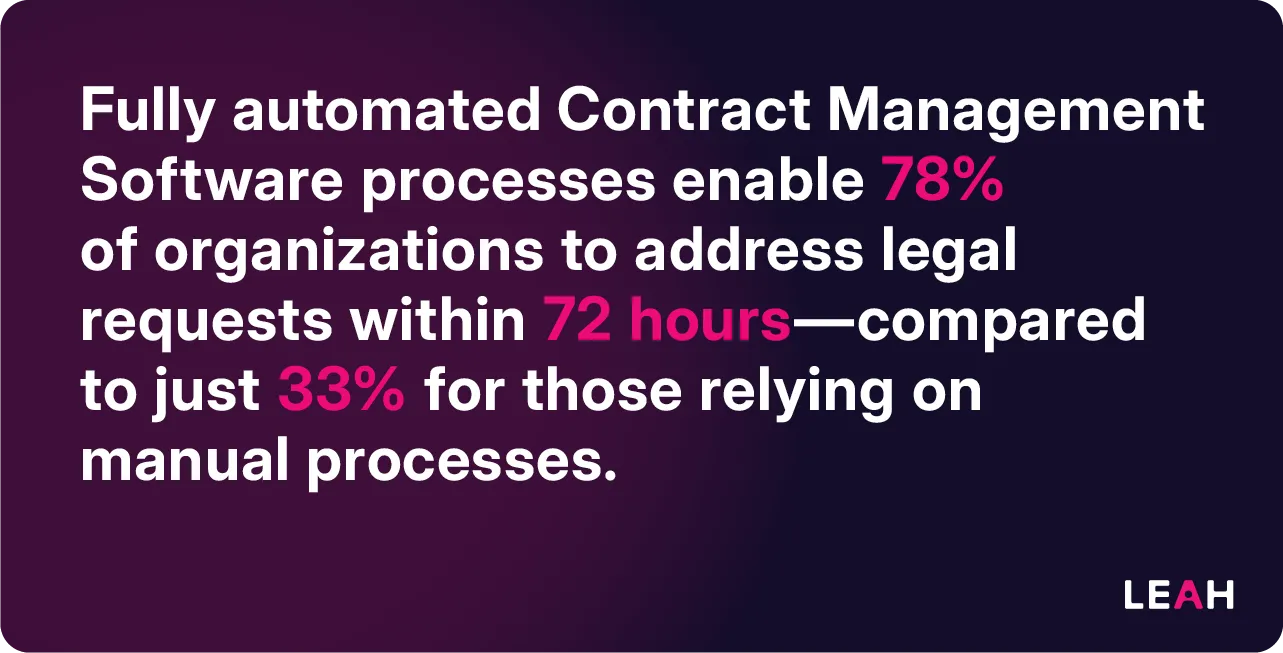
The ability to automate and track workflows is invaluable for professionals, especially those managing high volumes of contracts. With Contract Management Software, teams can ensure compliance with legal regulations, avoid missing contractual obligations, and manage risks more effectively. Fully automated Contract Management Software processes enable 78% of organizations to address legal requests within 72 hours—compared to just 33% for those relying on manual processes.
Compliance and Regulatory Considerations
Regulatory compliance is non-negotiable in contract management. A suitable Contract Management Software must support adherence to regulations like GDPR, SOX, and other jurisdiction-specific requirements.
Impact on the Whole Enterprise
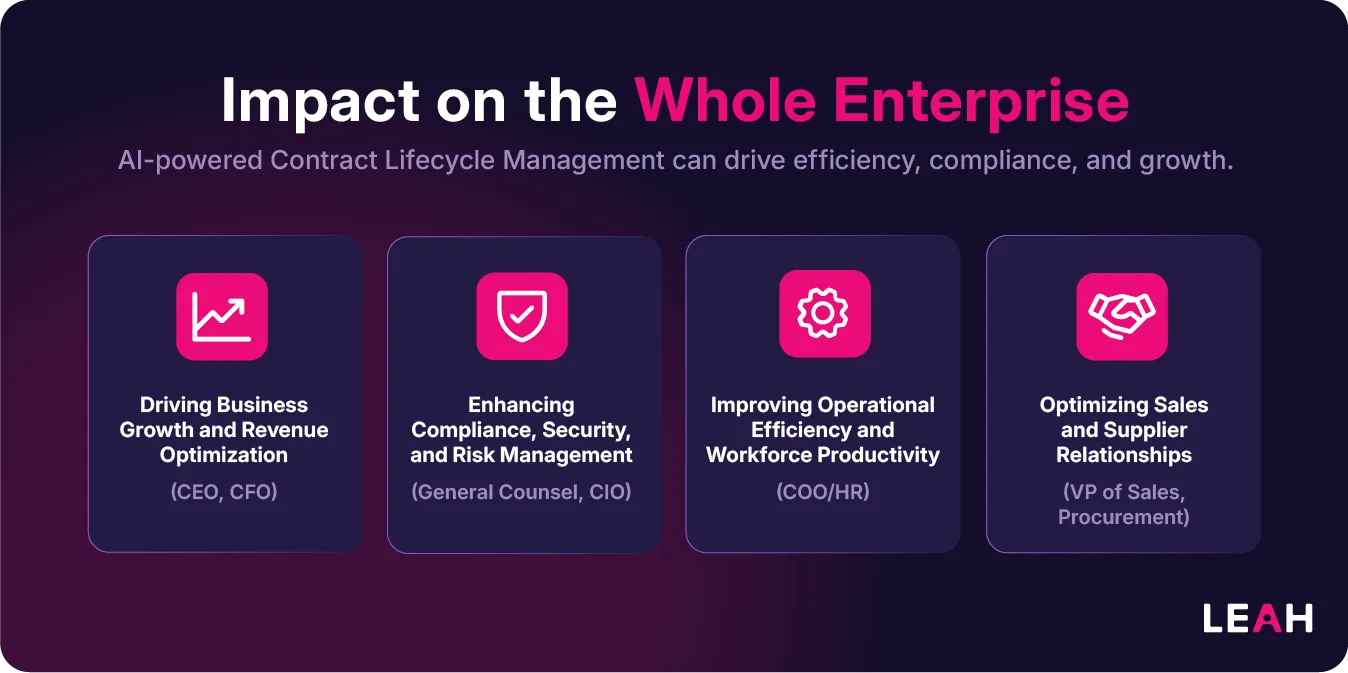
AI-powered Contract Lifecycle Management (CLM) doesn’t just benefit legal teams—it transforms operations across the entire enterprise. Here are just a few ways different departments can leverage AI-driven CLM to drive efficiency, compliance, and growth:
Driving Business Growth and Revenue Optimization (CEO, CFO)
For leaders focused on business growth, AI in Contract Lifecycle Management (CLM) is pivotal in driving revenue, minimizing financial risks, and improving decision-making:
- Expediting Deal Closures: AI-generated contract drafts and automated workflows speed up negotiations, shortening contract cycles and boosting revenue realization
- Enhancing Financial Performance: AI-powered contract analytics assist finance teams in reducing missed renewals, revenue loss, and unstructured discounting, improving profitability
- Scaling Without Increasing Legal Resources: AI-driven automation supports growth without the need for additional legal staff, ensuring sustainable expansion
Enhancing Compliance, Security, and Risk Management (General Counsel, CIO)
Compliance and risk management are vital to every organization, and AI-powered CLM revolutionizes legal operations by proactively identifying risks and strengthening security:
- Ensuring Ongoing Compliance: AI monitors obligations, renewal deadlines, and compliance terms, reducing legal risks
- Providing Comprehensive Audit Trails: AI-driven tracking records all contract actions, improving audit readiness and regulatory compliance
- Boosting Data Security: AI-enabled CLM systems reduce dependence on outdated technologies, integrating smoothly with modern IT infrastructures to enhance security
Improving Operational Efficiency and Workforce Productivity (COO, HR)
AI-driven CLM decreases administrative tasks and boosts workforce efficiency by streamlining contract processes:
- Reducing Employee Turnover: Automating HR processes like offer letters and employee agreements enhances operational efficiency and minimizes delays
- Facilitating Team Collaboration: AI-powered workflows improve communication and contract visibility across legal, sales, procurement, and HR teams, breaking down silos
- Enhancing Workforce Utilization: AI automation frees up employees to focus on strategic initiatives instead of routine contract management tasks
Optimizing Sales and Supplier Relationships (VP of Sales, Procurement)
AI-driven contract management helps sales and procurement teams streamline negotiations, improve supplier performance, and increase customer satisfaction:
- Accelerating Sales Cycles: AI speeds up contract drafting and approval processes, enabling sales teams to close deals more quickly and boost customer acquisition rates
- Improving Supplier Performance Management: AI monitors third-party contract compliance, ensuring vendor agreements align with organizational goals
- Benchmarking Competitive Pricing and SLAs: AI extracts pricing trends and SLA performance data from past contracts, enabling procurement teams to negotiate more favorable terms
Once stakeholders understand the enterprise-wide benefits, the next step is evaluating the key features that will make your CLM solution most effective.
Essential Features of Modern Contract Management Software Solutions
Selecting the right contract management software is a strategic decision that requires more than just comparing features—it demands a thorough understanding of how the platform aligns with your organization's business goals, contract lifecycle management (CLM) maturity, and long-term scalability.
To help jump-start this evaluation, we’ve outlined key questions that serve as a starting point for assessing vendors. These questions will help you explore critical aspects such as technology, functionality, support, and cost structure. However, they are not a one-size-fits-all checklist—the right solution will depend on your organization’s unique needs and operational priorities.
Beyond these initial considerations, we also delve into advanced capabilities that differentiate modern contract management solutions. By asking the right questions early in the process, you can better identify a platform that seamlessly integrates with your workflows and delivers the efficiency, intelligence, and automation required to optimize contract management.
Some Questions to Ask When Evaluating Vendors
Technology
- What security certifications does the platform hold?
- How is data encrypted at rest and in transit?
- What is the system’s uptime guarantee?
Functionality
- How configurable are the workflows?
- What AI capabilities are included?
- How are template updates managed?
Support
- What level of implementation support is provided?
- How are feature requests handled?
- What is the average response time for support tickets?
Cost Structure
- What is included in the base price?
- Are there additional costs for integrations?
- How is pricing scaled as usage grows?
Some Questions to Ask About Advanced Contract Management Software Features
Contract Workflow Capabilities:
- Does the solution support all contract types?
- Does the solution offer an agreement creation wizard?
- Can users make edits to the contract within the platform?
- Can custom approval rules be configured by contract type?
- Can signature requests be sent directly from your product?
Signature:
- Can the solution integrate with electronic signature systems?
- Where is the final document stored?
- Does the platform enable additional methods of acceptance, including click-to-accept?
- Describe the counterparty experience.
- Can files be stored in a cloud storage system?
Document Repository:
- Does the solution provide centralized, electronic storage of all contracts?
- Does the solution provide the ability to view obligations within contracts?
- Can contracts be uploaded in bulk, and is there a volume threshold?
- Does the solution leverage AI/ML capabilities for document analysis?
- Is there assisted migration and onboarding for legacy contracts?
Contract Negotiation:
- Can versions generated during contract negotiations be compared side by side?
- Does the solution provide a full audit trail of activity?
- Can users include comments for every approval/denial?
- Does the solution support renewal options?
- Can approvals be collected via email?
Collaboration:
- Does the solution provide the ability for counterparties to view or log into your system?
- Does the solution support sending emails with attached contract drafts?
- Can you set automated reminders around key events in contracts?
- Does the solution provide knowledge management features?
- Describe features for cross-functional collaboration.
Reporting:
- Does the solution provide the ability to report on contracts by type, category, etc.?
- Are there out-of-the-box reports available?
- Can timed reports be scheduled for distribution?
- Does the solution provide an end-to-end contract execution timeline?
- Can the solution display graphic dashboards of reportable data?
Integrations:
- Does the solution offer an open API?
- Can the solution integrate with CRM systems?
- Can the solution integrate with ERP systems?
- Can the solution integrate with Business Analytics tools?
- Are integrations generally available?
User Management & Usability:
- Does the solution provide user access management?
- Can users configure/update the workflow matrix without technical resources?
- Can the solution be accessed from mobile devices?
- Can contracts be mass reassigned or transferred due to organizational changes?
- Can business users be trained on the platform, and is there a sandbox environment?
Artificial Intelligence:
- How does your product leverage artificial intelligence?
- Is the AI third-party or native to your company?
- Can AI be used for document classification and clause analysis?
- Does the solution support OCR functionality for languages other than English?
- How are risks in the AI space managed?
New Releases:
- How often are new product releases?
- Are new releases included in the price?
Implementation & Ongoing Support:
- Will we work with implementation partners, and what is the average time for implementation?
- What are the fees for implementation and additional templates/workflows?
- What is the average support response time?
- How are supported integrations set up?
- How are business users trained, and is there access to a sandbox environment?
- Does your offering include assistance with data migration?
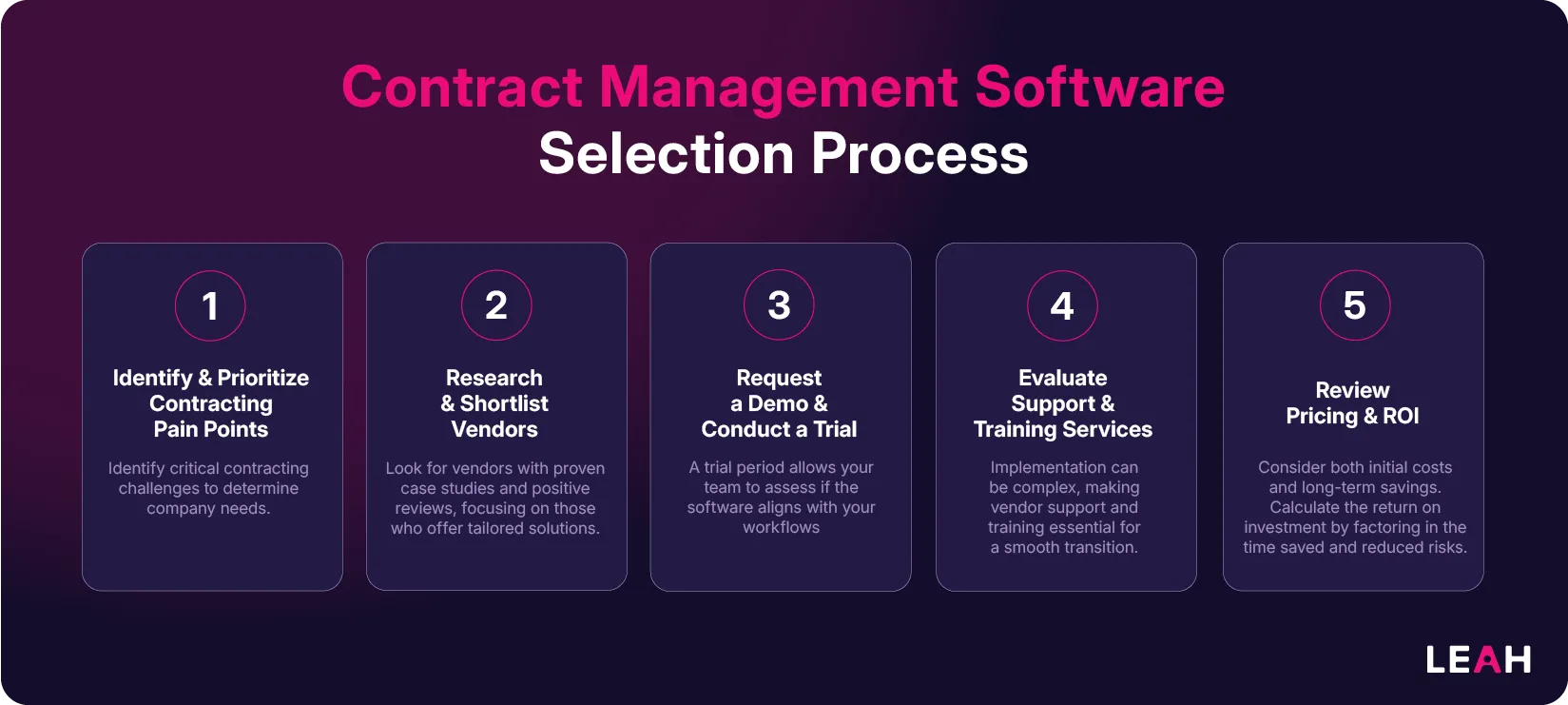
Selection Process
After you have evaluated features, you will begin the selection process. Below, we walk you through the key steps to select a solution that not only meets your contract lifecycle needs but also drives long-term value for your business.
Looking Ahead: Transforming Enterprise Operations in 2025 and Beyond
The evolution of contract management continues to change rapidly as we move through 2025. Organizations that invest in the right contract management software aren’t just buying a tool—they’re investing in their future competitive advantage.
Here’s a few things to keep in the forefront of your mind:
Digital Transformation is No Longer Optional
With the increasing complexity of business relationships and regulatory requirements, manual contract management is becoming unsustainable. Modern contract management software serves as a cornerstone of digital transformation, enabling legal departments to:
- Reduce contract processing time
- Minimize human error in contract creation and review
- Free up valuable legal resources for strategic work
- Maintain comprehensive audit trails and compliance records
The AI Advantage Becomes Standard
As AI technology continues to mature, organizations without AI-powered contract management capabilities risk falling behind. Leading solutions now offer:
- Predictive analytics for risk assessment
- Automated contract classification and data extraction
- Smart recommendations for clause optimization
- Real-time insights into contract performance and obligations
- Agentic AI with domain specific capabilities
Future-Proofing Operations
Selecting the right contract management software isn’t just about solving today’s challenges—it’s about preparing for tomorrow’s opportunities. Consider how your chosen solution will:
- Scale with your organization’s growth
- Adapt to new regulatory requirements
- Integrate with emerging technologies
- Support increasingly complex global operations
Taking the Next Step
The journey to optimal contract management begins with a single step. As you evaluate your options, remember that the right solution should align with both your current needs and future aspirations.
Ready to Transform Your Contract Management?
Leah offers a comprehensive, AI-powered solution designed to meet the evolving needs of modern enterprises Our platform combines cutting-edge technology with intuitive usability to deliver immediate value while positioning your organization for future success.
Take the first step toward transforming your contract management processes—schedule a personalized demo today to see how Leah can help your company can thrive.

![How to Write a CLM RFP: Complete Guide for Legal & Procurement Teams [2026]](https://d32q3dexag516z.cloudfront.net/64d506de4c92a679c361f5c0/6958b1026bd074f1b27e810c_Hero_RFP-CLM_1200x628.webp)