
Published: June 6, 2023
Updated: November 17, 2026
Quick answer: The main benefits of contract management, and of contract lifecycle management (CLM) in particular, are faster contracts, fewer missed renewals and obligations, consistent terms and approvals, and one place to see everything you have agreed to. Together these lower legal and financial risk, cut manual work for legal, procurement, sales, and finance, and give leaders contract data they can act on.
CLM is important because contracts set your revenue, costs, and risk, and when they live in shared drives and inboxes, deadlines slip and agreed terms go unenforced. Each benefit can be measured: take a baseline for cycle time, missed renewals, template use, and obligations met, then track the same numbers after you change the process.
Let me paint you a picture that's probably all too familiar: It's 4:30 PM on a Friday, and your CEO walks into your office asking about the termination clause in that vendor agreement from 2019. You know, the one buried somewhere in your shared drive, probably in a folder called "Contracts - Misc" or maybe "Legal Stuff 2019 - Final Version."
Sounds about right?
If you're nodding along, you're definitely not alone. Many legal teams are drowning in contract chaos, and honestly, it's not your fault. The traditional approach to contract management (spreadsheets, email chains, and the occasional panic attack when renewal deadlines sneak up) just wasn't built for the volume and pace of contracting today.
Here's what we're dealing with: The average Fortune 1000 company juggles somewhere between 20,000 to 40,000 active contracts at any given moment. That's not a typo. Twenty thousand. And if you're managing even a fraction of that number manually, well, my hat's off to you because that's basically impossible.
The cost of that chaos is real. In its August 2025 report on contract management, World Commerce & Contracting (WorldCC) found that poor contracting practices cost the average business value equivalent to almost 9% of annual revenue. The best performers lose about 3% of value, and the worst lose 15% or more.
This is where Contract Lifecycle Management (CLM) comes in. But before you roll your eyes and think "great, another tech solution promising to solve all my problems," hear me out. CLM isn't just about digitizing your contracts, though that's certainly part of it. It's about fundamentally changing how your legal team operates, from reactive firefighters to strategic business partners.
Here are the ten ways CLM can transform your legal operations (and maybe save your sanity in the process), starting with a table that shows how to measure each one.
The 10 Benefits of CLM at a Glance, and How to Measure Them
A benefit you can't measure is hard to defend at budget time. Use this table to pick the benefits that matter most to your business, then collect the data before and after you change the process.
| Benefit | How to measure it | Data you need |
|---|---|---|
| 1. Time for legal work | Hours legal spends per contract on administration (chasing approvals, finding documents, re-keying data), and the share of routine contracts completed on templates without legal drafting. | A two-week time sample before and after; contract records flagged by template and by who drafted them. |
| 2. Compliance | Contracts signed on approved templates or within playbook fallbacks, deviations approved by the right person, and contract-related audit findings. | Template ID and version, clause deviation flags, approval log with approver and date, internal audit reports. |
| 3. Visibility | Time to answer a standard question, such as "Which contracts renew in the next 90 days?", and the share of contracts with every key field filled in. | Repository fields: parties, contract type, value, start and end dates, renewal terms, notice period, owner. |
| 4. Contract insights | Most-negotiated clauses, rounds of negotiation, and cycle time by contract type and counterparty. | Redline history, workflow stage timestamps, contract type and counterparty fields. |
| 5. Fewer silos | Handoffs and approval loops per contract, time spent waiting at each stage, and "where is my contract?" requests sent to legal. | Workflow stage timestamps, approval routing logs, legal inbox or ticket volume. |
| 6. AI-assisted review | Time from receiving third-party paper to first review comments, before and after AI review, and how often reviewers accept or change AI suggestions. | Review start and end times, playbook issue flags, accepted and rejected suggestions. |
| 7. Cost and leakage | Unwanted auto-renewals avoided and their annual value, invoices billed above contracted rates, missed rebates or service credits, and cost per contract. | Renewal dates and notice periods, contracted rates, invoice and purchase order data from ERP or accounts payable, legal time and outside counsel spend. |
| 8. Relationships | Obligations met on time (yours and the counterparty's), disputes and escalations per year, and supplier or customer satisfaction scores. | Obligation register with owner, due date, and status; dispute log; supplier scorecards or customer surveys. |
| 9. Scalable growth | Contracts completed per legal or contracts team member, and volume handled each quarter without added headcount. | Monthly contract volume by type, team headcount. |
| 10. Faster deals | Days from "ready for contract" to signature for customer deals, deals that slip a quarter because of contracting, and time to first invoice. | CRM opportunity stages and dates, contract status, billing start dates. |
Pick three or four rows, take a baseline for at least one quarter before you change anything, and measure the same way afterward so you compare like with like. For definitions and formulas, see our guide to contract management KPIs. To turn the results into a business case, see how to calculate contract management ROI.
1. You'll Actually Have Time to Practice Law Again
Remember why you went to law school? It probably wasn't to spend your afternoons playing detective, hunting down contract versions, or chasing approvals through email chains that somehow involve seventeen people (plus a couple of folks that may not even work here anymore).
With CLM, contract creation becomes much simpler. Pre-approved templates mean you're not starting from scratch every time. Automated workflows route documents to the right people without you having to remember who needs to sign off on what. And that approval process that used to take three weeks? Try three days.
I've seen legal teams cut their administrative time by 60-70% after implementing CLM. When the administrative load shrinks, you're no longer the person who tracks down signatures; you're the strategic advisor helping the business make smarter deals. That's the kind of change that makes Monday mornings feel different (and lets you head out early on a Friday afternoon).
2. Compliance Becomes Your Friend, Not Your Enemy
Let's be honest: compliance anxiety is real. That nagging worry that you've missed something, that a regulatory change slipped by, or that someone in procurement approved terms that make your stomach turn. CLM removes much of that worry.
Every contract follows the same review process. No exceptions, no shortcuts, no "just this once" scenarios. When regulations change, you update the template and clause library once, and every new contract uses the new language. Unusual terms get flagged before signature, not after they've already caused damage.
The best part? Your team stops being the "department of no" and starts being the group that helps the business move fast while staying safe. That's a much better place to be.
3. You'll Know What You Don't Know (And Fix It)
Quick question: How many contracts expire in the next 90 days? Which ones auto-renew? What's your total contractual liability across all vendor agreements?
If you can't answer these questions in about thirty seconds, you need CLM. A centralized repository turns your contract portfolio from a mystery novel into an open book.
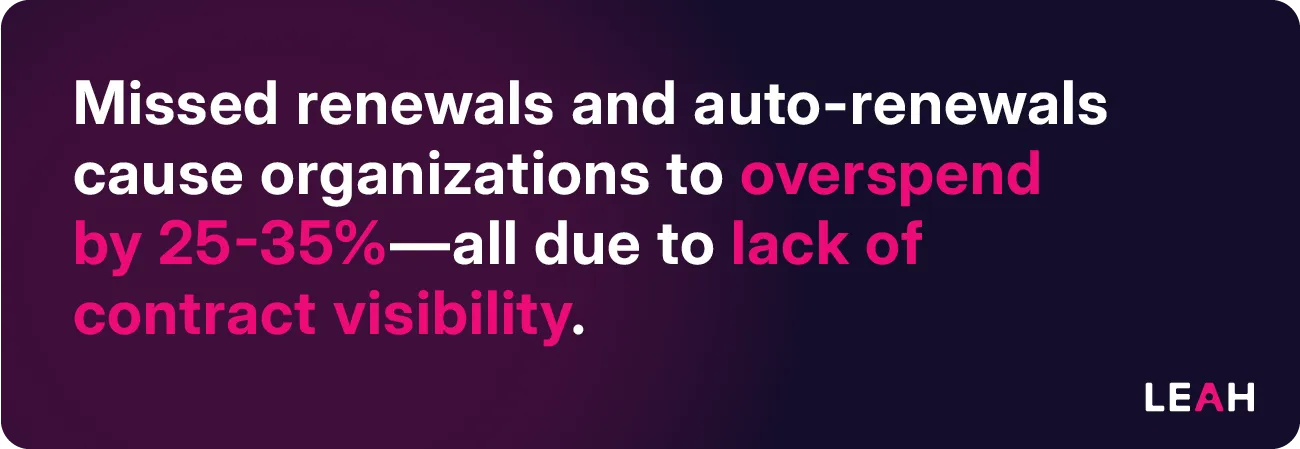
Real-time dashboards show you exactly where everything stands. You'll spot bottlenecks before they become crises. You'll catch renewal decisions before they turn into expensive auto-renewals (our guide to managing contract renewals covers notice periods in detail). Most importantly, you'll make decisions based on actual data instead of educated guesses.
4. Your Contracts Will Start Talking to You
Here's something that might surprise you: Your contracts are full of business intelligence. You just can't access it when everything's scattered across different systems and file formats.
CLM platforms turn your contracts into a goldmine of insights. Which vendors consistently push back on your standard terms? Where do negotiations typically get stuck? What contract types take the longest to close? These patterns help you negotiate better, plan better, and advise the business better.
I've seen legal teams use contract data to predict which deals are likely to face delays, which vendors might need contract modifications, and even which business units need additional contract training. That's the kind of strategic value that means you get to choose the restaurant when the deal closes, instead of David from Sales (seriously, can we get sushi instead of steak just once?)…
5. The Silos Finally Come Down
Contracts touch everyone: legal, procurement, sales, operations, and finance. Yet somehow, these teams often feel like they're working in parallel universes. CLM bridges these gaps through shared workspaces and transparent processes.
Suddenly, procurement can see exactly where legal reviews stand. Sales knows precisely what's holding up their deals. Operations understands their upcoming obligations. This transparency doesn't just speed things up; it also reduces the friction that drives everyone crazy.
The result is faster deal cycles, better internal relationships, and contracts that actually reflect what the business needs instead of what legal thinks the business might need.
6. AI Becomes Your Research Assistant
Let's talk about artificial intelligence for a minute. AI-powered contract analysis isn't science fiction anymore; it's a normal Tuesday afternoon. These systems can do a first-pass review of a contract against your playbook and flag risky or missing clauses for an attorney to confirm, which helps most on a busy day.
But here's what's really exciting: AI democratizes contract intelligence. Information that used to require years of legal experience becomes accessible to business users through intuitive dashboards and plain-language summaries. Your procurement team can understand contract risks without calling you for every vendor agreement.
Predictive analytics take this even further. By learning from your contract history, the system can help you see which contracts are likely to face disputes, which vendors typically request extensions, and where to focus your attention for maximum impact.
7. The ROI Is Actually Measurable
CLM isn't just about making your life easier, though it certainly does that. The financial benefits are real, and you can measure them.
By cutting manual processes, you reduce the hours spent on contract administration. Your team focuses on high-value legal work instead of administrative tasks. Automated alerts warn you well ahead of renewal deadlines and compliance dates.
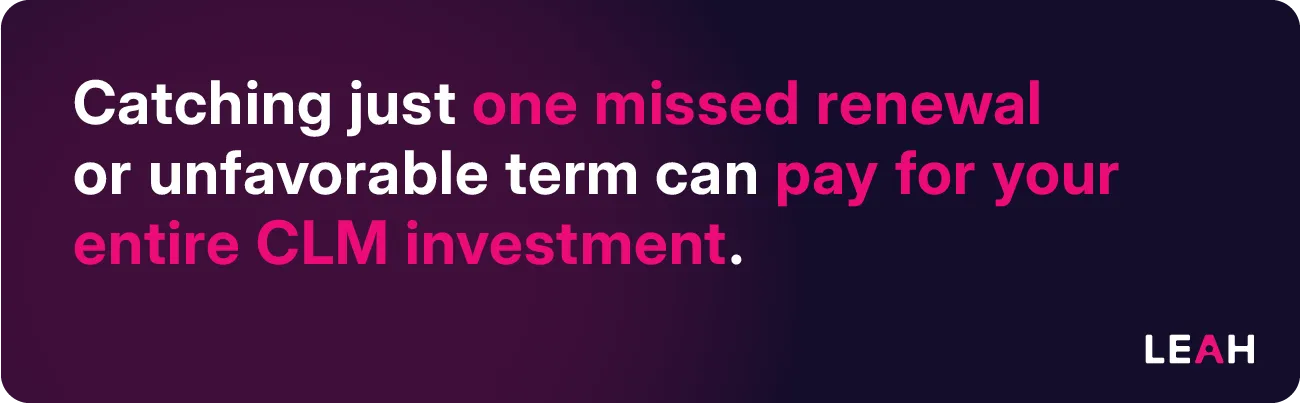
One avoided penalty or one caught renewal opportunity often pays for the entire CLM investment. I've seen organizations save hundreds of thousands of dollars in their first year just by catching favorable renewal terms they would have otherwise missed.
Start with the obvious leaks. Count last year's unwanted auto-renewals, missed price-review windows, and invoices paid above the contracted rate, and put a value on each. Set against the cost of a CLM program, that total is the core of your business case.
Consider the hidden costs that CLM reduces: missed obligations, unfavorable auto-renewals, expensive contract disputes, and the opportunity cost of slow deal cycles. These savings add up quickly.
For a partner's perspective on CLM and faster ROI, watch this video:
8. Your Relationships Actually Improve
Clear communication builds trust. When everyone understands their contractual obligations and can easily access contract terms, relationships tend to improve.
CLM systems support consistent contract performance through automated reminders and contract obligation tracking. Vendors appreciate working with organizations that are professional and prepared. Internal clients value legal teams that make doing business easier, not harder.
A reputation for reliable contracting becomes an advantage. Good partners want to work with organizations that honor their commitments and make contracting straightforward, and a reliable counterparty is in a stronger position when it asks for better terms.
9. Growth Doesn't Have to Hurt
Your contract volume will grow (and it should, in a growing and expanding company!). The only question is whether your processes can keep pace. CLM platforms scale from hundreds to hundreds of thousands of contracts without proportional increases in staff or complexity.
Customizable workflows adapt to your organization's unique needs. Technology contracts require different processes than real estate agreements, and CLM platforms handle these differences within one system. As your business evolves, your contract management evolves with it.
This flexibility extends to global operations. Multi-language support, regional compliance tracking, and local workflow variations all configure within the same platform. International expansion doesn't mean starting over with contract management.
10. You'll Actually Get Ahead of the Competition
A well-run CLM program helps you close deals faster, manage risk better, and operate more efficiently. This isn't only about keeping up; it's about pulling ahead.
While your competitors struggle with manual processes, you're using AI-powered insights. While they react to contract problems, you're preventing them. While they guess at their contractual position, you know exactly where you stand.
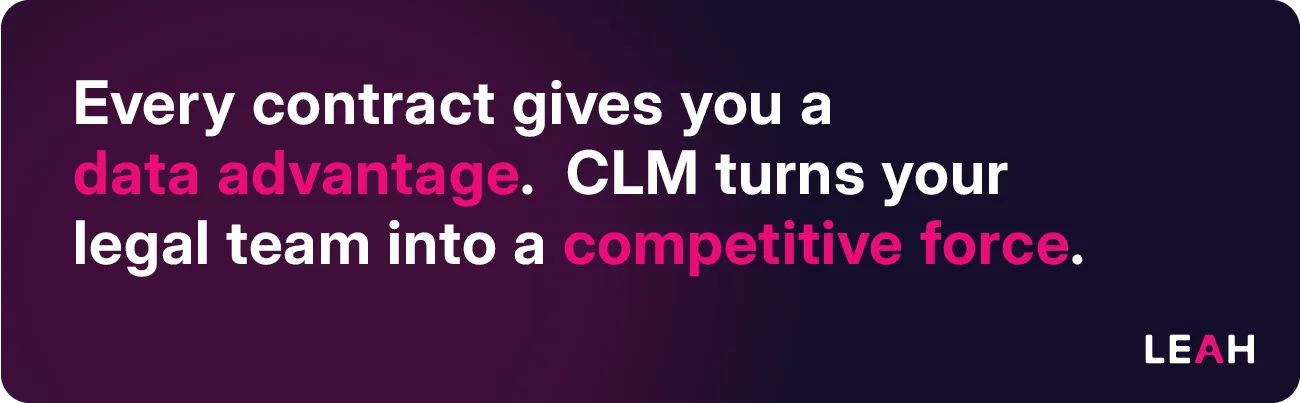
This advantage compounds over time. Every contract adds to your data advantage. Every process improvement widens the gap. Every efficiency gain strengthens your competitive position. Often, this means that you and your legal team, regardless of size, begin to be seen as a benefit, a sales driver, and a team of superheroes: your very own "Justice League" (at least for contracts, I suppose).
FAQ
What are the benefits of contract management?
The main benefits are faster contracts, fewer missed renewals and obligations, consistent terms and approvals, and a clear view of everything you have agreed to. Together they lower legal and financial risk and reduce the value lost to poor contracting. They also free legal, procurement, and finance teams from manual chasing so they can spend time on decisions.
Why is contract lifecycle management important?
Contracts set what you pay, what you are paid, and what risk you carry, so managing them across their whole life protects revenue and margin. Without a lifecycle process, renewal deadlines pass, obligations go unowned, and negotiated terms are never enforced. CLM gives every contract an owner, a workflow, and tracked dates from request to renewal or termination.
What is the difference between contract management and contract lifecycle management?
Contract management is often used for the work after signature: storing contracts, tracking obligations, and managing performance and renewals. Contract lifecycle management covers the whole life of a contract, from request and drafting through negotiation, approval, signature, performance, and renewal, usually with software that supports each stage. In practice the terms overlap; our guide to contract management basics covers the fundamentals that apply to both.
Which teams benefit from CLM?
Legal gets templates, playbooks, and less administrative work. Procurement gets faster supplier contracts and visibility of renewals and commitments, sales gets faster customer contracts, and finance gets contract terms it can match to invoices, budgets, and forecasts. Operations, HR, and IT benefit too, because they own many obligations and vendor relationships, and organizations with high contract volumes or heavy regulation usually have the strongest case.
How does a CLM platform help prevent missed renewal deadlines?
A CLM platform records each contract's renewal date, notice period, and auto-renewal terms, then reminds the owner before the notice deadline, not just before the renewal date. Because every contract has a named owner and a status, someone has to decide whether to renew, renegotiate, or terminate. Portfolio reports show upcoming renewals, so nothing depends on one person's calendar.
What are the measurable benefits of contract management software?
The most measurable benefits are shorter cycle times, fewer unwanted auto-renewals, higher template and playbook use, more obligations met on time, and lower cost per contract. Measure each against a baseline taken before you change the process. The table near the top of this article lists the data you need for each benefit.
The Bottom Line
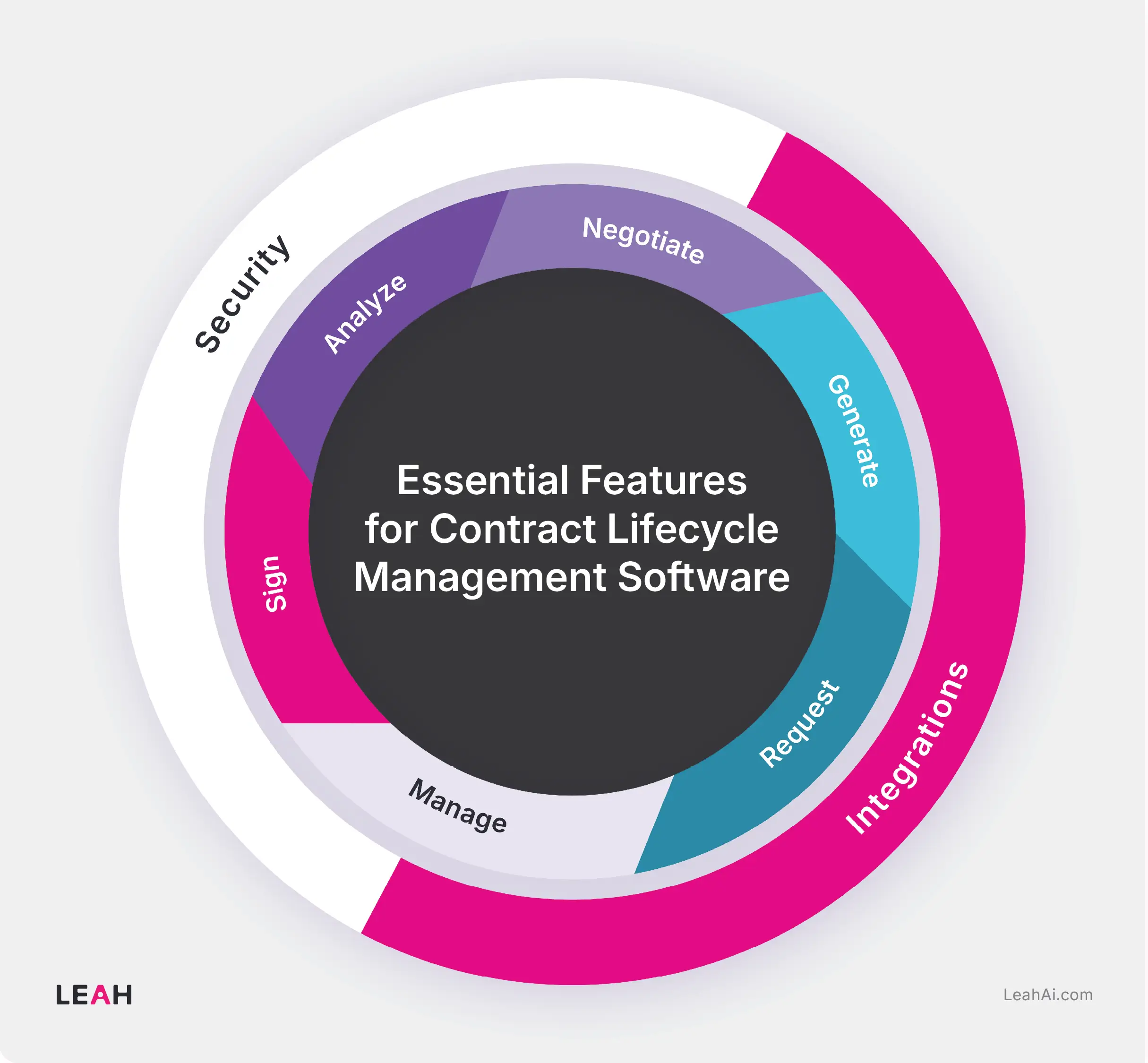
Contract Lifecycle Management delivers measurable benefits across every aspect of legal operations: operational efficiency through automation, risk mitigation via standardized processes, strategic insights from contract data, cost reduction by eliminating manual work, and competitive advantage through faster, smarter contract management.
The question isn't whether to manage contracts better; it's how quickly you can start capturing these benefits. Every quarter your contracts stay in spreadsheets and shared drives, more renewals, obligations, and negotiated terms slip through.
New to CLM? Start with what is contract lifecycle management?, then see how the work runs step by step in the contract management process.
Your contracts represent relationships, obligations, and opportunities. They deserve better than spreadsheets and shared drives. They deserve a system that transforms them from administrative burdens into strategic business assets.
Ready to see what CLM can do for your legal team? Leah, formerly ContractPodAi, offers Leah Agentic CLM, a platform in which AI drafts, reviews, routes, and tracks contracts while your team approves the decisions that matter. It includes obligation tracking, renewal alerts, and a contract helpdesk that links each answer to the clause it came from. Schedule a demo to see it on your own contracts.